What this calculator does
E85 is about 85% ethanol. It carries less energy per pound than gasoline and runs a richer stoichiometric ratio (about 9.8:1 instead of 14.7:1), so an engine on E85 needs roughly 30-40% more fuel to make the same power. This calculator works out the smallest injector that can supply that fuel for your target horsepower without going past a safe duty cycle.
How to use it
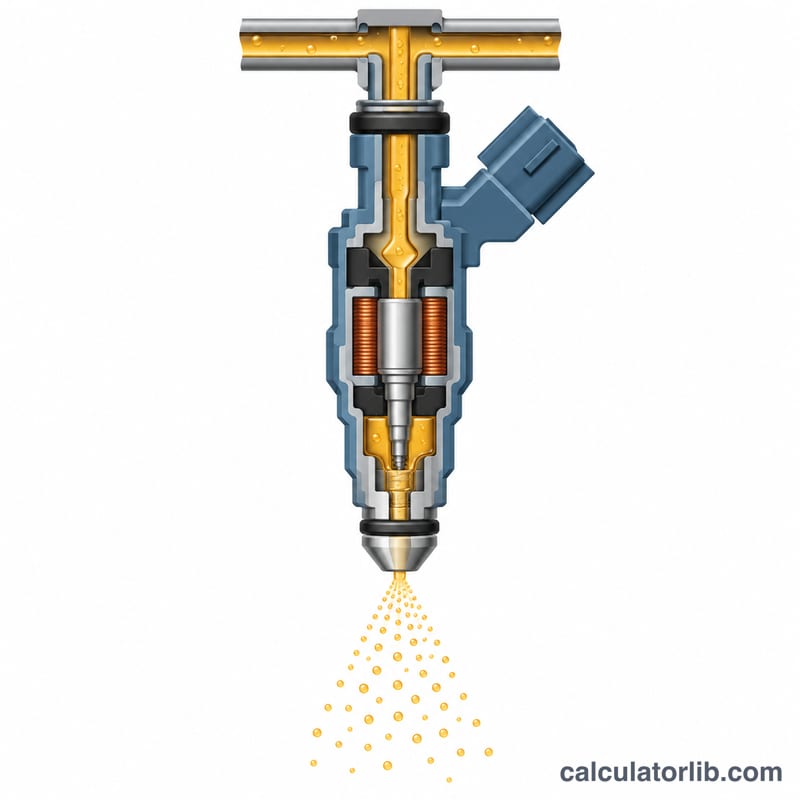
Enter your target crank horsepower and the number of injectors (usually one per cylinder). Then enter a brake specific fuel consumption (BSFC) figure. For E85, use about 0.70 lb/hp/hr for naturally aspirated engines and 0.80-0.85 for turbocharged or supercharged builds. Last, set the maximum duty cycle. 80% is the usual design limit, which leaves headroom and keeps the injector from going static.
The formula
$$\text{Injector}_{lb/hr} = \frac{\text{HP} \times \text{BSFC}}{N \times \text{DC}}$$Here \(\text{HP}\) is target horsepower, \(\text{BSFC}\) is fuel used per horsepower per hour, \(N\) is the number of injectors and \(\text{DC}\) is the duty cycle as a decimal. To get cc/min, multiply by the common rating factor: \(\text{cc/min} = \text{lb/hr} \times 10.5\).
Worked example
Say you have a turbo V8 aiming for 500 hp, with a BSFC of 0.80 and an 80% duty cycle:
$$\frac{500 \times 0.80}{8 \times 0.80} = \frac{400}{6.4} = 62.5\,\text{lb/hr}$$$$62.5 \times 10.5 = 656.25\,\text{cc/min}$$Treat this as a minimum, and round up to the next size you can buy, such as a 750 cc or 1000 cc injector. That margin covers future upgrades and colder ethanol blends.
E85 Injector Size by Horsepower and Engine Setup
Every row in this table uses the same formula as the calculator. It is worked out at an 80% injector duty cycle, with a BSFC of 0.70 lb/hp·hr for naturally aspirated (NA) engines and 0.82 lb/hp·hr for boosted engines (turbo or supercharged). The last row repeats the 1,000 hp, 8-injector case at 0.85 to show how the higher end of the typical 0.80–0.85 boosted range changes the answer.
$$\text{Injector (lb/hr)} = \frac{\text{HP} \times \text{BSFC}}{N \times \text{DC}}, \qquad \text{cc/min} = \text{lb/hr} \times 10.5$$For example, a 400 hp NA engine with 4 injectors needs \(\frac{400 \times 0.70}{4 \times 0.80} = \frac{280}{3.2} = 87.5\) lb/hr per injector. That is \(87.5 \times 10.5 = 918.75\) cc/min.
| Crank HP | Setup | BSFC (lb/hp·hr) | Injector count | Required lb/hr (per injector) | Required cc/min (×10.5) |
|---|---|---|---|---|---|
| 300 | NA | 0.70 | 4 | 65.6 | 689 |
| 300 | Boosted | 0.82 | 4 | 76.9 | 807 |
| 400 | NA | 0.70 | 4 | 87.5 | 919 |
| 400 | Boosted | 0.82 | 4 | 102.5 | 1,076 |
| 400 | NA | 0.70 | 6 | 58.3 | 613 |
| 500 | NA | 0.70 | 6 | 72.9 | 766 |
| 500 | Boosted | 0.82 | 6 | 85.4 | 897 |
| 500 | NA | 0.70 | 8 | 54.7 | 574 |
| 600 | Boosted | 0.82 | 6 | 102.5 | 1,076 |
| 600 | NA | 0.70 | 8 | 65.6 | 689 |
| 600 | Boosted | 0.82 | 8 | 76.9 | 807 |
| 800 | NA | 0.70 | 8 | 87.5 | 919 |
| 800 | Boosted | 0.82 | 6 | 136.7 | 1,435 |
| 800 | Boosted | 0.82 | 8 | 102.5 | 1,076 |
| 1000 | Boosted | 0.82 | 6 | 170.8 | 1,794 |
| 1000 | Boosted | 0.82 | 8 | 128.1 | 1,345 |
| 1000 | Boosted | 0.85 | 8 | 132.8 | 1,395 |
Each figure is the minimum flow per injector. Round up to the next injector size you can actually buy. For example, the 918.75 cc/min result points to a 1000 cc/min injector, not a 900. The extra size gives you headroom for fuel-pressure drop, ethanol content that varies from pump to pump, and future power gains. Rows that end up with the same lb/hr show how adding injectors or lowering BSFC trades off against horsepower.
Common Injector Sizes and Approximate E85 Horsepower Capacity
This table works the formula backwards to estimate how much crank horsepower a set of injectors can support on E85:
$$\text{HP} = \frac{\text{lb/hr} \times N \times \text{DC}}{\text{BSFC}}, \qquad \text{lb/hr} = \frac{\text{cc/min}}{10.5}$$All values assume an 80% duty cycle (DC = 0.80). They use a BSFC of 0.70 for naturally aspirated (NA) engines and 0.82 for boosted engines. For example, eight 1000 cc/min injectors on an NA engine work out to \(\frac{95.24 \times 8 \times 0.80}{0.70} \approx 871\) hp.
| cc/min | lb/hr | NA, BSFC 0.70 (crank hp) | Boosted, BSFC 0.82 (crank hp) | ||||
|---|---|---|---|---|---|---|---|
| 4 inj. | 6 inj. | 8 inj. | 4 inj. | 6 inj. | 8 inj. | ||
| 440 | 41.9 | 192 | 287 | 383 | 164 | 245 | 327 |
| 550 | 52.4 | 239 | 359 | 479 | 204 | 307 | 409 |
| 650 | 61.9 | 283 | 424 | 566 | 242 | 362 | 483 |
| 750 | 71.4 | 327 | 490 | 653 | 279 | 418 | 557 |
| 850 | 81.0 | 370 | 555 | 740 | 316 | 474 | 632 |
| 1000 | 95.2 | 435 | 653 | 871 | 372 | 557 | 743 |
| 1300 | 123.8 | 566 | 849 | 1,132 | 483 | 725 | 966 |
| 1700 | 161.9 | 740 | 1,110 | 1,480 | 632 | 948 | 1,264 |
| 2200 | 209.5 | 958 | 1,437 | 1,916 | 818 | 1,226 | 1,635 |
Injector flow ratings are measured at the manufacturer's reference fuel pressure. This is often 3 bar (43.5 psi), but check the data sheet. Ratings are also usually measured with gasoline or a gasoline-like test fluid. Actual flow changes with fuel pressure: it rises roughly with the square root of the pressure ratio. On engines with a rising-rate (boost-referenced) fuel regulator, what matters is the pressure across the injector. The 10.5 conversion factor is an approximation.
Treat these horsepower figures as estimates for sizing, not guaranteed outputs. Real capacity depends on the engine's actual BSFC, the ethanol content of the fuel (pump E85 varies), your target air–fuel ratio, fuel-pump capacity and injector condition. If you are close to a limit, choose the next size up.
FAQ
Why is BSFC so much higher for E85?
Ethanol contains less energy per pound, so the engine has to burn more mass of fuel for each horsepower. That is why BSFC values for E85 run about 30-40% higher than gasoline values (0.45-0.65).
Should I size for crank or wheel horsepower?
Use crank horsepower. If you only know wheel horsepower, add 10-20% for drivetrain loss first.
Does fuel pressure matter?
Yes. Injector ratings are given at a reference pressure, often 43.5 psi. Raising the pressure increases flow roughly with the square root of the pressure ratio, so check your injector data sheet.