
What is the Turbo Size Calculator?
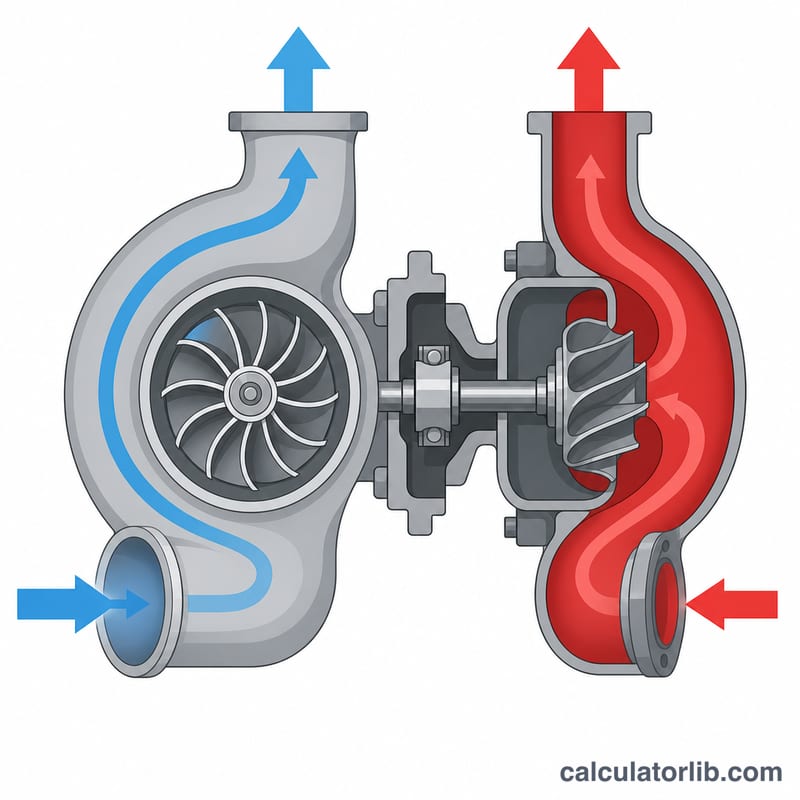
This calculator estimates the mass of air (in pounds per minute) that a turbocharger needs to flow in order to support a chosen horsepower target. Compressor maps for turbos are plotted in lb/min of airflow, so knowing your required airflow is the first step in picking a turbo that lands in its efficient operating range rather than running out of breath or surging.
How to use it
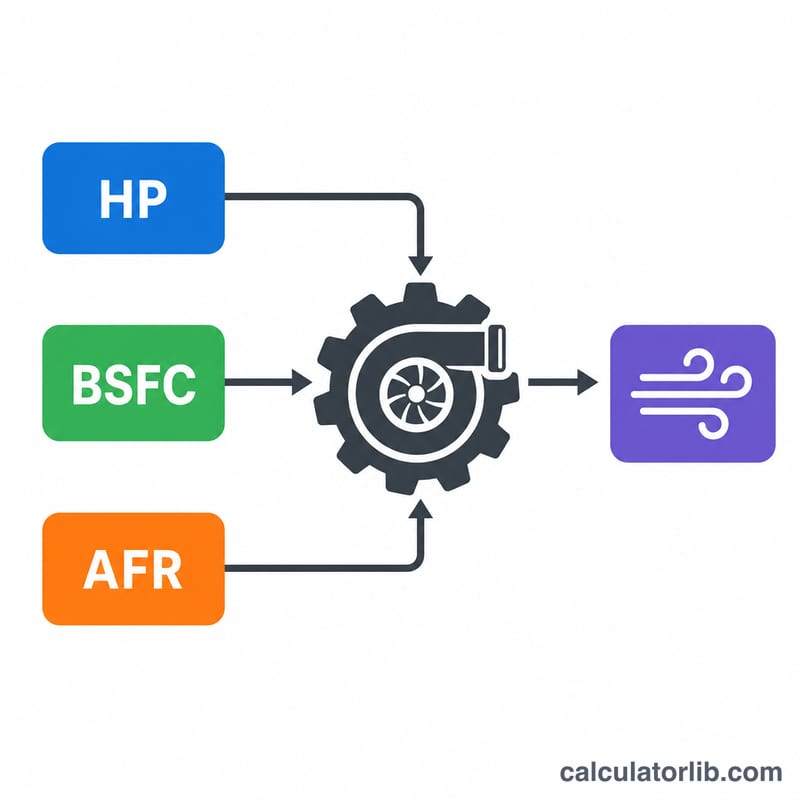
Enter your target crank horsepower, a brake-specific fuel consumption (BSFC) value, and your target air/fuel ratio (AFR). Modern boosted gasoline engines typically use a BSFC of about 0.50–0.60 lb/hp/hr and a power AFR near 11.5:1. The result is the airflow in lb/min, which you compare against compressor maps to choose a suitable turbo frame size.
The formula explained
Fuel flow is horsepower multiplied by BSFC, giving pounds of fuel per hour, divided by 60 to get pounds per minute. Multiplying that fuel flow by the air/fuel ratio yields the air mass needed to burn it: $$\text{Airflow} = \frac{\text{HP} \times \text{BSFC}}{60} \times \text{AFR}$$ CFM is approximated by dividing lb/min by the density of air (~0.0807 lb/ft³).
Worked example
For a 400 HP goal with BSFC 0.55 and AFR 11.5: fuel flow = \((400 \times 0.55) \div 60 = 3.667\) lb/min. Airflow = \(3.667 \times 11.5 \approx 42.2\) lb/min. A turbo rated comfortably around 42 lb/min would be a good match for this build.
FAQ
What BSFC should I use? A naturally aspirated engine may be ~0.45–0.50; a turbo gasoline engine is often modeled at 0.55–0.60 to account for richer, safer tuning.
Why AFR 11.5? Boosted engines run rich under full load to control combustion temperatures, so peak-power AFR is well below the 14.7 stoichiometric value.
Is this crank or wheel horsepower? Use crank (engine) horsepower for best accuracy, since BSFC describes the engine's fuel use, not drivetrain losses.