
What is the Bikini Size Calculator?
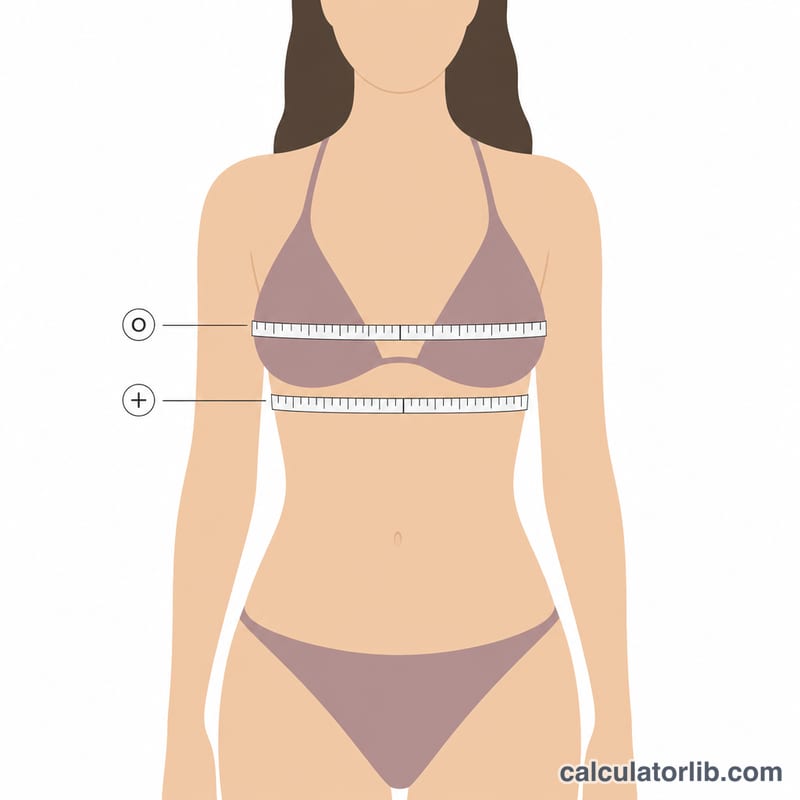
This calculator estimates a bikini top (or bra) size from two simple body measurements: your underbust (the snug measurement directly under your bust) and your bust (around the fullest part). It returns a numeric band size plus a cup letter, such as 72B, using a metric (centimetre) sizing approach common in much of Europe.
How to use it
Wrap a soft tape measure firmly under your bust and read the value in centimetres — that is your underbust. Then measure loosely around the fullest part of your bust. Enter both numbers and the calculator does the rest. For the most reliable result, measure while standing relaxed and wearing a non-padded bra or none at all.
The formula explained
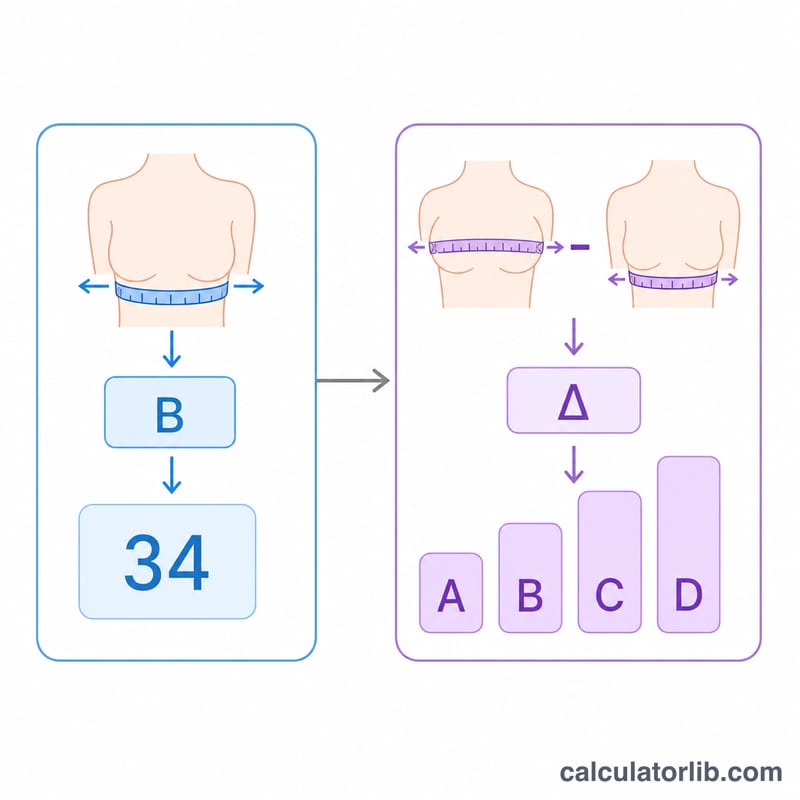
The band size is your underbust divided by 2.5, then rounded to the nearest even number (bands are sold in even sizes like 70, 72, 75). The cup is found from the difference between bust and underbust: roughly every 2.5 cm of difference adds one cup letter, stepping through AA, A, B, C, D, DD, E, F and beyond.
$$\text{Band} = \operatorname{round_{even}}\!\left(\frac{\text{Underbust (cm)}}{2.5}\right), \qquad \text{Cup index} = \operatorname{round}\!\left(\frac{\text{Bust (cm)} - \text{Underbust (cm)}}{2.5}\right)$$
$$\text{where}\quad \left\{ \begin{aligned} \text{Band} &= \text{round to nearest even number} \\ \text{Cup} &= [\text{AA},\,\text{A},\,\text{B},\,\text{C},\,\text{D},\,\text{DD},\,\text{E},\,\text{F},\,\text{FF},\,\text{G},\,\text{GG},\,\text{H}]_{\,\text{Cup index}} \end{aligned} \right.$$
Worked example
Suppose your underbust is 72 cm and your bust is 87 cm. Band = \(72 \div 2.5 = 28.8\), rounded to 29, then up to the nearest even number = 30… in this metric example \(72/2.5 \approx 28.8 \to 29 \to\) even 30 is the band index, while the difference \(87 - 72 = 15\) cm gives \(15 \div 2.5 = 6 \to\) cup letter E. Your estimated size is therefore the band number with cup E.
Cup Letter Lookup Table
Your cup size is determined by the difference between your bust and underbust measurements. Each step of roughly 2.5 cm equals one cup letter. To find your cup index, subtract underbust from bust and divide by 2.5, then round to the nearest whole number:
$$\text{Cup index} = \operatorname{round}\!\left(\frac{\text{Bust} - \text{Underbust}}{2.5}\right)$$For example, a bust of 92 cm and underbust of 77 cm gives a difference of 15 cm, so the cup index is E.
| Bust − Underbust (cm) | Cup index | Cup letter |
|---|---|---|
| ~0–1 | 0 | AA |
| ~2.5 | 1 | A |
| ~5 | 2 | B |
| ~7.5 | 3 | C |
| ~10 | 4 | D |
| ~12.5 | 5 | DD |
| ~15 | 6 | E |
| ~17.5 | 7 | F |
| ~20 | 8 | FF |
| ~22.5 | 9 | G |
| ~25 | 10 | GG |
| ~27.5 | 11 | H |
The labels above follow common UK/EU cup conventions, which include the doubled steps DD, FF and GG between single letters. Note that cup-letter naming diverges between sizing systems past a D cup — see the conversion table below.
Interpreting Your Result
The band and cup this calculator returns is a starting estimate, not a guaranteed fit. The formula maps your raw measurements onto standard sizing intervals, but real garments vary by brand, country of origin, style and fabric. A swimwear top with thick padding, a triangle bikini, and a structured underwire top can all fit differently at the same nominal size.
Sister sizes. Each band/cup pair has neighbouring sizes that share roughly the same cup volume. When you move up one band, you go down one cup letter to keep the cup volume similar — and vice versa. For example, a 34C, 32D and 36B are sister sizes. If a top's band feels too tight but the cups fit, try the next band up and one cup down; if the band is loose but cups fit, go one band down and one cup up.
Signs of a poor fit:
- Band rides up the back — usually means the band is too big; size down a band (and up a cup to compensate).
- Band digs in or leaves deep marks — the band is too small; size up.
- Gaps or wrinkling in the cups — the cup is too large; go down a cup letter.
- Spillover or the underwire/edge sitting on breast tissue — the cup is too small; go up a cup letter.
- Centre gore or front not lying flat — often a cup-size issue rather than a band issue.
For everyday bras, the band should sit level and snug on the loosest hook when new, leaving room to tighten as the elastic relaxes over time. Measure yourself periodically, since weight changes, posture and even the time of day can shift your numbers. Use the result here to narrow your search, then try on a couple of sizes around it to confirm the best fit.
FAQ
Is this exact? No. Brands vary widely, so treat the result as a starting point and always try styles on when possible.
Which units? Both inputs are in centimetres.
Can I use it for swimwear and bras? Yes — bikini tops generally follow the same band-and-cup system as bras.