
What this calculator does
The Hangover-Free Drinking Amount Calculator estimates the maximum volume of an alcoholic beverage you could drink over a session so that your liver fully metabolizes the alcohol before the next morning. It is a generic physiological estimate based on body weight and liver clearance rate, so it is not tied to any specific country's rules and can be used anywhere.
How to use it
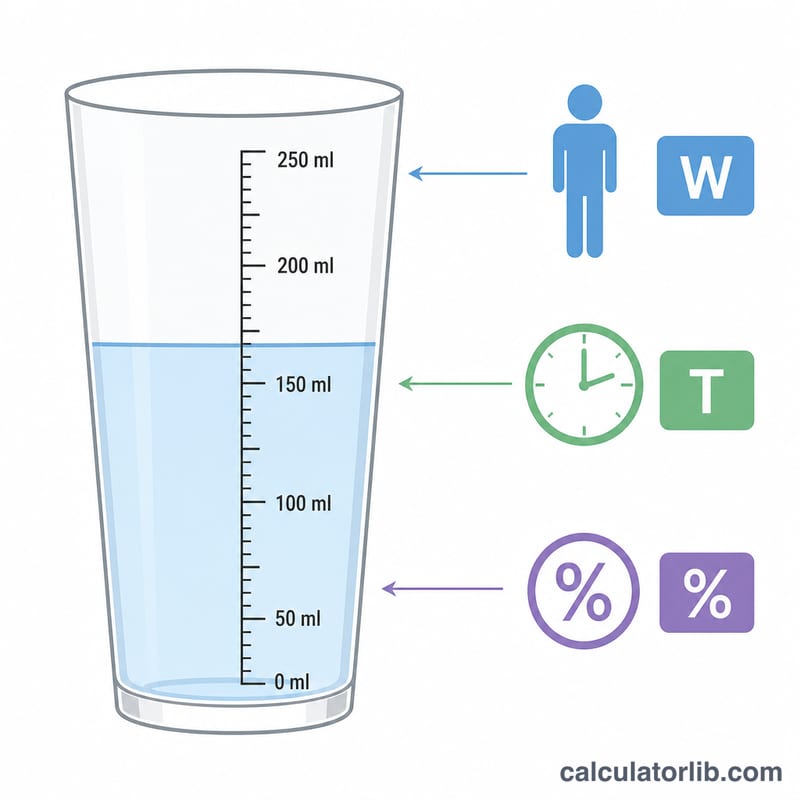
Enter your body weight in kilograms, the number of hours from when you start drinking until you wake up the next morning, and the alcohol content (ABV) of the drink as a percentage. Typical ABV values are about 5% for beer, 12-15% for wine, and higher for spirits. The result is the approximate volume in milliliters of that beverage your liver can clear over the period.
The formula explained
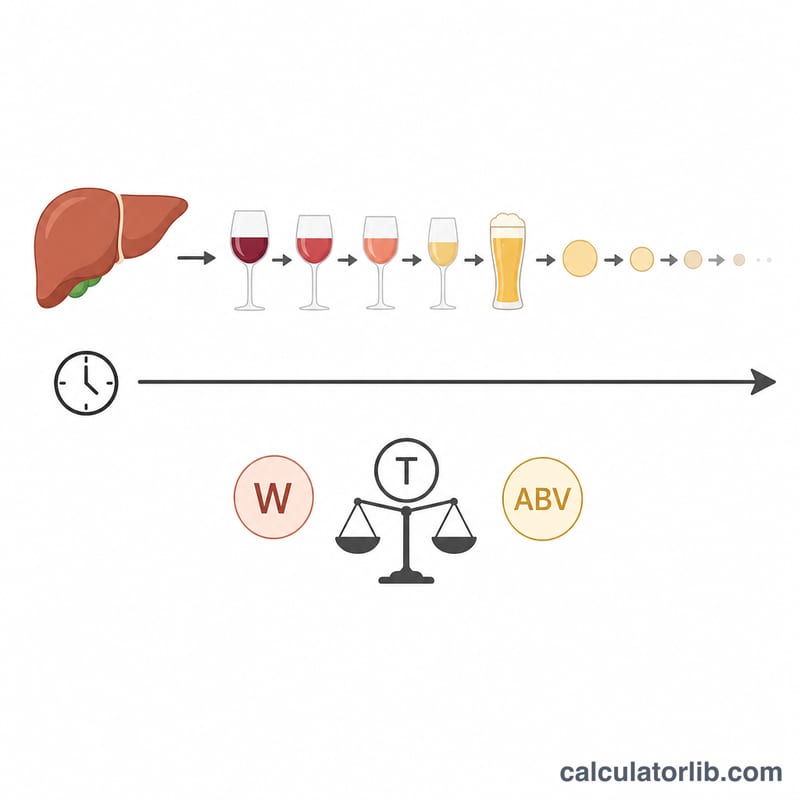
The tool assumes the liver metabolizes roughly 0.15 grams of pure alcohol per kilogram of body weight per hour. Over \(T\) hours a body of weight \(W\) can clear \(0.15 \times W \times T\) grams of alcohol. Each milliliter of a drink contains \((\text{ABV}/100) \times 0.8\) grams of pure alcohol, since the density of ethanol is about 0.8 g/ml. Dividing the metabolizable grams by the grams per ml gives the volume, and folding the percent conversion into the constant gives: $$\text{Amount (mL)} = \frac{15 \times \text{Weight (kg)} \times \text{Hours}}{\text{ABV (\%)} \times 0.8}$$
Worked example
A 60 kg person drinking 15% ABV wine over 10 hours: $$\frac{15 \times 60 \times 10}{15 \times 0.8} = \frac{9000}{12} = 750 \text{ ml}$$ roughly one bottle of wine. For 5% beer the same person gets $$\frac{15 \times 60 \times 10}{5 \times 0.8} = \frac{9000}{4} = 2250 \text{ ml}$$
FAQ
Does this guarantee no hangover? No. It only checks whether the total alcohol mass can be metabolized over the session. It ignores drinking pace, food, sleep timing, sex and genetics, and peak blood alcohol level, so you can still get intoxicated.
Why does the number look so large for beer? Low-ABV drinks contain little alcohol per ml, so a large volume is needed to reach the same metabolizable mass.
What if ABV is zero? A non-alcoholic drink has no alcohol limit, so the formula does not apply; all inputs must be greater than zero.