What this calculator does
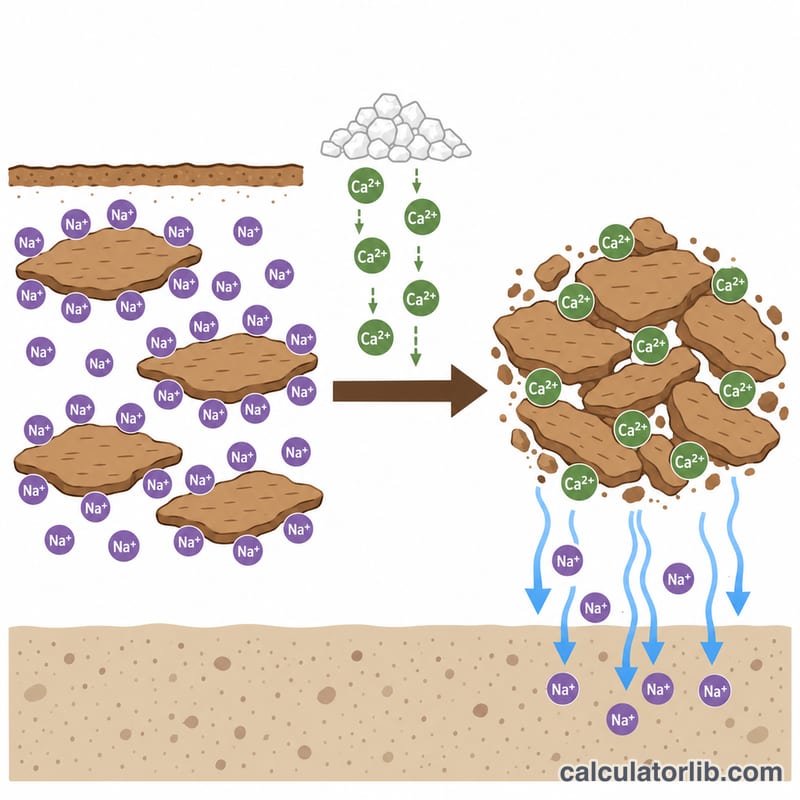
Gypsum (calcium sulfate dihydrate) is the standard amendment for sodic soils and a common calcium source for crops. This calculator turns a soil test into a practical rate: tonnes of gypsum product per hectare, the equivalent in lb/acre and kg/m², and the total tonnage for your field. Use it in one of two ways: give the CEC with the current and target exchangeable sodium percentage (ESP), or enter a calcium requirement that you already know.
How to use it
Pick the soil test basis. For sodium mode, enter the CEC, the current ESP and the ESP you want to reach (often 5–10%). Then enter the depth of soil to treat, its bulk density (1.2–1.6 g/cm³ is typical), the purity of your gypsum, an efficiency factor and the field area in hectares. An efficiency factor of about 1.25 allows for the fact that calcium never replaces sodium perfectly in the field.
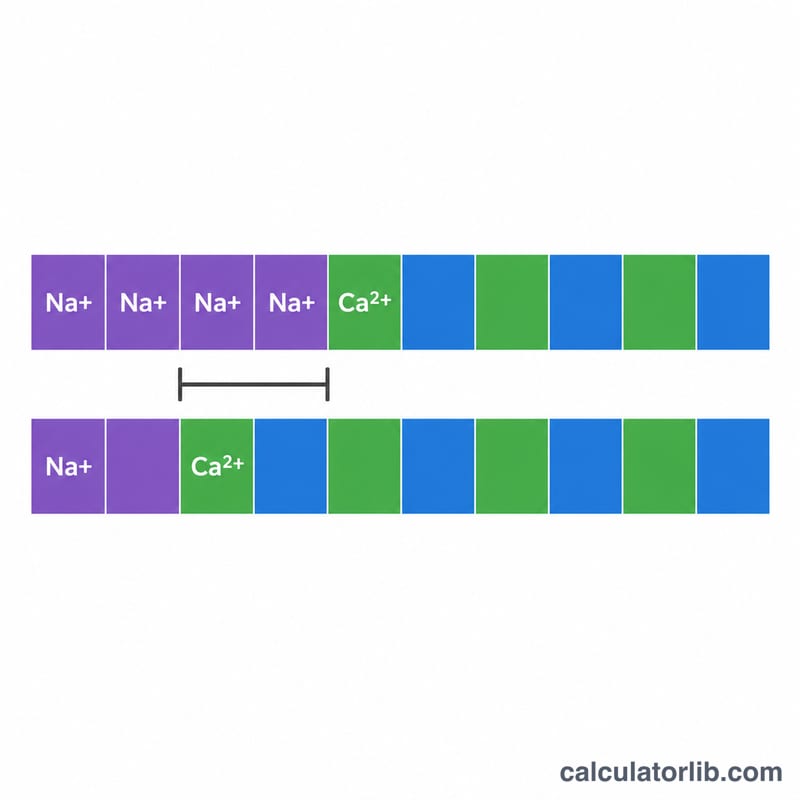
The formula explained
The calcium needed is the sodium you want to remove:
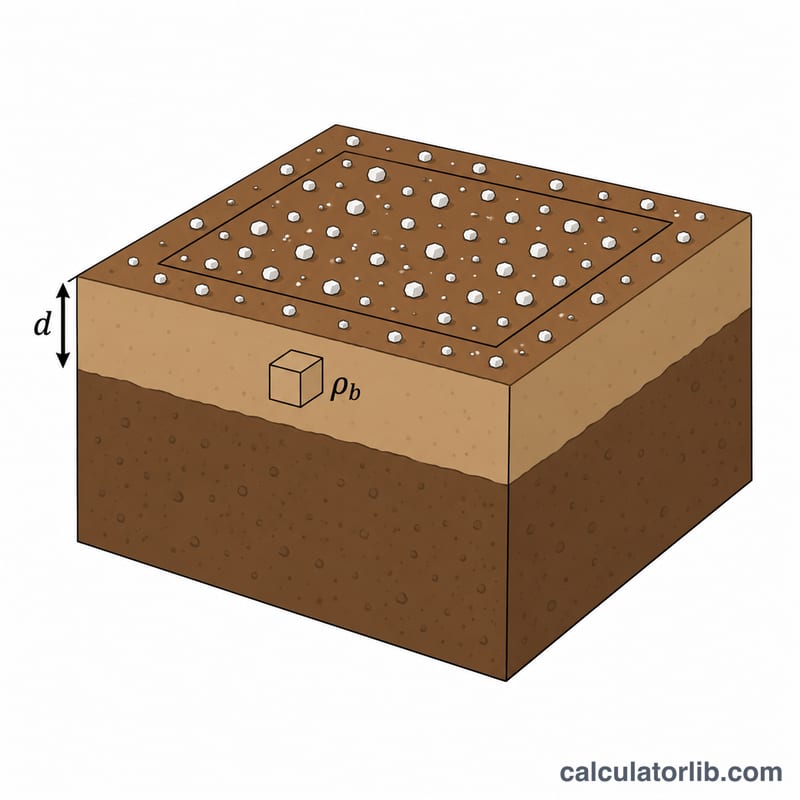
$$\Delta \text{Ca} = \text{CEC} \times \frac{\text{ESP}_c - \text{ESP}_t}{100}$$Gypsum has an equivalent weight of 86.1 g, so each cmol/kg of calcium takes 0.861 g of gypsum per kg of soil. Multiplying by the soil mass per hectare (\(d\) in cm × 100 × \(\rho_b\) tonnes) gives:
$$G = \frac{\Delta \text{Ca} \times 0.0861 \times d \times \rho_b \times F}{P/100}$$Here \(G\) is t/ha, \(F\) is the efficiency factor and \(P\) is purity in percent.
Worked example
A soil has CEC 20 cmol/kg and ESP 25%, and you want ESP 10% in the top 15 cm (bulk density 1.4), using 90% pure gypsum with \(F = 1.25\):
$$\Delta \text{Ca} = 20 \times \frac{25-10}{100} = 3\ \text{cmol/kg}$$$$G = \frac{3 \times 0.08609 \times 15 \times 1.4 \times 1.25}{0.9} \approx 7.53\ \text{t/ha}$$That is about 6,720 lb/acre, or 75.3 t across a 10 ha field.
Sodicity Classes by ESP
Exchangeable sodium percentage (ESP) is the share of the soil's cation exchange capacity (CEC) held by sodium. It is the main number used to decide whether a soil is sodic and whether it needs gypsum. No single classification applies everywhere. The two most widely cited systems use different thresholds:
| ESP (%) | Australian usage (e.g. Northcote & Skene) | USDA / US Salinity Laboratory (Handbook 60) |
|---|---|---|
| < 6 | Non-sodic | Non-sodic |
| 6–15 | Sodic | Non-sodic (below the 15% threshold) |
| > 15 | Strongly sodic | Sodic (ESP ≥ 15%) |
Thresholds depend on the standard and the soil. In Australia, soils start to disperse at a much lower ESP than the US 15% cut-off suggests, which is why Australia sets the sodic boundary at 6%. How a soil actually behaves also depends on clay mineralogy, organic matter and the salinity (EC) of the soil solution and irrigation water. Saline-sodic soils can stay well structured until the salts are leached out. Use the classes your local agronomy service uses, and treat the table as a guide only.
Typical target ESP: most gypsum programmes aim for an ESP of about 5–10%. Going lower usually needs much more gypsum for little extra benefit. Use the low end of that range for dispersive clays or crops sensitive to sodium.
Gypsum Rates Across Typical Soil Scenarios
Every scenario below uses the calculator's formula with a bulk density of 1.4 g/cm³, 90% gypsum purity and an efficiency factor of F = 1.25:
$$R = \frac{0.08609 \cdot \Delta\text{Ca} \cdot d \cdot 1.4 \cdot 1.25}{0.90}, \qquad \Delta\text{Ca} = \frac{\text{CEC} \times (\text{ESP}_{\text{current}} - \text{ESP}_{\text{target}})}{100}$$With these fixed values the formula reduces to \(R \approx 0.16740 \times \Delta\text{Ca} \times d\) t/ha. For example, CEC 20, ESP 25→10 and a depth of 15 cm give \(\Delta\text{Ca} = 20 \times 15 / 100 = 3.0\) cmolc/kg and \(R = 0.08609 \times 3.0 \times 15 \times 1.4 \times 1.25 / 0.90 \approx 7.53\) t/ha. To convert to lb/acre, multiply t/ha by 892.18.
| CEC (cmolc/kg) | ESP current → target (%) | Depth (cm) | ΔCa (cmolc/kg) | Gypsum (t/ha) | Gypsum (lb/acre) |
|---|---|---|---|---|---|
| 10 | 15 → 5 | 15 | 1.0 | 2.51 | ≈ 2,240 |
| 20 | 25 → 10 | 15 | 3.0 | 7.53 | ≈ 6,721 |
| 20 | 25 → 10 | 30 | 3.0 | 15.07 | ≈ 13,441 |
| 35 | 20 → 8 | 15 | 4.2 | 10.55 | ≈ 9,409 |
| 35 | 30 → 10 | 30 | 7.0 | 35.15 | ≈ 31,363 |
The rate rises in direct proportion to CEC, to the ESP reduction and to depth. Treating 30 cm instead of 15 cm doubles the gypsum needed. High-CEC, strongly sodic clays reclaimed to depth can need more than 30 t/ha. Rates that large are usually split over several seasons rather than applied all at once, which also helps manage cost and leaching.
Typical Bulk Density by Soil Texture
Bulk density (ρb) turns a per-kilogram calcium requirement into a per-hectare amount. A higher bulk density means more soil mass in the treated layer, so more gypsum is needed. If you have no measurement, the ranges below are typical for uncompacted topsoils:
| Soil texture | Typical bulk density (g/cm³) |
|---|---|
| Sands, loamy sands | ≈ 1.5–1.7 |
| Loams, sandy loams, silt loams | ≈ 1.3–1.5 |
| Clay loams | ≈ 1.2–1.4 |
| Clays | ≈ 1.1–1.3 |
Compaction from traffic, tillage pans or dispersion and hard-setting in sodic soils raises these values. Compacted subsoils often read 0.1–0.3 g/cm³ above the typical range. Organic-rich surface layers usually read lower. The gypsum rate scales directly with bulk density, so moving from 1.2 to 1.5 g/cm³ raises the calculated rate by 25%. Where you can, measure bulk density yourself with intact core samples (known core volume, oven-dry soil mass) taken from the depth you plan to treat.
FAQ
Should I apply it all at once?
Rates above about 10 t/ha are usually split over several seasons, and the soil needs enough rain or irrigation to leach the displaced sodium below the root zone.
Does gypsum change soil pH?
Not much. Gypsum is a neutral salt. It improves structure and supplies calcium and sulfur but does not lime acid soils.
What if I treat a deeper layer?
The rate scales directly with depth. Treating 30 cm instead of 15 cm doubles the gypsum needed.