What is the Langelier Saturation Index?
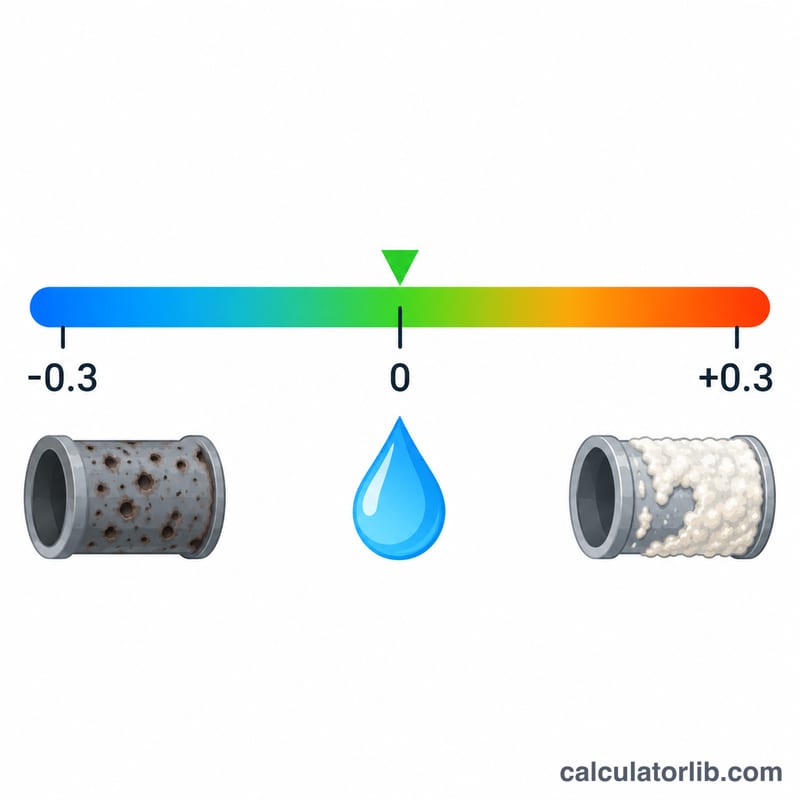
The Langelier Saturation Index (LSI) tells you whether water will dissolve calcium carbonate or deposit it. Pool water with a negative LSI is corrosive. It pulls calcium out of plaster and grout and attacks heaters and metal fittings. Water with a positive LSI is scaling. It leaves cloudy water, crusty tile lines and scale inside heat exchangers. Most pool professionals aim for an LSI between -0.3 and +0.3, and ideally close to zero.
How to use this calculator
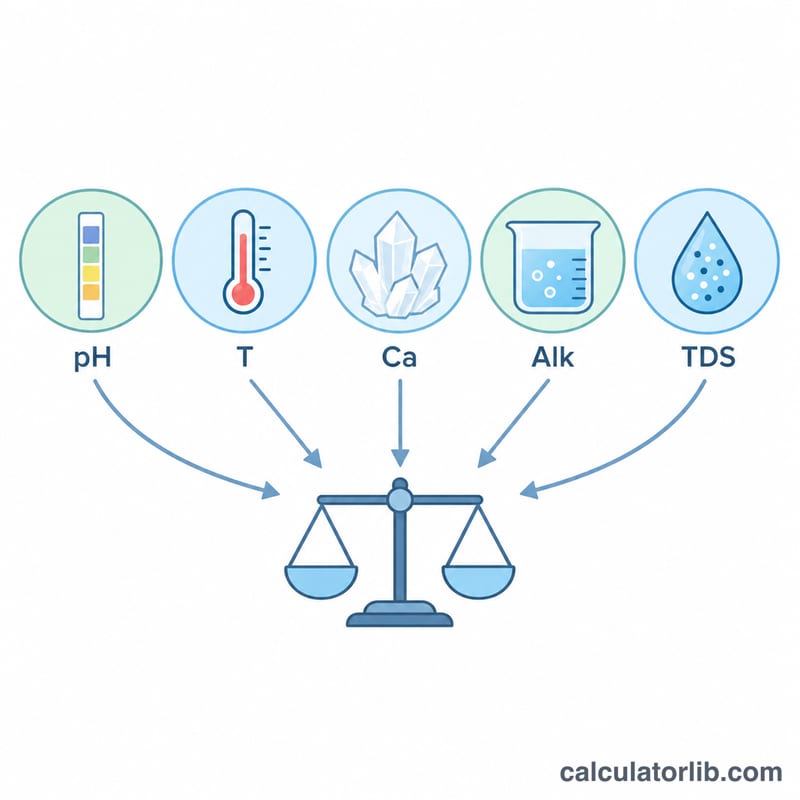
Enter your test-kit readings: pH, water temperature (in °C or °F), calcium hardness and total alkalinity (both in ppm as CaCO3), and total dissolved solids. If you have not measured TDS, 1,000 ppm is a reasonable default for a chlorine pool. A saltwater pool usually reads 3,000 to 4,000 ppm. The calculator shows the LSI, the saturation pH and each correction factor, so you can see which reading moves the balance the most.
The formula
The index is the difference between the actual pH and the saturation pH \(\text{pH}_s\):
$$\text{LSI} = \text{pH} - \left[(9.3 + A + B) - (C + D)\right]$$Here \(A = (\log_{10}\text{TDS} - 1)/10\) corrects for dissolved solids, and \(B = -13.12\log_{10}(T_K) + 34.55\) corrects for temperature, with \(T_K\) in kelvin. \(C = \log_{10}(\text{Ca}) - 0.4\) accounts for calcium hardness, and \(D = \log_{10}(\text{Alk})\) accounts for total alkalinity.
Worked example
Take pH 7.5, 25 °C, calcium hardness 250 ppm, alkalinity 100 ppm and TDS 1,000 ppm:
$$A = \frac{3 - 1}{10} = 0.2,\quad B = -13.12\log_{10}(298.15) + 34.55 = 2.0854$$$$C = \log_{10}(250) - 0.4 = 1.9979,\quad D = \log_{10}(100) = 2$$$$\text{pH}_s = (9.3 + 0.2 + 2.0854) - (1.9979 + 2) = 7.5875$$$$\text{LSI} = 7.5 - 7.5875 = -0.09$$The result is slightly negative but still within the balanced range.
Recommended Pool Water Ranges
The targets below are ones commonly cited in US industry and public-health guidance. They mainly come from the ANSI/PHTA/ICC-11 (formerly ANSI/APSP-11) water-quality standard, from the Pool & Hot Tub Alliance (PHTA), and from the CDC Model Aquatic Health Code (MAHC), which covers US public pools. Other countries may set different legal limits, so check your local health authority or your equipment and surface manufacturer. Treat these figures as typical working ranges, not universal rules.
| Parameter | Commonly cited target | Notes and source |
|---|---|---|
| pH | 7.2–7.8 (ideal 7.4–7.6) | The 7.2–7.8 range appears in the MAHC (US) and PHTA guidance. Swimmers are most comfortable and chlorine works well near 7.4–7.6. |
| Total alkalinity | 80–120 ppm | A general PHTA-style target. Plaster/gunite pools are often kept in the middle to upper part of this range to protect the surface. Vinyl and fibreglass pools, and saltwater pools (where pH tends to rise), are often run lower. Follow your surface or equipment maker's figure if it gives one. |
| Calcium hardness | 200–400 ppm (plaster/gunite) | Cement-based surfaces need enough calcium so the water doesn't dissolve it from the plaster. Vinyl and fibreglass pools are usually kept lower (about 150–250 ppm is often quoted) because there's no plaster to protect, and high calcium just raises the risk of scale. |
| Total dissolved solids (TDS) | Chlorine pools: ideally within about 1,500 ppm of the fill water. Saltwater pools: about 3,000–4,000 ppm | In a saltwater pool most of the TDS is salt (sodium chloride), so the salt-cell maker's specification takes priority. |
| Water temperature | Pools: about 26–29 °C (78–84 °F). Spas/hot tubs: about 36–40 °C (97–104 °F) | 40 °C (104 °F) is the widely used US maximum for spas (CPSC and MAHC guidance). |
| Langelier Saturation Index (LSI) | −0.3 to +0.3 | Below −0.3 the water tends to be corrosive. Above +0.3 it tends to form scale. Many pool professionals aim close to 0. |
No single reading decides balance. The LSI combines all five inputs, so water can be balanced even when one value sits at the edge of its range, as long as the others make up for it.
Bringing Your LSI Back Into Balance
The LSI tells you which way to move, not exactly how much chemical to add. The right dose depends on your pool's volume, the product's strength and your current readings. Use these steps as general guidance.
If the LSI is negative (corrosive water)
- Raise pH with sodium carbonate (soda ash). This is usually the quickest way to raise the LSI, because pH enters the index directly.
- Raise total alkalinity with sodium bicarbonate (baking soda). This raises the D term and steadies the pH, and it raises pH only slightly.
- Raise calcium hardness with calcium chloride when calcium is below the target for your surface. This matters most in plaster, gunite and tiled pools, where corrosive water etches the surface and grout.
If the LSI is positive (scaling water)
- Lower pH and alkalinity with muriatic (hydrochloric) acid or dry acid (sodium bisulfate). Both lower pH right away and lower alkalinity over time.
- Partially drain and refill with fresh water if calcium hardness or TDS is too high. No common chemical removes calcium or dissolved solids, so dilution is the practical fix. It only helps if your fill water is lower in these than the pool water.
- Watch heated water closely. As the scenario table shows, a spa or heated pool can move into scaling just because the temperature rose. Recheck the LSI at the temperature you actually run.
Adjust safely and in small steps
- Add only part of the calculated dose at a time. Small corrections are easier to control than overshooting and then correcting the other way.
- Run the pump and let the water circulate before you retest. A few hours is typical for pH and alkalinity, and longer for calcium products. The product label gives the recommended wait.
- Retest and recalculate the LSI before adding more.
- Always follow the product label for doses and handling. Add chemicals to water, never water to chemicals. Never mix acids with chlorine products. Wear eye and hand protection.
This is general information, not professional advice. For commercial or public pools, local regulations and a qualified pool operator should guide the treatment.
FAQ
Which reading should I adjust first?
Fix total alkalinity first, because it buffers pH. Next, set pH to 7.4 to 7.6. Only then adjust calcium hardness, since it is slow and expensive to change.
Why does temperature matter?
Calcium carbonate becomes less soluble as water warms. The same water can be balanced at 20 °C and start scaling in a hot spa, so test balance at the temperature you actually run the pool.
Should I subtract cyanuric acid from alkalinity?
For stabilised pools, a common correction is to subtract about one third of the cyanuric acid level from total alkalinity before entering it. That gives you the carbonate alkalinity.