What Is a Hydroponic Nutrient Solution Calculator?
A hydroponic nutrient solution calculator tells you exactly how much liquid fertilizer to add to your reservoir. Instead of guessing, you enter your water volume and the manufacturer dose rate for each nutrient part, and the tool returns the precise volume in milliliters to pour in.
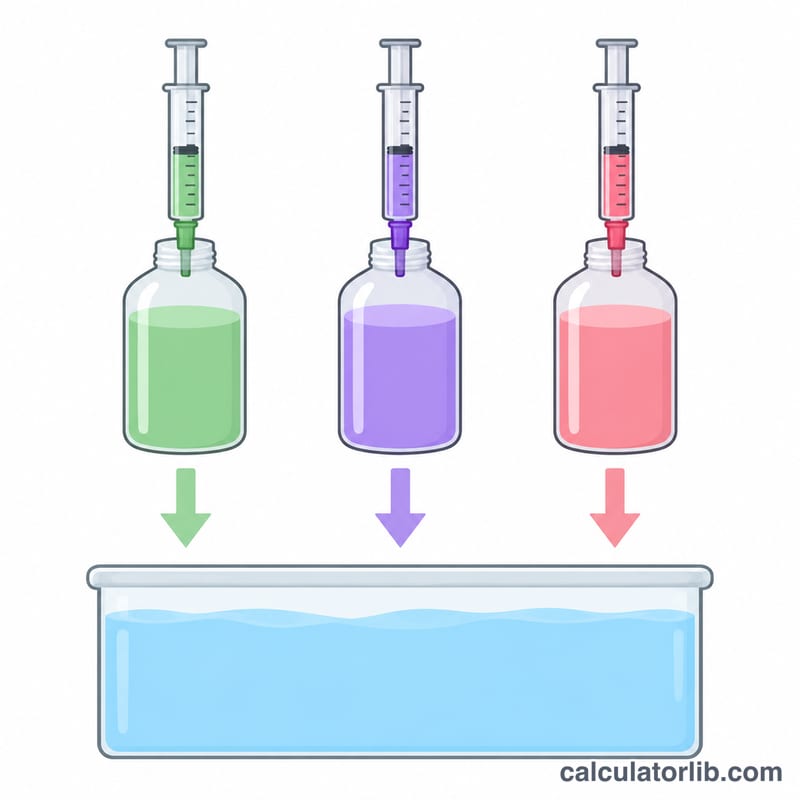
The Formula
Each nutrient part is dosed in proportion to the water volume. If the rate is given per liter, the amount for one part is:
$$\text{Amount}_{\text{part}} = \text{Rate}_{\text{part}} \times V_L$$where \(\text{Rate}_{\text{part}}\) is in mL per liter and \(V_L\) is the reservoir volume in liters. If you measure in US gallons, convert first with \(V_L = V_{\text{gal}} \times 3.78541\). The total nutrient volume is the sum of all parts.
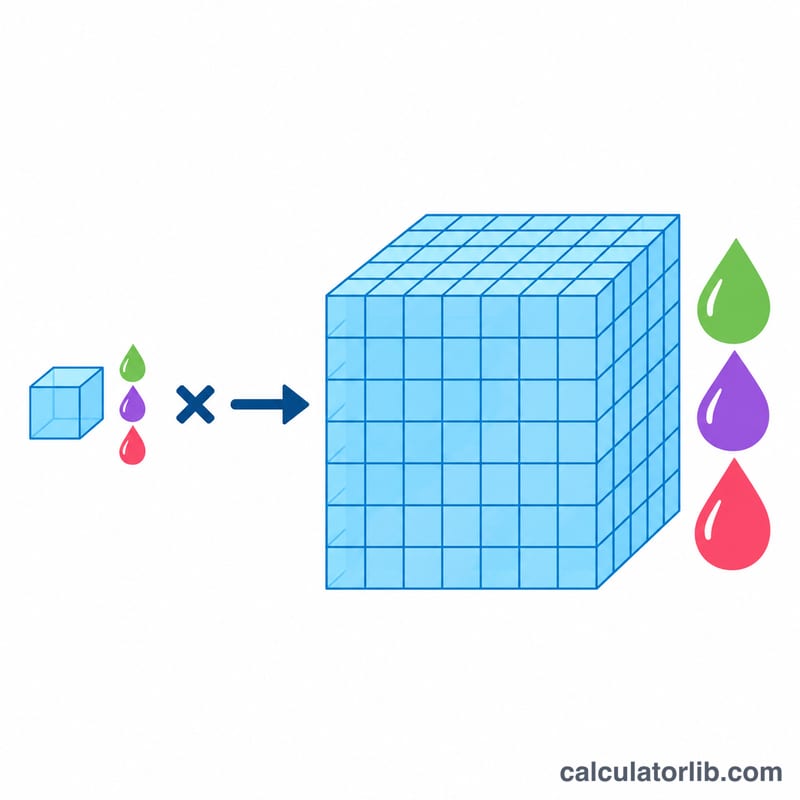
How to Use It
Enter your reservoir volume and pick liters or gallons. Add the grow, micro, and bloom dose rates from your nutrient label (commonly 1 to 2 mL/L each). The calculator shows the amount for every part plus the combined total you pour into the tank.
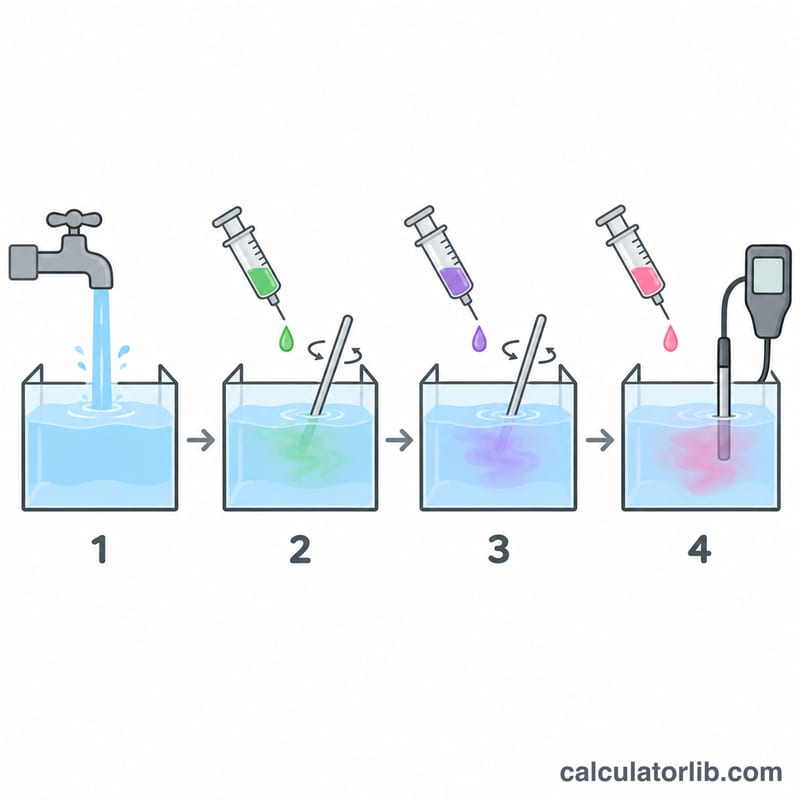
Worked Example
For a 100 L reservoir dosed at 2 mL/L grow, 2 mL/L micro, and 1 mL/L bloom:
$$\text{Grow} = 2 \times 100 = 200\,\text{mL}$$ $$\text{Total} = 200 + 200 + 100 = 500\,\text{mL}$$So you add 200 mL grow, 200 mL micro, and 100 mL bloom for 500 mL total.
Typical EC and pH Ranges by Growth Stage
Electrical conductivity (EC) tells you roughly how much dissolved fertiliser is in the reservoir. Many meters show parts per million (ppm, also called TDS) instead. A ppm reading is only an EC reading converted with a fixed factor. The two common factors are 500 (the "500 scale", based on NaCl) and 700 (the "700 scale", based on KCl), so always check which scale your meter uses:
$$\text{ppm}_{500} = \text{EC (mS/cm)} \times 500 \qquad \text{ppm}_{700} = \text{EC (mS/cm)} \times 700$$For example, EC 1.6 mS/cm reads as \(1.6 \times 500 = 800\) ppm on the 500 scale and \(1.6 \times 700 = 1120\) ppm on the 700 scale.
| Growth stage | EC (mS/cm) | ppm (500 scale) | ppm (700 scale) | pH |
|---|---|---|---|---|
| Seedlings / clones | 0.6–1.0 | 300–500 | 420–700 | 5.5–6.5 |
| Vegetative | 1.2–1.8 | 600–900 | 840–1260 | 5.5–6.5 |
| Flowering / fruiting | 1.8–2.4 | 900–1200 | 1260–1680 | 5.5–6.5 |
These are commonly published ranges for crops of different strengths:
| Crop | Typical EC (mS/cm) | Typical pH | Notes |
|---|---|---|---|
| Lettuce | 0.8–1.2 | 5.5–6.5 | Light feeder; too much EC can cause tip burn |
| Basil and other leafy herbs | 1.0–1.6 | 5.5–6.5 | Moderate feeder |
| Tomato | 2.0–5.0 | 5.5–6.5 | Heavy feeder; usually run at the higher end while fruiting |
These numbers are general guidance from published hydroponic references, not a universal standard. Plants need different strengths depending on cultivar, light, temperature, growing system and the EC of your source water. Your nutrient manufacturer's feeding chart comes first. Use this table to sanity-check a mix, and judge the final result by how the plants respond.
Dose Amounts for Common Reservoir Sizes
Each part is dosed by the reservoir volume in litres. For a volume in US gallons, convert it first using 1 US gal = 3.78541 L:
$$\text{Amount (mL)} = \text{Rate (mL/L)} \times V_L, \qquad V_L = V_{\text{gal}} \times 3.78541$$For example, a 5-gallon bucket holds \(5 \times 3.78541 = 18.93\) L. At a grow rate of 2 mL/L, that needs \(2 \times 18.927 = 37.85\) mL of grow.
The tables use two example schedules, each totalling 5 mL/L. The vegetative schedule is grow/micro/bloom = 2/2/1 mL/L and the bloom schedule is 1/2/2 mL/L. Your own product's rates may be quite different.
Vegetative schedule (2 / 2 / 1 mL/L)
| Reservoir | Volume (L) | Grow (mL) | Micro (mL) | Bloom (mL) | Total (mL) |
|---|---|---|---|---|---|
| 10 L | 10 | 20 | 20 | 10 | 50 |
| 20 L | 20 | 40 | 40 | 20 | 100 |
| 5 US gal | 18.93 | 37.85 | 37.85 | 18.93 | 94.64 |
| 50 L | 50 | 100 | 100 | 50 | 250 |
| 100 L | 100 | 200 | 200 | 100 | 500 |
Bloom schedule (1 / 2 / 2 mL/L)
| Reservoir | Volume (L) | Grow (mL) | Micro (mL) | Bloom (mL) | Total (mL) |
|---|---|---|---|---|---|
| 10 L | 10 | 10 | 20 | 20 | 50 |
| 20 L | 20 | 20 | 40 | 40 | 100 |
| 5 US gal | 18.93 | 18.93 | 37.85 | 37.85 | 94.64 |
| 50 L | 50 | 50 | 100 | 100 | 250 |
| 100 L | 100 | 100 | 200 | 200 | 500 |
Both example schedules add up to 5 mL/L, so the total for a given reservoir is the same in both tables. Only the split between the three parts changes. The gallon figure uses US gallons. One imperial (UK) gallon is 4.54609 L, so a 5-imperial-gallon tank holds about 22.73 L.
Practical Mixing Tips
- Start weak with young plants. Feed seedlings and fresh clones at about half the label strength, or less. Then raise the strength gradually as they put out new roots and leaves. Watch for leaf-tip burn (too strong) or pale new growth (too weak).
- Measure accurately. Use a dosing syringe for small amounts and a graduated cylinder for larger ones. Kitchen spoons and bottle caps are not accurate enough. Round each dose only to the precision your tool can actually read. For example, 37.85 mL becomes about 38 mL in a cylinder marked every 1 mL.
- Shake the bottles before measuring. Some ingredients settle to the bottom during storage, so a dose drawn from an unshaken bottle may not be the strength the label intends.
- Add each part separately. Pour each part into the water and stir well before adding the next. Never mix concentrates directly together, because calcium in one part can react with sulfates or phosphates in another and drop out of solution. Follow the order on the label if one is given, and adjust pH last.
- Top off with plain water or a weaker mix. Plants take up water faster than nutrients, and evaporation removes only water, so the reservoir gets more concentrated over time. Refill with plain pH-adjusted water, or a solution weaker than the original, rather than full-strength nutrient.
- Re-check EC and pH after every top-off. Stir the reservoir, take new readings, and bring pH back into the 5.5–6.5 range before plants are fed from it.
- Change the whole reservoir every 1–2 weeks. Over time, plants take up some nutrients faster than others, so the balance drifts even if EC looks fine. A full change resets it. Change it sooner in small reservoirs or warm conditions.
- Keep records. Write down the volume, the dose for each part, and the starting and ending EC and pH. Over a few cycles this shows how fast your plants feed, so you can adjust the schedule with confidence.
These tips are general growing guidance. Always follow the instructions and safety information on your nutrient product's label.
FAQ
In what order do I mix? Add micro first and stir, then grow, then bloom, to avoid nutrient lockout from concentrated salts meeting.
Should I check EC and pH? Yes. After mixing, measure EC to confirm strength and adjust pH to 5.5 to 6.5 for most crops.
Can rates differ by stage? Yes, use higher grow rates in vegetative growth and higher bloom rates during flowering.