What the Horse Rider Weight Ratio Calculator Does
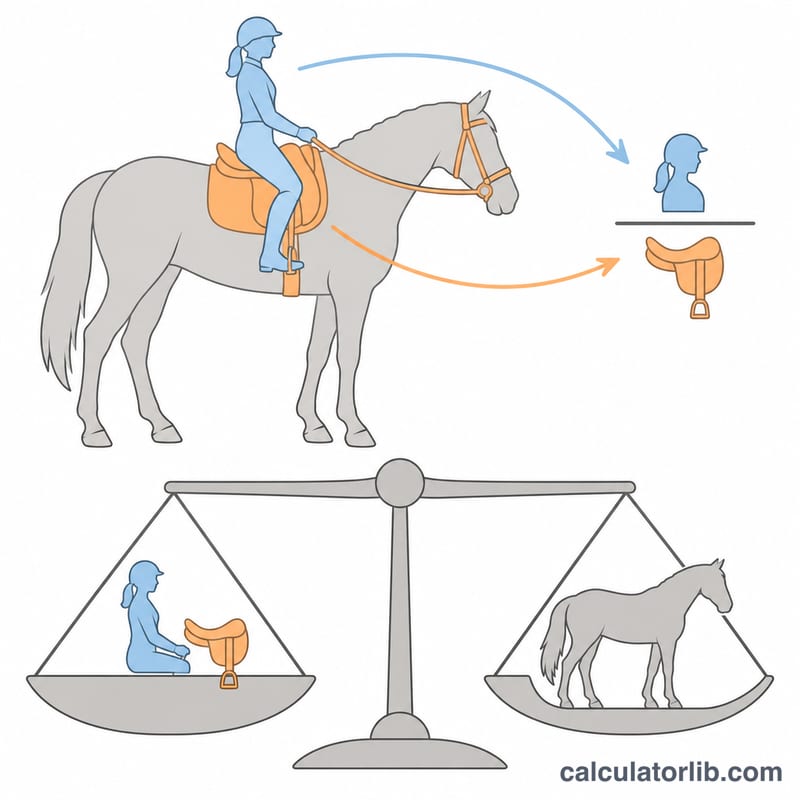
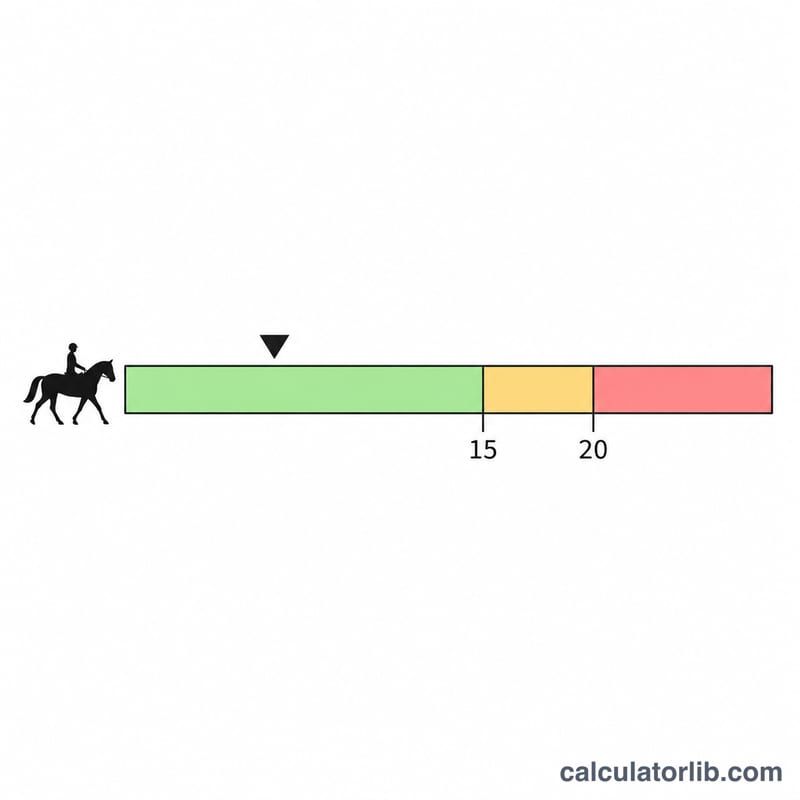
This tool estimates how heavy a rider plus saddle and gear is relative to the horse carrying them. Research and long-standing riding guidelines suggest that the total carried load should stay within roughly 15% to 20% of the horse's body weight to protect its back, gait and long-term soundness. Entering three numbers gives you an instant percentage and a plain-language status.
How to Use It
Enter the horse's body weight, the rider's weight, and the combined weight of tack and gear (saddle, pad, bridle, boots). All values use kilograms. The calculator adds the rider and tack together, divides by the horse's weight, and multiplies by 100 to produce the carried-load percentage, then flags it as ideal, acceptable, caution or overloaded.
The Formula Explained
The core calculation is a simple ratio expressed as a percentage:
$$\text{Load \%} = \frac{\text{Rider} + \text{Tack}}{\text{Horse Weight}} \times 100$$
Here \(\text{Rider}\) = rider weight in kg, \(\text{Tack}\) = saddle and gear weight in kg, and \(\text{Horse Weight}\) = the horse's body mass in kg. The recommended ceiling is \(0.20 \times \text{Horse Weight}\).
Worked Example
A 500 kg horse carries a 70 kg rider with 10 kg of tack. The combined load is 80 kg, so:
$$\text{Load \%} = \frac{70 + 10}{500} \times 100 = 16\%$$
At 16% the load is within the acceptable 15-20% band, just above the 75 kg ideal limit and well under the 100 kg recommended maximum.
Interpreting Your Load Percentage
The calculator adds the rider's weight to the weight of the tack (saddle, pad, bridle and any other equipment), divides the total by the horse's body weight and multiplies by 100. It then places the result in one of four status bands:
| Status | Load ratio | What it means |
|---|---|---|
| Ideal | 15% or less | Most horses carry this load comfortably, including for longer rides, if they are fit and the saddle fits. |
| Acceptable | Over 15% up to 20% | This is within the widely quoted upper limit of 20%. Most sound, fit horses manage it, but they get tired sooner on long or demanding rides. |
| Caution | Over 20% up to about 25% | In research, horses at about 25% have shown clear signs of physical stress, such as higher heart and breathing rates and more muscle soreness. Keep rides short and easy, or reduce the load. |
| Overloaded | Above 25% | This is above the levels research supports. The risk of fatigue, back soreness and lameness rises sharply. Reduce the load or choose a larger, stronger horse. |
Example: a 500 kg horse carries an 80 kg rider with 12 kg of tack.
$$\text{Load Ratio} = \frac{80 + 12}{500} \times 100 = \frac{92}{500} \times 100 = 18.4\%$$The load is 18.4%, which falls in the acceptable band.
Where the thresholds come from
The most-cited modern source is a 2008 study by Powell and colleagues, published in the Journal of Equine Veterinary Science. Riding horses carried 15%, 20%, 25% and 30% of their body weight. Signs of stress became noticeable at 25% and pronounced at 30%. The authors concluded that loads should stay below about 20%. Older military cavalry guidance is often quoted with a similar limit of roughly 20% of body weight. Together, these sources are the basis for the common 15–20% rule of thumb.
Factors that change how a horse copes
The same percentage can suit one horse and be too much for another. Fitness and muscle condition matter a lot: a well-conditioned horse copes better than an unfit one. Conformation matters too, with a short, strong back, broad loins and solid bone helping. Ride duration and pace, and terrain such as hills, deep going or rough ground, all add strain. A balanced, independent rider is easier to carry than an unbalanced one of the same weight. A saddle that fits poorly concentrates pressure and can make even a modest load uncomfortable. Age, soundness and existing back or joint problems also count.
This is a general guideline and not a veterinary assessment. For decisions about a specific horse, especially one that is young, old, recovering from injury or showing discomfort, ask a veterinarian, a qualified saddle fitter or an experienced equine professional.
Maximum Rider + Tack Weight by Horse Weight
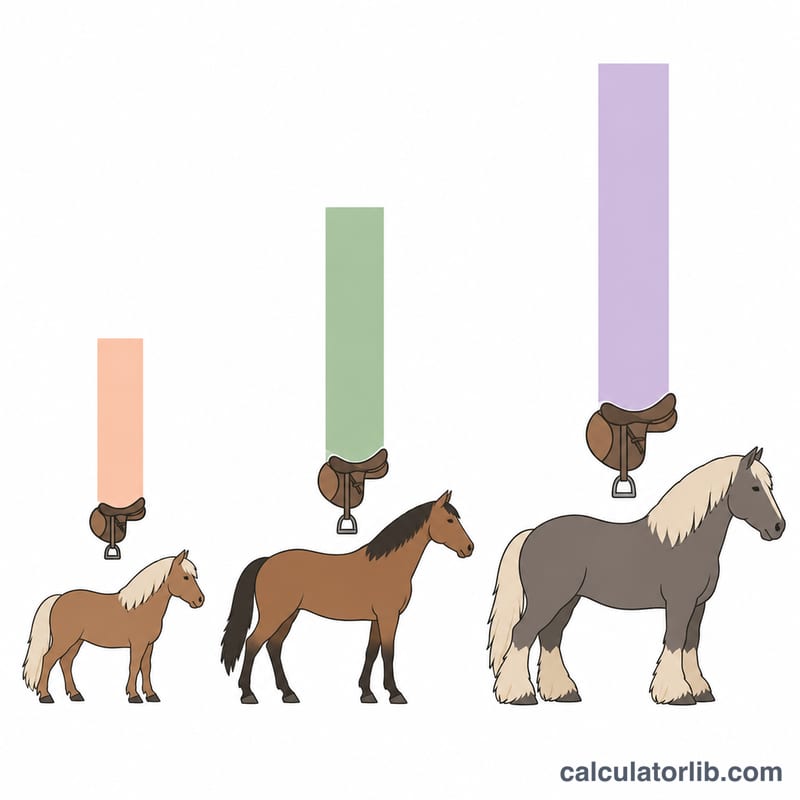
Each value comes straight from the formula: the combined load equals the horse's weight × 0.15 for the ideal limit and × 0.20 for the recommended maximum. For example, 500 kg × 0.15 = 75 kg and 500 kg × 0.20 = 100 kg. The last column takes away a typical 10 kg of tack from the 20% limit to show how much the rider can weigh. Pound values use 1 kg = 2.2046 lb and are rounded to one decimal place.
| Horse weight | Rider + tack at 15% (ideal) | Rider + tack at 20% (max) | Rider weight at 20% with 10 kg tack |
|---|---|---|---|
| 300 kg (661.4 lb) | 45 kg (99.2 lb) | 60 kg (132.3 lb) | 50 kg (110.2 lb) |
| 350 kg (771.6 lb) | 52.5 kg (115.7 lb) | 70 kg (154.3 lb) | 60 kg (132.3 lb) |
| 400 kg (881.8 lb) | 60 kg (132.3 lb) | 80 kg (176.4 lb) | 70 kg (154.3 lb) |
| 450 kg (992.1 lb) | 67.5 kg (148.8 lb) | 90 kg (198.4 lb) | 80 kg (176.4 lb) |
| 500 kg (1,102.3 lb) | 75 kg (165.3 lb) | 100 kg (220.5 lb) | 90 kg (198.4 lb) |
| 550 kg (1,212.5 lb) | 82.5 kg (181.9 lb) | 110 kg (242.5 lb) | 100 kg (220.5 lb) |
| 600 kg (1,322.8 lb) | 90 kg (198.4 lb) | 120 kg (264.6 lb) | 110 kg (242.5 lb) |
| 650 kg (1,433.0 lb) | 97.5 kg (215.0 lb) | 130 kg (286.6 lb) | 120 kg (264.6 lb) |
| 700 kg (1,543.2 lb) | 105 kg (231.5 lb) | 140 kg (308.6 lb) | 130 kg (286.6 lb) |
| 750 kg (1,653.5 lb) | 112.5 kg (248.0 lb) | 150 kg (330.7 lb) | 140 kg (308.6 lb) |
| 800 kg (1,763.7 lb) | 120 kg (264.6 lb) | 160 kg (352.7 lb) | 150 kg (330.7 lb) |
Tack weight varies widely. A light synthetic saddle with a bridle may weigh 6–8 kg, while a heavy western or working saddle with pads can weigh 15–20 kg or more. Weigh your own tack and use that figure. Every extra kilogram of tack reduces the rider allowance by the same amount.
Converting Pounds and Stone to Kilograms
The calculator works in kilograms. Use these factors to convert weights given in pounds or stone (stone is used mainly in the UK and Ireland):
- 1 lb = 0.4536 kg
- 1 stone = 14 lb = 6.350 kg
- 1 kg = 2.2046 lb
For example, a 12 st rider weighs 12 × 14 = 168 lb, and 168 × 0.4536 ≈ 76.2 kg.
Common rider weights
| Stone | Pounds | Kilograms |
|---|---|---|
| 8 st | 112 lb | 50.8 kg |
| 9 st | 126 lb | 57.2 kg |
| 10 st | 140 lb | 63.5 kg |
| 11 st | 154 lb | 69.9 kg |
| 12 st | 168 lb | 76.2 kg |
| 13 st | 182 lb | 82.6 kg |
| 14 st | 196 lb | 88.9 kg |
| 15 st | 210 lb | 95.3 kg |
| 16 st | 224 lb | 101.6 kg |
| 17 st | 238 lb | 108.0 kg |
| 18 st | 252 lb | 114.3 kg |
Common horse weights
| Pounds | Kilograms |
|---|---|
| 800 lb | 362.9 kg |
| 900 lb | 408.2 kg |
| 1,000 lb | 453.6 kg |
| 1,100 lb | 499.0 kg |
| 1,200 lb | 544.3 kg |
| 1,300 lb | 589.7 kg |
| 1,400 lb | 635.0 kg |
| 1,500 lb | 680.4 kg |
| 1,600 lb | 725.7 kg |
A livestock or weighbridge scale gives the most accurate horse weight. Weight tapes and girth-and-length formulas only give estimates and can be off by several percent.
Frequently Asked Questions
Is 20% a hard limit? No. It is a cautious guideline; fitness, conformation, ride duration and terrain all matter. Many sources treat 15% as ideal and 20% as a sensible cap.
Should tack be included? Yes. A saddle, pad and gear can add 7-15 kg, which meaningfully changes the ratio.
What if my horse is very fit? A strong, well-conditioned horse may comfortably carry slightly more, but exceeding 25% is generally discouraged.