
What Is Power-to-Weight Ratio?
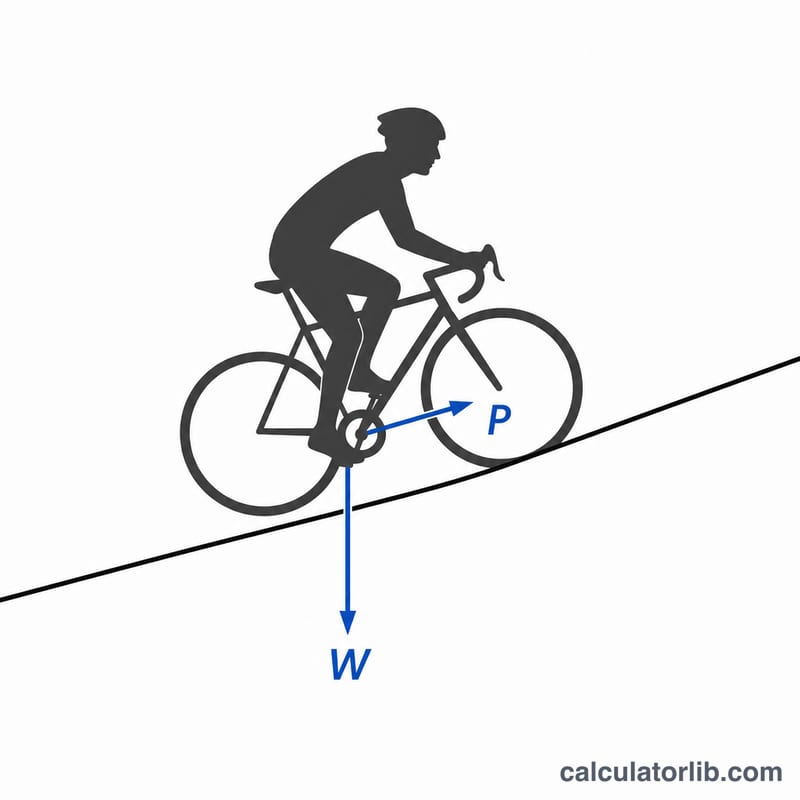
Power-to-weight ratio (W/kg) is one of the most important performance metrics in cycling. It expresses how many watts of power a rider produces for each kilogram of body weight. Because gravity scales with mass, W/kg is especially decisive on climbs — two riders with the same raw wattage will perform very differently if one weighs significantly less. A higher ratio means faster climbing and better all-round cycling fitness relative to your size.
How to Use the Calculator
Enter your power output in watts and your body weight in kilograms, then read your W/kg result. For the most meaningful comparison, use your Functional Threshold Power (FTP) — the highest average power you can sustain for about an hour — as the power value. If you weigh yourself in pounds, divide by 2.205 to convert to kilograms first.
The Formula Explained
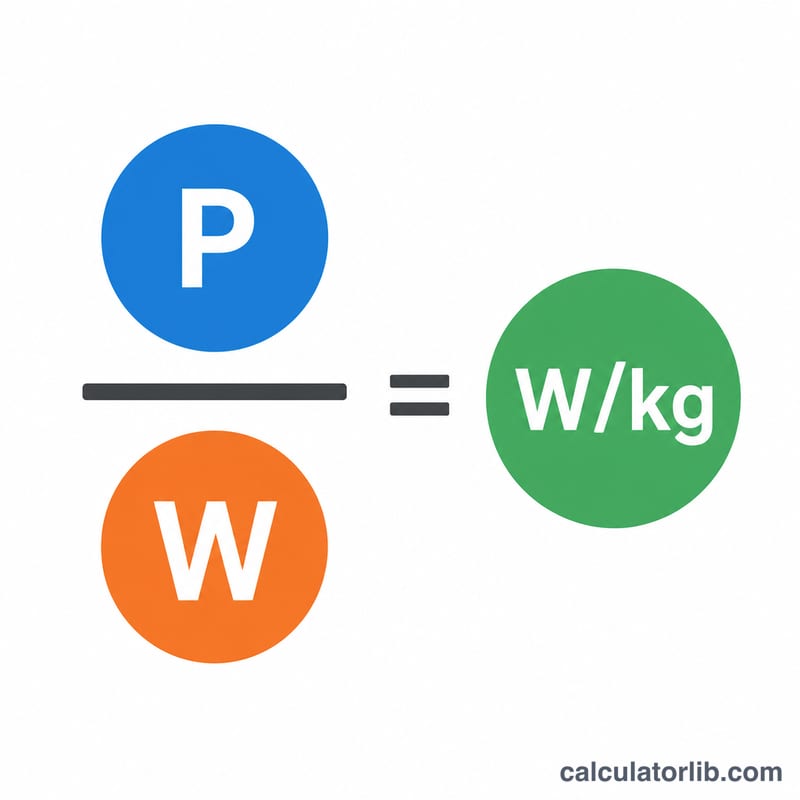
The calculation is simply:
$$\text{W/kg} = \dfrac{\text{Power (watts)}}{\text{Weight (kg)}}$$
If your power is 280 watts and you weigh 70 kg, your ratio is \(280 \div 70 = 4.0\) W/kg. As a rough guide, recreational riders sit around 2–3 W/kg at threshold, strong club racers reach 3.5–4.5 W/kg, and elite professionals can exceed 6 W/kg for sustained efforts.
Worked Example
Suppose a rider holds an FTP of 250 watts and weighs 70 kg. Their power-to-weight ratio is \(250 \div 70 = 3.57\) W/kg — a solid amateur figure. Losing 5 kg of body weight (to 65 kg) at the same power would raise the ratio to \(250 \div 65 = 3.85\) W/kg, showing why both training and weight matter.
FAQ
Should I use FTP or sprint power? Use FTP for climbing and endurance comparisons. Short sprint power gives a different ratio used for explosive efforts.
Why does weight matter so much? On flat ground aerodynamics dominate, but on climbs you fight gravity, which is proportional to mass — so a better W/kg directly translates to faster ascents.
What is a good W/kg? It depends on duration. For a 20–60 minute effort, 3 W/kg is fit, 4 W/kg is competitive amateur, and 5+ W/kg is approaching elite level.