
What is the Barbell Plate Calculator?
This tool tells you exactly which weight plates to slide onto each side of a barbell to hit a target weight. Loading a bar is a small math problem every lifter solves dozens of times per workout — this calculator does it instantly and removes the guesswork, especially when fatigue sets in between heavy sets.
How to use it
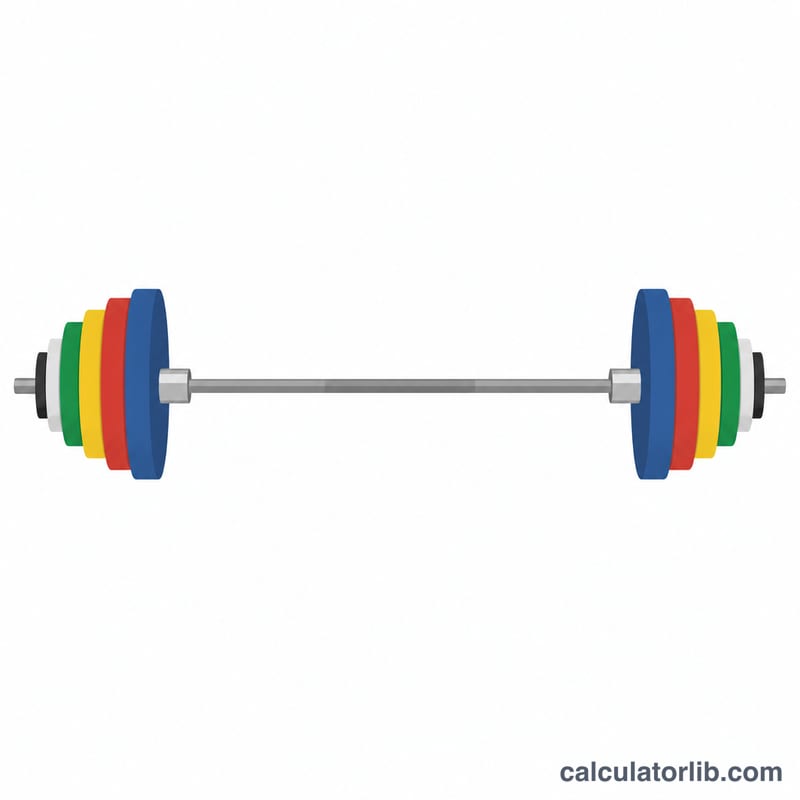
Enter your target weight (the total you want the loaded bar to weigh) and your bar weight (an Olympic barbell is typically 45 lb; women's bars are often 35 lb). The calculator subtracts the bar, splits the remainder evenly between both ends, and lists the plates for one side using a standard plate set: 45, 35, 25, 10, 5 and 2.5 lb.
The formula explained
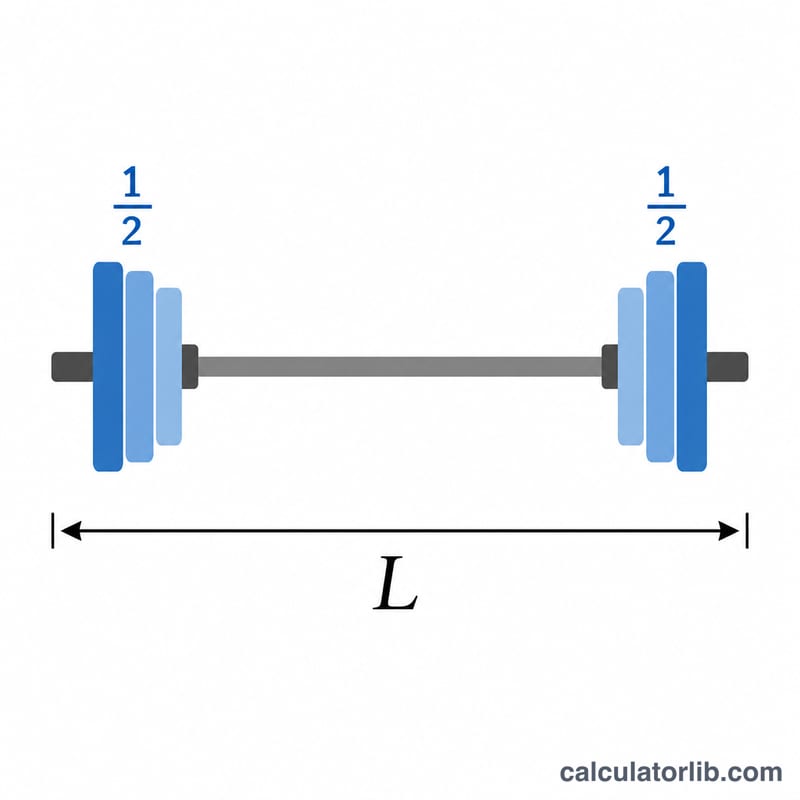
First we find the weight per side: \(\text{per side} = \frac{\text{target} - \text{bar}}{2}\). Then a greedy algorithm fills that amount starting from the largest plate. For each plate size it takes as many as fit, subtracts their weight, and moves to the next smaller size:
$$n_i = \left\lfloor \frac{r}{d_i} \right\rfloor,\quad r \leftarrow r - n_i d_i$$Any leftover that no plate can cover is reported as "unmatched" — a hint that your target isn't reachable with the available plates (try a multiple of 5 lb).
Worked example
Target 225 lb with a 45 lb bar:
$$\text{plates per side} = \frac{225 - 45}{2} = 90 \text{ lb per side}$$The greedy fill gives \(2 \times 45 \text{ lb} = 90 \text{ lb}\) per side, exactly. The total loaded weight is \(45 + 2 \times 90 = 225\) lb, the classic two-plates-a-side benchmark.
FAQ
Why is there an "unmatched" value? If your target minus the bar isn't divisible into the available plates (e.g. an odd half-pound), the leftover appears here so you know the exact weight can't be loaded.
What bar weight should I use? Standard Olympic bars are 45 lb. Use 35 lb for many women's bars, 15 lb for technique bars, or 0 to ignore the bar entirely.
Does this support kilograms? The plate set here is in pounds. Enter pound values for accurate plate recommendations.