
What is the Safe Period (Rhythm) Calculator?
The rhythm method, also called the calendar method, is a natural family-planning technique that estimates the days in your menstrual cycle when pregnancy is more or less likely. This calculator identifies your fertile window — the days you should avoid unprotected intercourse if you are trying not to conceive — and the relatively safe days on either side of it. It is a universal biological estimate and does not depend on any country or region.
How to Use It
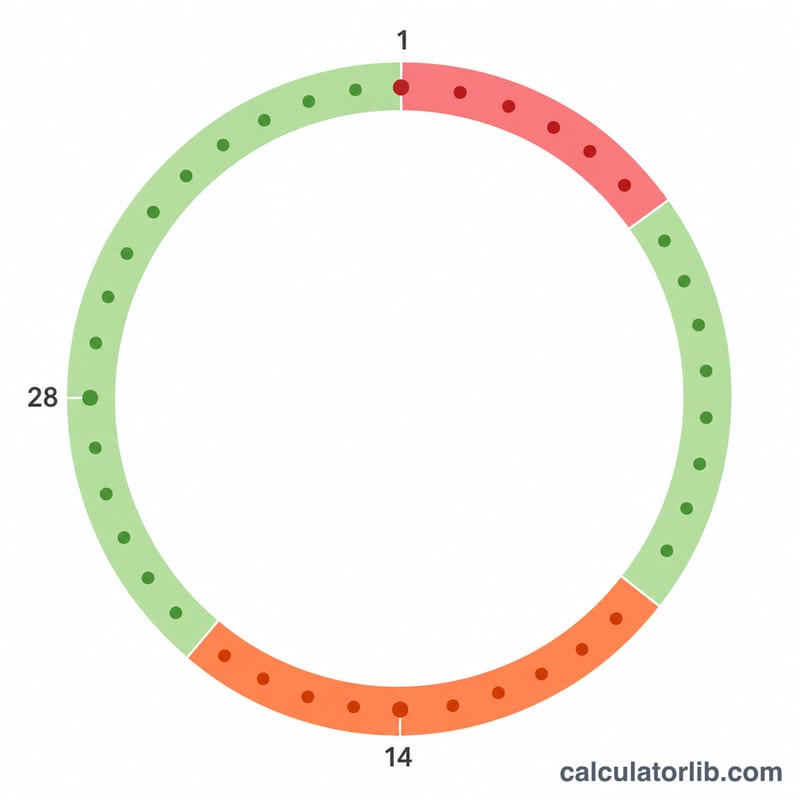
Track several cycles and enter your average cycle length (the number of days from the first day of one period to the first day of the next). Day 1 is always the first day of menstrual bleeding. The calculator returns your fertile range and your safe ranges as cycle-day numbers, which you can map onto your calendar starting from the first day of your last period.
The Formula Explained
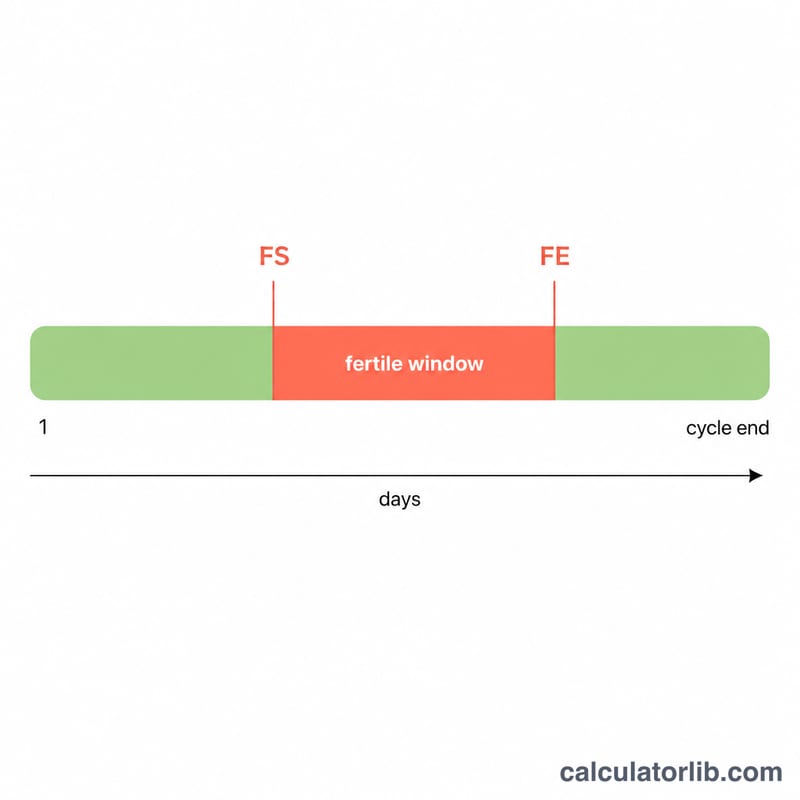
Ovulation typically occurs about 14 days before the next period, and sperm can survive several days, so the standard rhythm formula marks the fertile window as cycle day (length − 18) through (length − 11). Everything before the start day and after the end day (up to your cycle length) is considered comparatively safe.
$$\text{Fertile} = (\text{Cycle}-18) \;\text{to}\; (\text{Cycle}-11)$$
$$\text{Start} = \text{Cycle Length} - 18$$
$$\text{End} = \text{Cycle Length} - 11$$
Worked Example
For a regular 28-day cycle: fertile start = $$28 - 18 = 8$$ day 8, fertile end = $$28 - 11 = 17$$ day 17. So days 1–7 and days 18–28 are the safe days, while days 8–17 are fertile and should be avoided for contraception.
FAQ
Is the rhythm method reliable? It is one of the less reliable contraceptive methods, with typical-use failure rates around 12–24%. It works best for those with very regular cycles and should not be relied on alone if avoiding pregnancy is critical.
What if my cycle is irregular? The calendar method is unreliable for irregular cycles. Consider tracking basal body temperature and cervical mucus, or consult a healthcare professional.
Does a "safe day" mean zero risk? No. Sperm survival and ovulation timing vary, so safe days carry a reduced — but not zero — chance of pregnancy.