
What this calculator does
The Menstrual Period Calculator estimates when your next period is likely to begin, the most probable day of ovulation, and your fertile window. It uses the first day of your last period and your typical cycle length. These are estimates based on a regular cycle — they are not a substitute for medical advice or a reliable form of contraception.
How to use it
Enter the first day of your last period, your average cycle length (the number of days from the start of one period to the start of the next, commonly 28), and how many days your bleeding usually lasts. The calculator returns your predicted next period date, ovulation day, fertile window, and when your current period is likely to end.
The formula explained
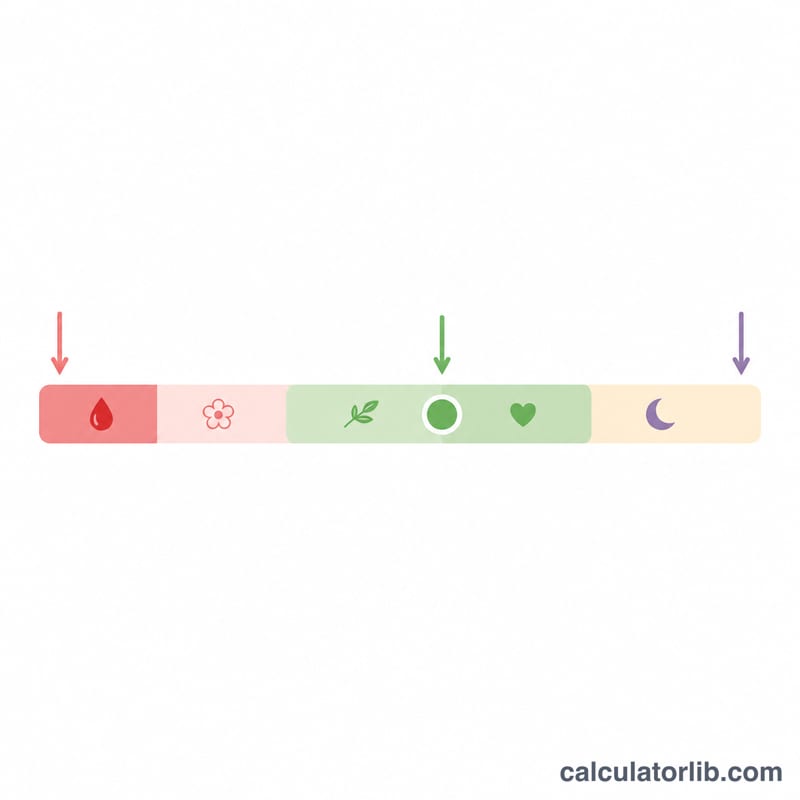
The next period start is simply the last period date plus the cycle length: $$\text{Next Period} = \text{Last Period} + \text{Cycle Length}$$ a 28-day cycle starting January 1 gives January 29. Ovulation is estimated as 14 days before the next period (the luteal phase is fairly constant): $$\text{Ovulation} = \text{Next Period} - 14$$ and the fertile window spans roughly 5 days before ovulation through 1 day after, reflecting sperm and egg viability.
Worked example
Last period: January 1, 2024. Cycle length: 28 days. $$\text{Next period} = \text{Jan 1} + 28 = \text{January 29, 2024}$$ $$\text{Ovulation} = \text{Jan 29} - 14 = \text{January 15, 2024}$$ Period duration 5 days means bleeding ends on January 5, 2024.
FAQ
Is this accurate if my cycle is irregular? No — predictions assume a consistent cycle length. With irregular cycles, treat results as a rough guide.
Can I use it as birth control? No. The fertile window is an estimate and should not be relied on to prevent pregnancy.
What cycle length should I enter? Most cycles range from 21 to 35 days; 28 is the common default. Track several cycles and use the average.