
What Is the Horse Weight Calculator?
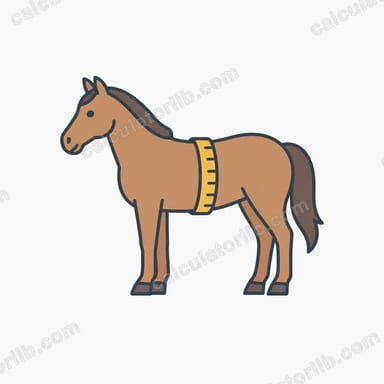
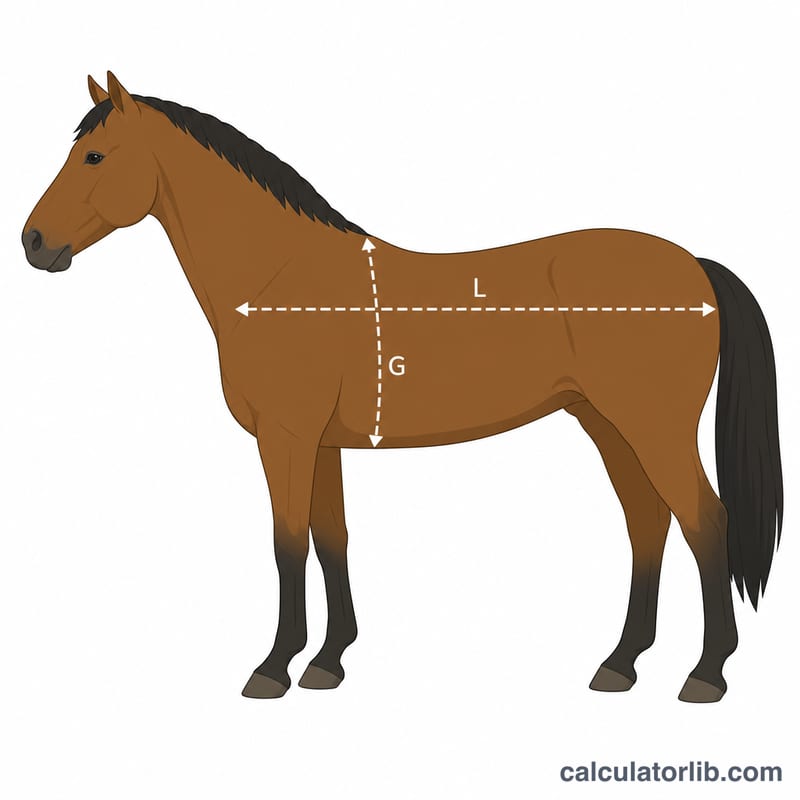
The Horse Weight Calculator estimates an adult horse's body weight using two simple tape measurements: the heart girth (the circumference of the body just behind the front legs and withers) and the body length (from the point of the shoulder to the point of the buttock). Knowing your horse's weight is essential for accurate feeding, deworming, and medication dosing, since many products are dosed by body weight.
How to Use It
Measure your horse with a flexible tape while it stands square on level ground. Take the heart girth all the way around the barrel, and measure body length from the point of the shoulder to the point of the buttock. Enter both values in inches and the calculator returns the estimated weight in pounds and kilograms.
The Formula Explained
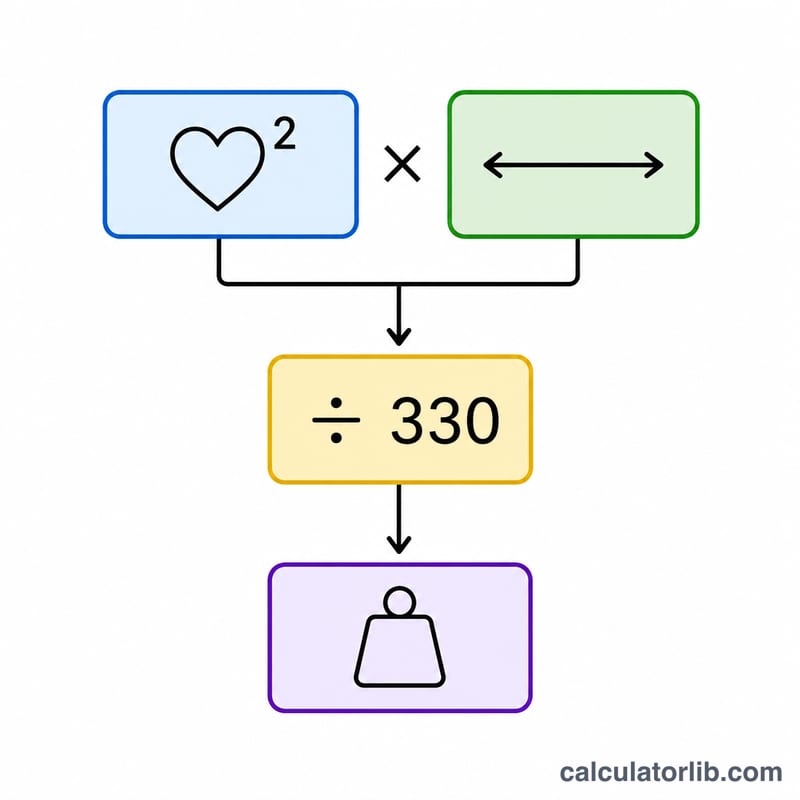
The estimate uses the standard weight tape equation:
$$\text{Weight (lb)} = \dfrac{\text{Heart Girth}^2 \times \text{Body Length}}{330}$$
The heart girth is squared because it approximates the cross-sectional area of the horse's body, while the body length scales that area into a volume. Dividing by 330 converts the result into pounds and accounts for average equine body density. This formula works best for mature, average-conditioned horses; ponies, draft breeds, and foals use different divisors.
Worked Example
Suppose a horse has a heart girth of 75 inches and a body length of 70 inches. Then: \(75^2 = 5{,}625\), multiplied by 70 = 393,750, divided by 330 ≈ 1,193 lb (about 541 kg). That is a typical weight for a light riding horse.
$$\frac{75^2 \times 70}{330} = \frac{393{,}750}{330} \approx 1{,}193 \text{ lb}$$
FAQ
How accurate is it? For average adult horses it is typically within 10% of a scale reading — close enough for feeding and most dosing decisions.
Can I use it for ponies or draft horses? The divisor of 330 is tuned for average horses. Ponies and draft breeds have different conformation, so treat the result as a rough guide.
Where do I measure the heart girth? Wrap the tape snugly around the barrel just behind the elbows and over the lowest part of the withers, taking the reading after the horse exhales.