What is the Pediatric Ceftriaxone Dosage Calculator?
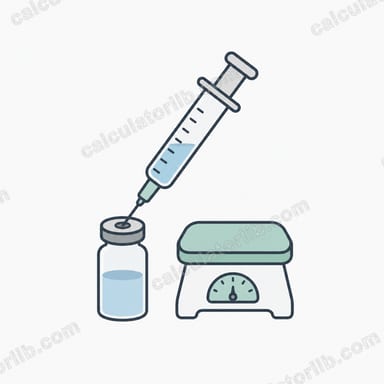
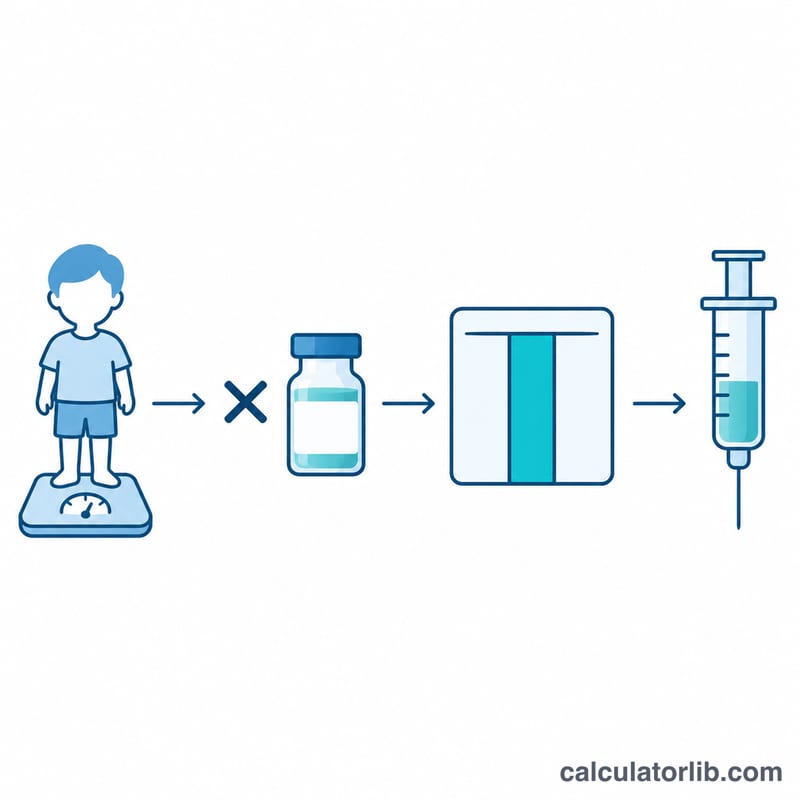
This tool estimates a child's daily ceftriaxone dose from body weight and the clinical indication, then converts that dose into a volume to draw up based on the reconstituted concentration. Ceftriaxone is a third-generation cephalosporin dosed on a milligram-per-kilogram basis, so the correct amount depends directly on the patient weight and the infection being treated.
How to use it
Enter the child weight in kilograms, choose the indication (which sets the mg/kg/day rate and the daily maximum), and enter the concentration of your reconstituted vial in mg/mL. The calculator returns the total daily dose in milligrams and the equivalent volume in milliliters.
The formula explained
The daily dose multiplies weight \(W\) by the dosing rate \(D\) in mg/kg/day, but never exceeds the maximum daily dose \(D_{\max}\):
$$\text{Dose (mg)} = \min(W \times D,\ D_{\max})$$The volume uses the vial concentration \(C\) in mg/mL:
$$V = \frac{\text{Dose (mg)}}{C}$$Typical rates are \(50\) mg/kg/day for standard infections, \(75\) for severe infections, and \(100\) for meningitis, with a 2000 mg cap for most indications and 4000 mg for meningitis.
Worked example
A 20 kg child with a standard infection at a concentration of 100 mg/mL:
$$20 \times 50 = 1000\,\text{mg}$$Because 1000 mg is below the 2000 mg cap, the dose stays at 1000 mg. The volume is:
$$V = \frac{1000}{100} = 10\,\text{mL}$$Dose and Volume Across Weights and Indications
The calculator multiplies the child's weight by the mg/kg/day rate for the indication you select, then caps the result at the maximum daily dose. The table uses three commonly cited pediatric ceftriaxone rates: 50 mg/kg/day for standard dosing, 75 mg/kg/day for the upper end of the usual range, and 100 mg/kg/day for meningitis. It uses a 2000 mg/day cap for the first two and a 4000 mg/day cap for meningitis. Check the indication labels in the calculator to see which rate each option uses.
The volume is the final dose divided by the concentration. The table shows two example concentrations: 100 mg/mL and 250 mg/mL. The concentration of your prepared solution depends on the product and the diluent volume, so always use the concentration on your actual preparation.
| Weight (kg) | Rate (mg/kg/day) | Weight × rate (mg) | Final daily dose (mg) | Volume at 100 mg/mL (mL) | Volume at 250 mg/mL (mL) | Cap applied? |
|---|---|---|---|---|---|---|
| 5 | 50 | 250 | 250 | 2.5 | 1 | No |
| 10 | 50 | 500 | 500 | 5 | 2 | No |
| 20 | 50 | 1000 | 1000 | 10 | 4 | No |
| 30 | 50 | 1500 | 1500 | 15 | 6 | No |
| 40 | 50 | 2000 | 2000 | 20 | 8 | No (exactly at the cap) |
| 50 | 50 | 2500 | 2000 | 20 | 8 | Yes, capped at 2000 mg |
| 5 | 75 | 375 | 375 | 3.75 | 1.5 | No |
| 10 | 75 | 750 | 750 | 7.5 | 3 | No |
| 20 | 75 | 1500 | 1500 | 15 | 6 | No |
| 30 | 75 | 2250 | 2000 | 20 | 8 | Yes, capped at 2000 mg |
| 40 | 75 | 3000 | 2000 | 20 | 8 | Yes, capped at 2000 mg |
| 50 | 75 | 3750 | 2000 | 20 | 8 | Yes, capped at 2000 mg |
| 5 | 100 | 500 | 500 | 5 | 2 | No |
| 10 | 100 | 1000 | 1000 | 10 | 4 | No |
| 20 | 100 | 2000 | 2000 | 20 | 8 | No |
| 30 | 100 | 3000 | 3000 | 30 | 12 | No |
| 40 | 100 | 4000 | 4000 | 40 | 16 | No (exactly at the cap) |
| 50 | 100 | 5000 | 4000 | 40 | 16 | Yes, capped at 4000 mg |
Example of a capped row: a 50 kg child at 50 mg/kg/day gives \(50 \times 50 = 2500\) mg. That is above the cap, so the result is \(\min(2500,\ 2000) = 2000\) mg. At 100 mg/mL, that is \(2000 \div 100 = 20\) mL. At 250 mg/mL, it is \(2000 \div 250 = 8\) mL.
Example of an uncapped row: a 20 kg child at 50 mg/kg/day gives \(20 \times 50 = 1000\) mg. At 100 mg/mL, that is \(1000 \div 100 = 10\) mL.
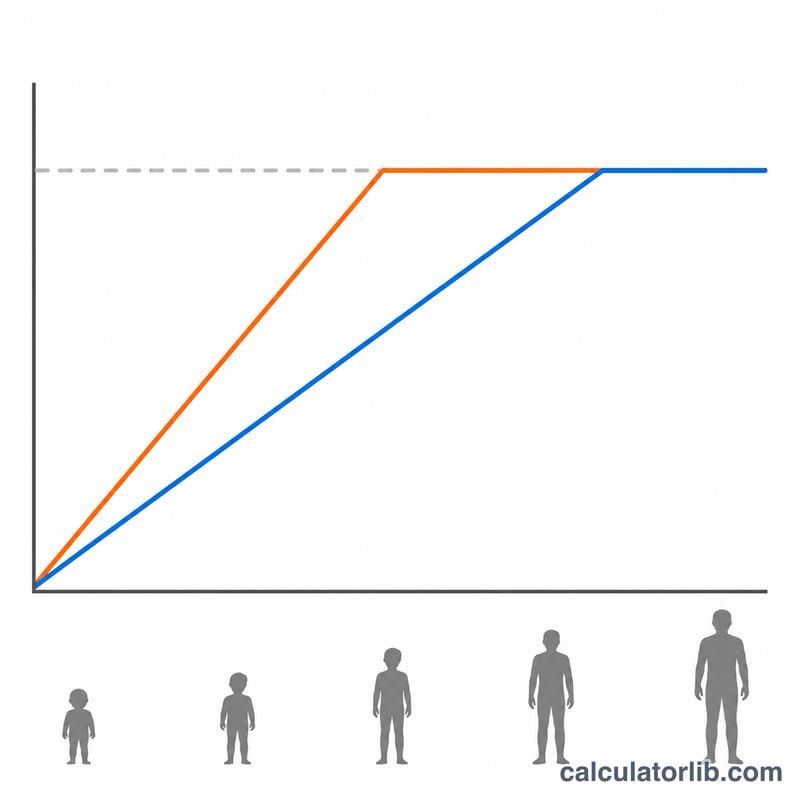
Once the cap is reached, a heavier child gets the same dose as a lighter one. For example, at 75 mg/kg/day, every weight from about 26.7 kg upward (\(2000 \div 75\)) gets 2000 mg.
Interpreting Your Result
The mg result is a 24-hour total. The dose is the total amount of ceftriaxone for one day, not the amount for each injection or infusion. Ceftriaxone is often given once daily. It can also be split into two doses about 12 hours apart, which is common for meningitis-range dosing. If the daily total is split into two doses, each dose is half the total:
$$\text{Each dose (mg)} = \frac{\text{Daily dose (mg)}}{2}$$For example, a daily total of 4000 mg given in two doses is \(4000 \div 2 = 2000\) mg per dose. The volume for each dose is also half the daily volume. At 100 mg/mL, that is \(2000 \div 100 = 20\) mL per dose.
A capped result means the maximum was used. If the weight × rate amount is more than the maximum daily dose (2000 mg, or 4000 mg for the meningitis option), the calculator returns the maximum instead. A capped result is not a calculation error. It means the weight-based dose would have gone over the usual daily maximum. This mostly happens for older or heavier children, whose dosing then matches adult limits.
The volume depends entirely on the concentration you enter. The same mg dose can be very different volumes. For example, 1000 mg is 10 mL at 100 mg/mL but only 4 mL at 250 mg/mL. Use the concentration of the solution you actually prepared. That concentration depends on the vial strength, the diluent and how much diluent was added. If the concentration you enter does not match the preparation, the mL result will be wrong, even though the mg dose is right.
Check the inputs. Make sure the weight is in kilograms, not pounds, and is a current measured weight. Make sure the indication you selected matches the clinical situation. Ceftriaxone needs special care in newborns. The FDA label contraindicates it in newborns with high bilirubin (hyperbilirubinemia), in premature newborns up to 41 weeks postmenstrual age, and in newborns 28 days or younger who need, or may need, calcium-containing IV solutions, including parenteral nutrition. In any patient it must never be given at the same time as calcium-containing IV solutions through the same line or a Y-site. Tick the "Newborn 28 days old or younger" box to show these warnings with the result; the weight-based formula itself does not change for newborns.
Important: This tool is a calculation aid for general information. It is not medical advice. It does not replace the prescriber's order, local protocols, the product labeling, or checking by a pharmacist or prescriber. Every dose should be independently double-checked before it is given.
FAQ
Does it cap the dose? Yes. If weight times the rate exceeds the daily maximum, the result is limited to that maximum.
What concentration should I use? Use the actual concentration of your reconstituted product, commonly 100, 250, or 350 mg/mL.
Is this a substitute for clinical judgment? No. Always confirm dosing against current guidelines and a pharmacist before administration.