What is the Canine Fluid Therapy Calculator?
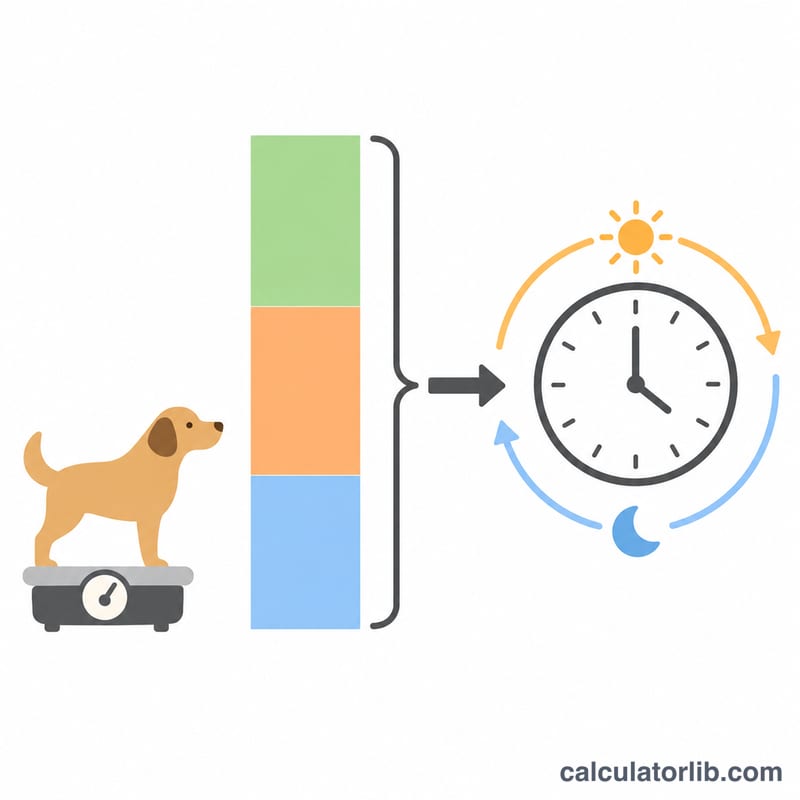
This tool estimates how much intravenous (IV) fluid a dog needs over 24 hours and converts that volume into a practical drip rate. It combines three components used in veterinary practice: normal maintenance needs, replacement of an existing dehydration deficit, and compensation for ongoing losses such as vomiting or diarrhea.
How to use it
Enter the dog body weight in kilograms, the estimated dehydration as a percentage (typically 5 to 12 percent based on clinical signs), any ongoing losses in mL per day, a maintenance rate (leave it blank to use the Merck Veterinary Manual formula \(132 \times BW^{0.75}\) mL/day), and the drop factor printed on your IV administration set. The calculator returns the maintenance volume, deficit, total 24-hour volume, hourly infusion rate, and the final drops-per-minute rate.
The formula explained
Let \(W\) be weight in kg, \(R_m\) the maintenance rate, \(V_o\) ongoing losses, and \(f\) the drop factor. The dehydration deficit is
$$V_d = W \times \%_{\text{dehy}} \times 10$$and the total daily volume and drip rate are
$$V_{24} = (R_m \times W) + V_d + V_o, \qquad \text{drops/min} = \frac{V_{24}\times f}{1440}$$where 1440 is the number of minutes in 24 hours.
Worked example
A 20 kg dog that is 5 percent dehydrated with no ongoing losses, at 60 mL/kg/day with a 15 drops/mL set:
$$V_m = 60 \times 20 = 1200\,\text{mL}$$ $$V_d = 20 \times 5 \times 10 = 1000\,\text{mL}$$ $$V_{24} = 1200 + 1000 = 2200\,\text{mL}$$ $$\text{rate} = \frac{2200}{24} \approx 91.7\,\text{mL/hr}$$ $$\text{drops/min} = \frac{2200 \times 15}{1440} \approx 22.9$$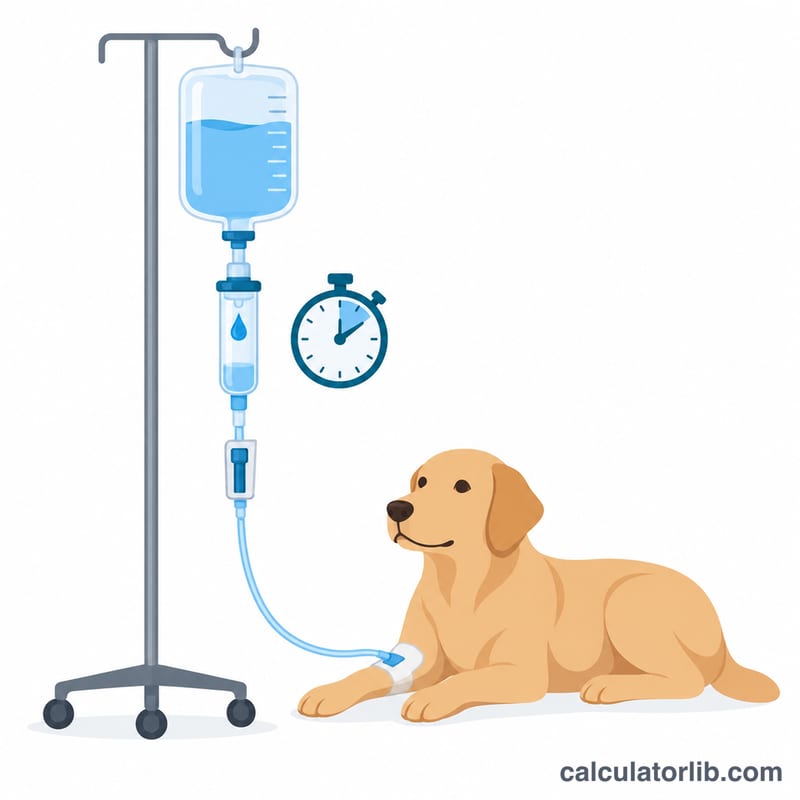
Estimating Percent Dehydration from Clinical Signs
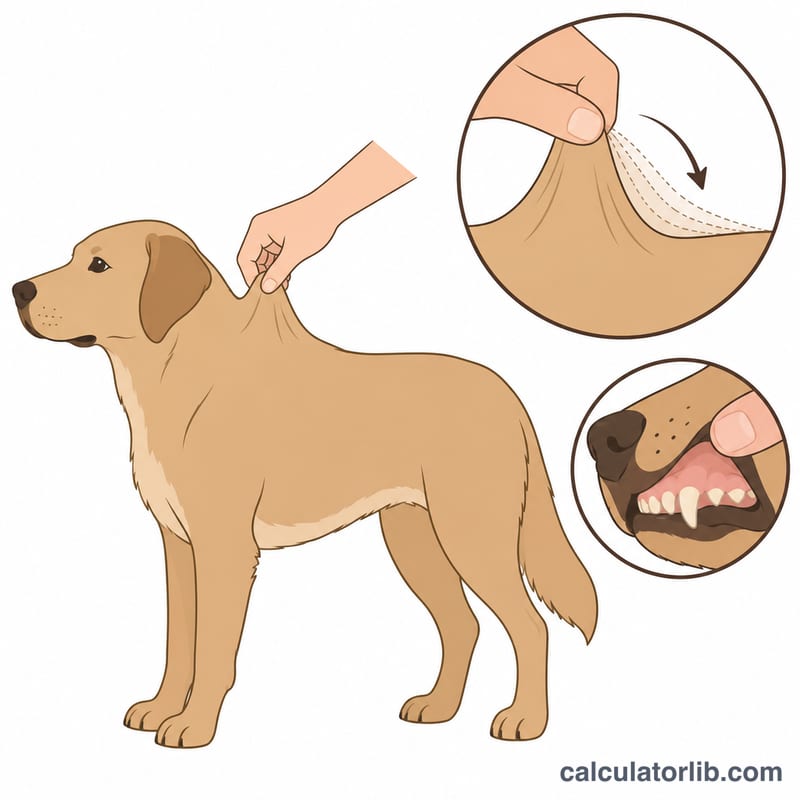
The dehydration percentage you enter in the calculator is usually estimated from a physical exam. The rows below follow Table 1-5 of Kirk and Bistner's Handbook of Veterinary Procedures and Emergency Treatment. They are rough clinical estimates, not measurements. Signs vary with age, body condition and other illness. For example, skin elasticity is naturally lower in older or thin dogs, and obese dogs can look better hydrated than they are. Use this table to learn the terms. It is not a way to diagnose your dog.
| Estimated dehydration | Typical clinical findings |
|---|---|
| 4% | History of vomiting and diarrhea, no visible clinical signs of deficit |
| 5% | Dry mucous membranes, mild skin tenting |
| 7% | Increased skin tenting, dry mucous membranes, mild tachycardia, normal pulse |
| 10% | Increased skin tenting, dry mucous membranes, tachycardia, weak pulse pressure |
| 12% | Increased skin tenting, dry corneas, dry mucous membranes, elevated or decreased heart rate, poor pulse quality, altered level of consciousness |
The calculator converts the estimate into a fluid deficit using \(V_d = W \times \text{Dehydration (\%)} \times 10\). This works because 1 kg of body weight lost as water is about 1,000 mL. For example, a 20 kg dog estimated at 8% dehydrated has a deficit of \(20 \times 8 \times 10 = 1600\) mL. A dog showing signs of shock needs emergency veterinary care. Shock is treated differently from routine replacement of a dehydration deficit.
Kirk and Bistner's table stops at 12%. At 10 to 12% a veterinarian checks for shock first, and dehydration above 12% is an emergency. If the dog is in shock, the veterinarian starts IV crystalloid fluids at one fourth of a calculated shock dose (90 mL/kg/hour in dogs) and reassesses perfusion before any rehydration plan. The calculator's 24-hour plan should never be the only treatment.
Kirk and Bistner add the dehydration deficit to maintenance and give it over 24 hours; the calculator's main drip rate follows that plan. The Merck Veterinary Manual says the rehydration volume is commonly given over 4 to 12 hours, so the result also shows the infusion rate when the deficit is replaced over 12 hours. Reassess hydration, body weight and ongoing losses regularly.
Typical Maintenance Fluid Rates for Dogs
Maintenance fluids replace the water a healthy, hydrated dog loses each day through urine, feces, breathing and skin. The Merck Veterinary Manual gives two formulas for the daily maintenance volume of a dog:
| Method | Canine value | Notes |
|---|---|---|
| Linear formula | \(30 \times BW + 70\) mL/day | For dogs and cats weighing 2 to 70 kg |
| Allometric formula | \(132 \times BW^{0.75}\) mL/day | BW = body weight in kg; based on metabolic body size |
A linear mL/kg rate assumes water needs rise in direct proportion to body weight. In reality, water needs follow metabolic rate, which grows more slowly than body weight. Small dogs therefore need more fluid per kilogram than large dogs. Dividing the allometric result by body weight shows the effect:
| Body weight | Allometric \(132 \times BW^{0.75}\) | Per kilogram of body weight |
|---|---|---|
| 5 kg | \(132 \times 5^{0.75} \approx 132 \times 3.344 \approx 441\) mL/day | about 88 mL/kg/day |
| 10 kg | \(132 \times 10^{0.75} \approx 132 \times 5.623 \approx 742\) mL/day | about 74 mL/kg/day |
| 40 kg | \(132 \times 40^{0.75} \approx 132 \times 15.91 \approx 2100\) mL/day | about 52 mL/kg/day |
If you leave the maintenance rate blank, the calculator uses the allometric formula; to compare it with a rate in mL/kg/day, divide the daily volume by the dog's weight. For a 10 kg dog, that is \(742 \div 10 \approx 74\) mL/kg/day. These figures describe published reference ranges only. They are general information, not veterinary advice. A veterinarian sets the actual fluid plan based on the dog's condition, and especially on heart and kidney function.
Common IV Administration Set Drop Factors
The drop factor (gtt/mL) is the number of drops an IV administration set delivers per millilitre. It depends on the size of the set's drip chamber opening. To convert an hourly rate into drops per minute:
$$\text{drops/min} = \frac{\text{mL/hr} \times \text{DF}}{60}$$The table shows drops per minute for an example rate of 100 mL/hr. For a 40 kg dog on 60 mL/kg/day with no deficit or ongoing losses, the total is \(40 \times 60 = 2400\) mL/day, which is 100 mL/hr. On a 15 gtt/mL set that gives 25 drops/min.
| Set type | Drop factor (gtt/mL) | Calculation at 100 mL/hr | Drops/min |
|---|---|---|---|
| Macrodrip | 10 | \(100 \times 10 \div 60\) | ≈16.7 |
| Macrodrip | 15 | \(100 \times 15 \div 60\) | 25 |
| Macrodrip | 20 | \(100 \times 20 \div 60\) | ≈33.3 |
| Microdrip (pediatric) | 60 | \(100 \times 60 \div 60\) | 100 |
With a 60 gtt/mL microdrip set, the factor of 60 cancels. Drops per minute then equal millilitres per hour, so 100 mL/hr is 100 drops/min. Microdrip sets are often used for small dogs and puppies because slow rates are easier to count and adjust. Macrodrip sets are more practical for large dogs and high rates. Drop factors vary by manufacturer, so always check the value printed on your own set's packaging before calculating a drip rate. If an infusion pump is used, it is programmed in mL/hr, and the drop factor is not needed.
FAQ
How is percent dehydration estimated? It is judged from clinical signs such as skin tent, mucous membrane moisture, and eye position; around 5 percent is mild and 10 to 12 percent is severe.
Can I replace the deficit faster? Yes. This tool spreads the deficit evenly over 24 hours, but critical patients may receive it more quickly under veterinary supervision.
Is this a substitute for veterinary judgment? No. It is an educational aid, so always confirm any fluid plan with a licensed veterinarian.