What is the Cattle Average Daily Gain Calculator?
Average daily gain (ADG) is one of the most important performance measures in beef production. It tells you how many kilograms an animal, or a pen of animals, gains each day over a feeding period. This calculator takes a start weight, an end weight and the number of days between the two weigh-ins, then reports the ADG, the total weight gained, and a projection of how many more days are needed to reach a target finishing weight.
How to use it
Weigh the animal at the start of the period and again at the end, ideally at the same time of day to reduce gut-fill variation. Enter the start weight, the end weight, the number of days on feed, and the target weight you want to reach. The calculator does the rest, giving you a clear daily gain figure and a finishing-date projection you can use for planning feed, marketing and sale dates.
The formula explained
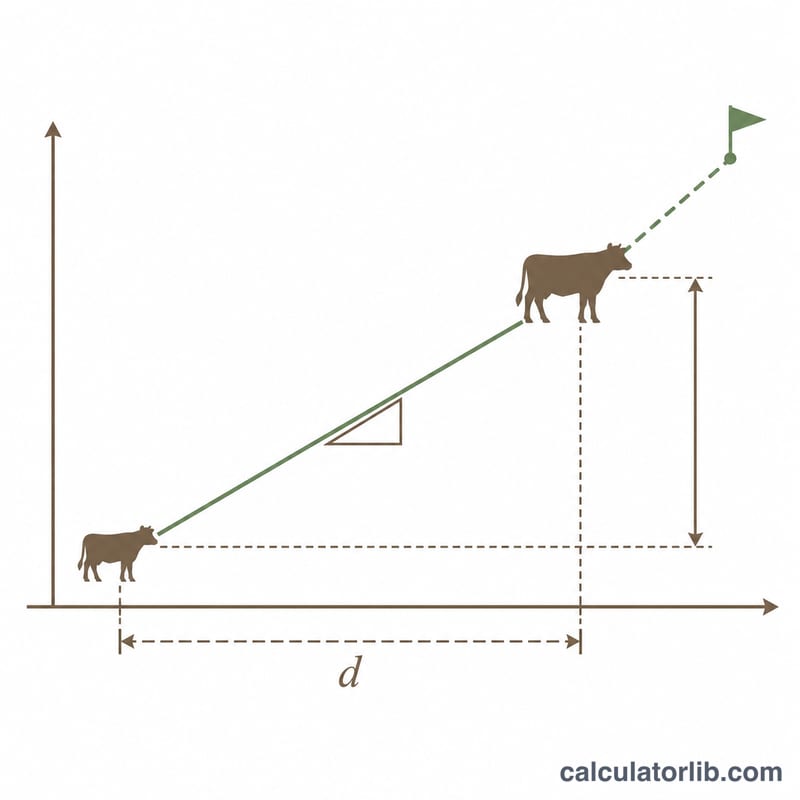
Average daily gain is simply the total weight change divided by the number of days:
$$\text{ADG} = \frac{W_{end} - W_{start}}{t}$$
where \(W_{end}\) = end weight in kg, \(W_{start}\) = start weight in kg, and \(t\) = days on feed. To project when the animal reaches a target weight \(W_{target}\), the remaining weight is divided by the current ADG:
$$t_{target} = \frac{W_{target} - W_{end}}{\text{ADG}}$$
Worked example
Suppose a steer starts at 250 kg and weighs 400 kg after 100 days, with a target of 550 kg. The total gain is \(400 - 250 = 150\) kg, so:
$$\text{ADG} = \frac{400 - 250}{100} = 1.5\,\text{kg/day}$$
At that rate the days needed to reach 550 kg are:
$$t_{target} = \frac{550 - 400}{1.5} = 100\,\text{days}$$
Typical ADG Ranges by Production Stage
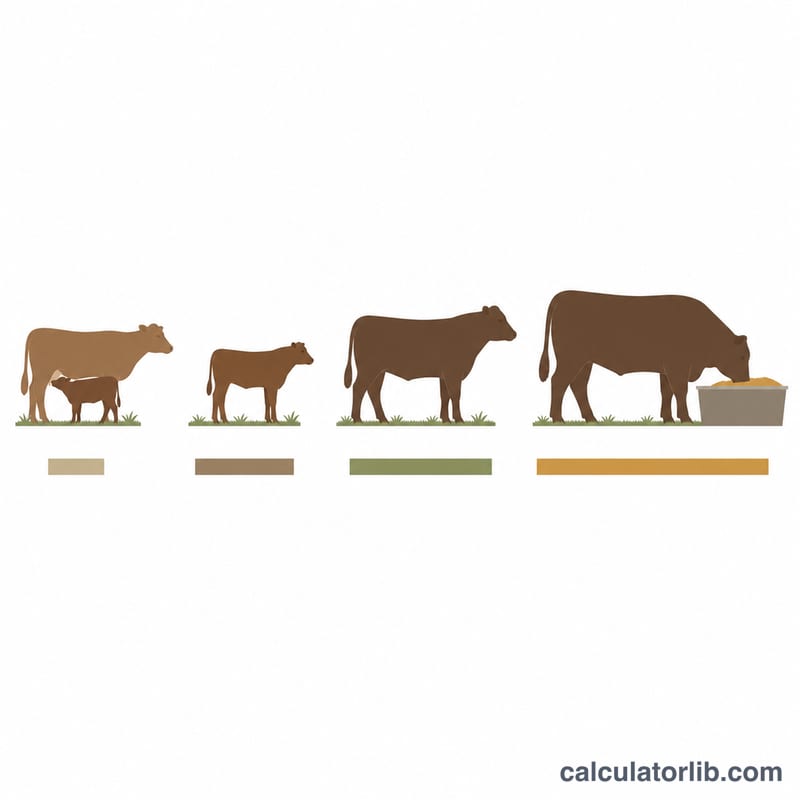
The ranges below are rough benchmarks. They are compiled from widely used beef extension guidance from US land-grant universities (for example Oklahoma State, Nebraska, Kansas State and Texas A&M) and from the nutrient-requirement framework in the NASEM (formerly NRC) Nutrient Requirements of Beef Cattle. These are general figures for common beef production systems, mostly in North America. They are not regulatory standards, and gains in your region may differ. Pound values are converted from kilograms and rounded (1 kg ≈ 2.2046 lb).
| Production stage | Typical ADG (kg/day) | Typical ADG (lb/day) | Notes |
|---|---|---|---|
| Pre-weaning calves (nursing) | 0.7 – 1.1 | 1.5 – 2.4 | Mostly driven by the dam's milk yield, the calf's genetics and the forage available. Creep feeding can push gains toward the upper end. |
| Backgrounding / stocker cattle on pasture or forage | 0.5 – 1.0 | 1.1 – 2.2 | Varies a lot with forage quality and season. Dormant or low-quality forage without supplement can give gains below this range. |
| Growing rations (drylot, moderate energy) | 0.9 – 1.4 | 2.0 – 3.1 | Rations are often limited on purpose to build frame before finishing. |
| Feedlot finishing (high-concentrate) | 1.4 – 1.8 | 3.1 – 4.0 | Steers usually gain faster than heifers. Gain tends to fall in the final weeks on feed. |
| Replacement heifers (weaning to breeding) | 0.45 – 0.7 | 1.0 – 1.5 | Gain is planned so heifers reach a target share of mature weight by breeding, often about 55–65%. Fast gain that makes heifers fat is not the goal. |
What shifts these ranges:
- Breed and frame size: larger-framed and continental-cross cattle usually gain faster than small-framed animals.
- Sex: intact bulls gain faster than steers, and steers gain faster than heifers.
- Diet: energy density, protein and the use of feed additives or growth implants (where they are legal) all matter.
- Health: respiratory disease and parasites cut gain.
- Environment: heat stress, cold, mud and wind all raise maintenance needs or reduce intake.
Use these figures as a starting point. Your own herd records, local extension advice and your nutritionist's ration targets are better benchmarks.
Interpreting Your ADG and Days-to-Target Result
Comparing with the stage ranges. Find the production stage that matches your cattle in the table above, then see where your ADG falls:
- Inside the range: the cattle are performing as expected for that system.
- Well below the range: check forage quality and quantity, ration energy and protein, water supply, health problems (parasites, respiratory disease, lameness) and weather stress.
- Above the range: this can be good, for example compensatory gain after a restricted period. It can also be inflated by the weighing conditions described below.
Example. A steer weighs 300 kg at the start and 342 kg after 35 days. The target weight is 400 kg.
$$\text{ADG} = \frac{342 - 300}{35} = \frac{42}{35} = 1.2\ \text{kg/day}$$The ADG is 1.2 kg/day (about 2.6 lb/day). That is typical of a growing ration.
$$\text{Days to Target} = \frac{400 - 342}{1.2} = \frac{58}{1.2} \approx 48.3\ \text{days}$$Constant-ADG assumption. The days-to-target figure assumes the animal keeps gaining at exactly the current ADG. In practice, gain usually slows as cattle get heavier and closer to finishing weight. More of each kilogram gained is fat rather than lean, and fat costs more energy to deposit. Intake per unit of body weight also often falls. So treat the projection as a minimum. The real time to reach the target is often longer, especially for finishing cattle. Re-weigh regularly and recalculate.
Gut fill and shrink. The contents of the rumen and gut can make up a large share of live weight. They can change by several percent within hours, depending on when the animal last ate and drank. Here is how this distorts ADG:
- An animal weighed full at the start and empty (shrunk) at the end shows less gain than it really made. The reverse inflates the gain.
- A change of diet between weighings, such as moving from lush pasture to dry feed, can change fill and create or hide apparent gain.
- Hauling, sorting and standing off feed cause shrink. Weighing at a different time of day, or after trucking, adds error.
To reduce these errors, weigh at the same time of day under the same conditions each time. Standardise access to feed and water before weighing, or apply a consistent pencil shrink. Many programmes take two weights on consecutive days for the start and end figures.
Short weigh periods. A fill error of a few kilograms is small compared with three months of gain. Over one or two weeks, though, it can be as large as the real gain. As a general guide, ADG from periods shorter than about 28 days is unreliable. Longer periods, or several weighings fitted with a trend line, give a much more trustworthy figure.
Zero or negative ADG. If the end weight equals or is below the start weight, the ADG is zero or negative. In that case the days-to-target projection is meaningless: you would be dividing by zero, or gaining toward the target is impossible at the current rate. Check for weighing errors first. If the weight loss is real, look into feed supply, health and stress before planning any marketing or breeding dates.
FAQ
What is a good ADG for beef cattle? It depends on breed, diet and age, but feedlot cattle on a finishing ration often gain between \(1.2\) and \(1.8\) kg per day, while backgrounding cattle on forage gain less.
Why is my ADG lower than expected? Common causes include gut-fill differences at weighing, poor ration quality, limited intake, heat stress or health problems.
Can I use pounds instead of kilograms? Yes. The math is unit-independent, so if you enter all weights in pounds the ADG will be returned in pounds per day.