What It Is
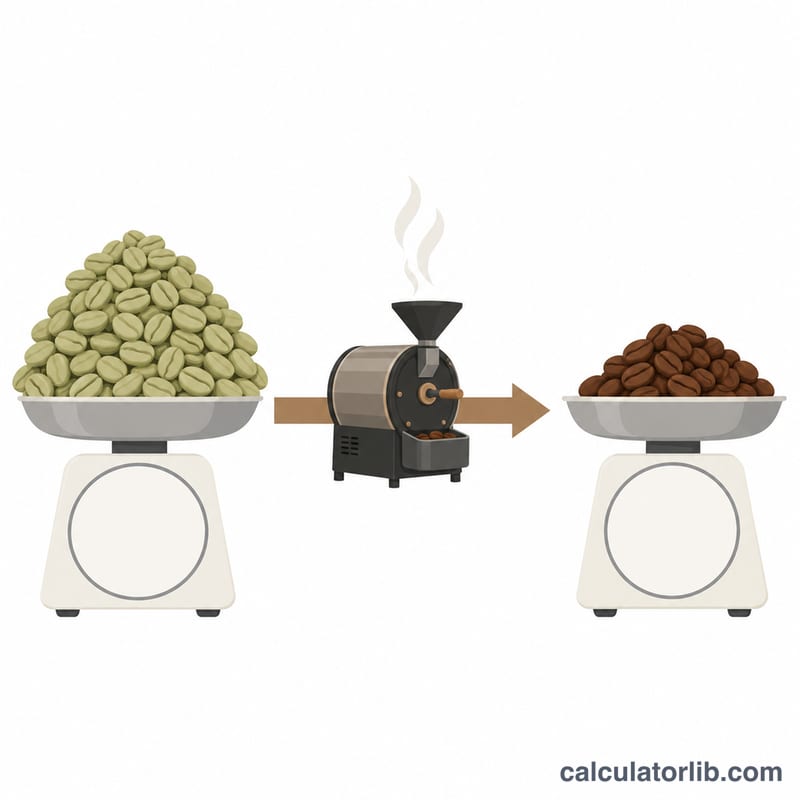
The Coffee Roaster Batch Calculator helps home and small-batch roasters plan a roast before the heat even comes on. During roasting, green coffee beans lose moisture and shed chaff, so the finished roasted weight is always lower than the green weight you loaded. This tool estimates the roasted yield, the grams lost, and how full your drum or air roaster will be.
The Formula
Roasted weight is the green weight scaled down by the expected loss rate. With \(G\) = green bean weight in grams, \(L\) = expected weight loss percent, and \(C\) = roaster capacity in grams:
$$\text{Roasted} = G \times \left(1 - \frac{L}{100}\right)$$The grams lost and the drum fill level follow directly:
$$\text{Loss} = G \times \frac{L}{100}, \qquad \text{Fill} = \frac{G}{C} \times 100$$How To Use It
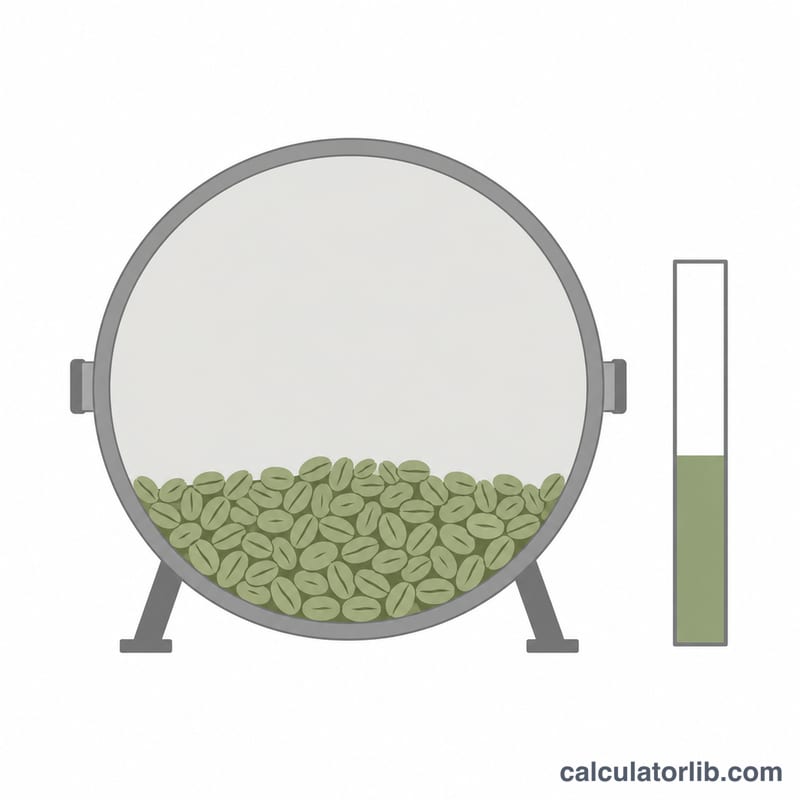
Enter the green bean weight you plan to load, your expected weight loss (typically about 12% for a light roast and up to 20% for a dark roast), and your roaster capacity. The calculator returns the roasted weight you can expect in the cooling tray, the grams of moisture and chaff lost, and the percentage of capacity used so you avoid over- or under-filling the drum.
Worked Example
Loading \(250\) g of green beans at a \(16\%\) loss into a \(500\) g roaster:
$$\text{Roasted} = 250 \times \left(1 - \frac{16}{100}\right) = 210\,\text{g}$$$$\text{Loss} = 250 \times \frac{16}{100} = 40\,\text{g}, \qquad \text{Fill} = \frac{250}{500} \times 100 = 50\%$$You finish with 210 g of roasted coffee, lose 40 g, and use half of the drum capacity.
Weight Loss by Roast Level
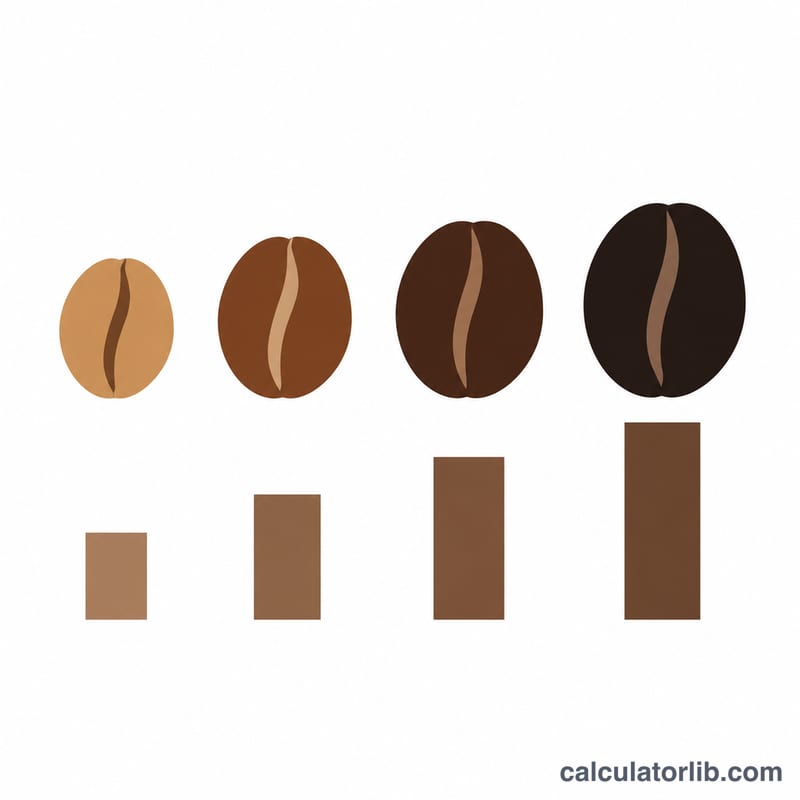
Coffee beans lose weight during roasting. Most of the loss is evaporating water, and the rest is organic matter burned off as the roast develops. The darker you roast, the more weight you lose. The ranges below are typical values that home roasters often use for planning. They are not fixed standards. The roast names follow the common North American specialty-coffee terms (Cinnamon, City, Full City, Vienna, French).
| Roast level | Typical weight loss | Approximate roast stage | Roasted yield per 100 g green |
|---|---|---|---|
| Light (Cinnamon – City) | about 12–14% | Near the end of first crack | about 88–86 g |
| Medium (City – City+) | about 14–16% | Just after first crack ends, with some development time | about 86–84 g |
| Medium-Dark (Full City) | about 16–18% | Close to, or at the very start of, second crack | about 84–82 g |
| Dark (Vienna – French) | about 18–20% or more | Into second crack, sometimes well into it | about 82–80 g or less |
To get the yield per 100 g, put the loss into the roasted-weight formula. For example, at 16% loss:
$$100 \times \left(1 - \frac{16}{100}\right) = 100 \times 0.84 = 84 \text{ g}$$Note: your actual loss depends on the beans' moisture content, how dense they are, and the roast profile (charge temperature, heat application and total time). Fresh-crop beans with more moisture, or a longer, slower roast, will usually lose more weight than the table suggests at the same colour. Treat these figures as starting points. Your own measured loss is more reliable.
Planning Green Bean Quantities for a Target Yield
If you know how much roasted coffee you want, you can work backwards to the green weight you need. Rearranging the roasted-weight formula gives:
$$G = \frac{R}{1 - \frac{L}{100}}$$Here \(G\) is the green weight, \(R\) is the roasted weight you want, and \(L\) is the expected weight loss in percent.
Worked case: one 12 oz bag
Say you want 340 g (12 oz) of roasted coffee at a medium roast with about 16% loss:
$$G = \frac{340}{1 - \frac{16}{100}} = \frac{340}{0.84} \approx 404.8 \text{ g}$$You need about 405 g of green beans. To check, enter 405 g green at 16% loss. The result is \(405 \times 0.84\) = 340.2 g roasted, which is just above the 340 g target.
Practical guidance
- Round up and add a buffer. Round the green weight up, then add about 5% to cover beans you cull (defects, quakers) and beans you set aside for samples or cupping. For the 12 oz bag: \(405 \times 1.05 \approx 425\) g green.
- Split large orders into equal batches. If the green weight you need is more than your roaster's capacity, divide it into equal batches. Each batch should fall within the fill range recommended for your roaster. For example, two 12 oz bags need about 850 g green, including the buffer. On a roaster rated for 500 g, that is two batches of 425 g, each at \(\frac{425}{500} \times 100 = 85\%\) fill. If your manufacturer recommends a lower maximum, use three smaller batches instead. Equal batches roast more consistently than one full batch followed by a small one.
- Weigh every roast and record the actual loss. Weigh the green beans before roasting and the roasted beans after they have cooled. Then calculate the loss you actually got: \(L = \frac{G - R}{G} \times 100\). Keep a log for each coffee and roast level. Then you can plan future batches with your own measured rate instead of the generic ranges.
- Re-check when something changes. A new crop, a different origin or processing method, or a change to your profile can shift the loss by a point or more. Measure again before relying on your old figures.
FAQ
Why do beans lose weight? Most of the loss is water evaporating, plus chaff and some organic compounds burning off during development.
What loss percentage should I use? Light roasts lose roughly 12-15%, medium roasts 15-18%, and dark roasts 18-20%.
How full should my roaster be? Most machines roast best between 70% and 100% of rated capacity; too little green coffee can scorch the beans.