What this calculator does
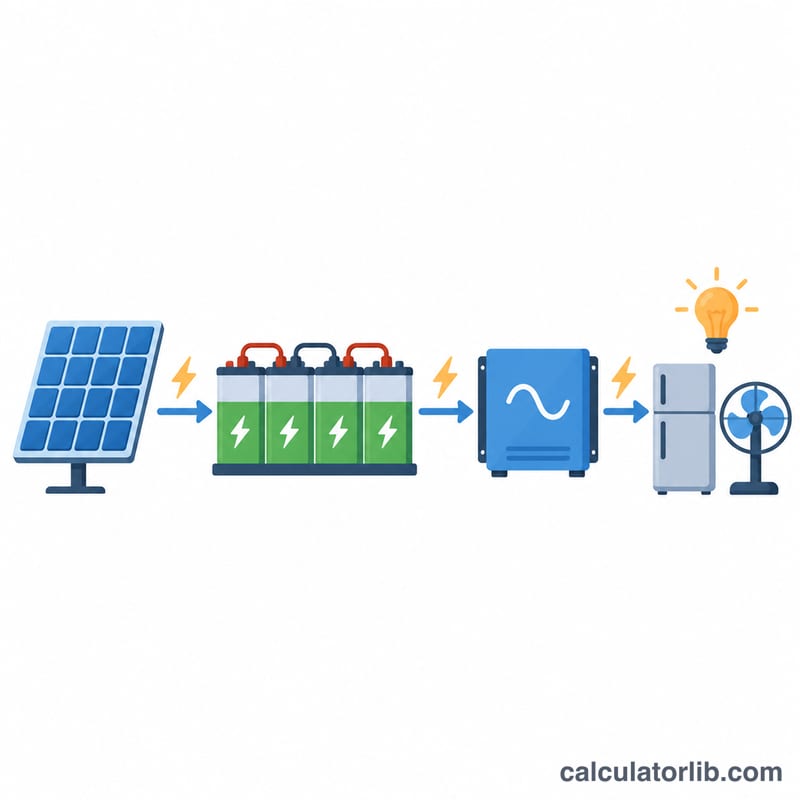
The Solar Inverter and Battery Sizing Calculator helps you specify two of the most important components of a hybrid or off-grid solar system: the inverter and the battery bank. Undersize either and the system trips or dies early; oversize them and you waste money. Enter your running load, expected startup surge, required backup time and battery details to get a sized inverter rating and battery bank in both watt-hours and amp-hours.
The formulas explained
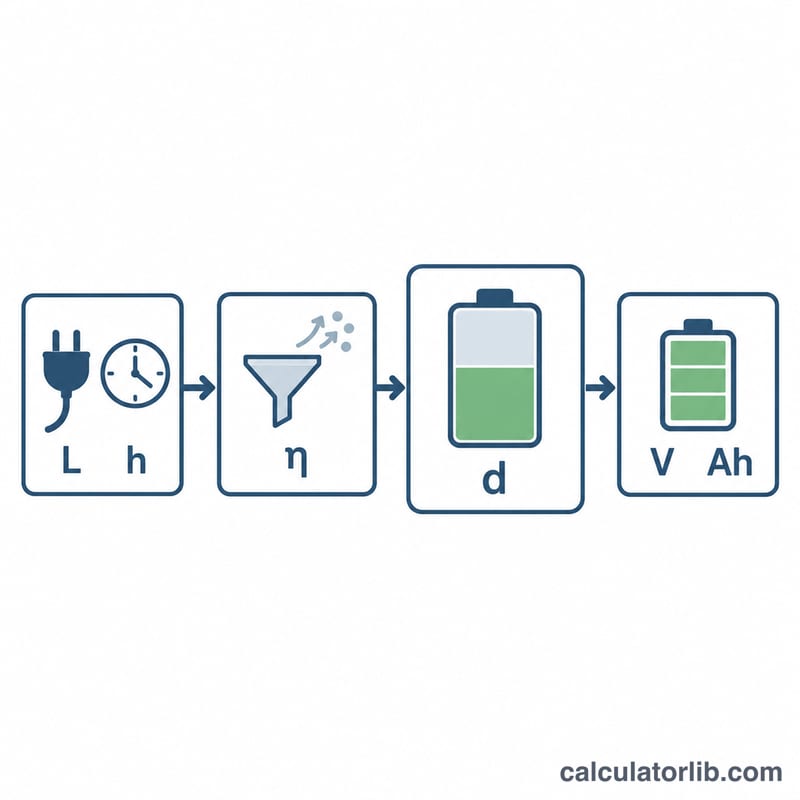
The inverter must handle both the steady load and the brief surge that motors and compressors draw at startup, so it is sized as \(P \times S\). The battery bank is sized from the energy your load consumes over the backup window, corrected for losses and usable capacity:
$$\text{Ah} = \frac{P \times t}{V \times \eta \times D}$$
where \(P\) = running load in watts, \(t\) = backup hours, \(V\) = battery bank voltage, \(\eta\) = inverter efficiency as a fraction, \(D\) = usable depth of discharge as a fraction, and \(S\) = surge factor.
How to use it
Add up every appliance that runs at the same time for the running load. Use a surge factor near \(1.5\) for mostly electronic loads or \(2\) or more when large motors start. Pick a higher voltage (48 V) for big systems to cut current and cable cost. Lead-acid batteries usually allow \(D = 0.5\), while lithium often allows \(0.8\) to \(0.9\).
Worked example
A 1000 W load with a 1.5 surge factor, 4 hours of backup, a 48 V lithium-like bank at 50% depth of discharge and 90% inverter efficiency gives:
$$\text{Inverter} = 1000 \times 1.5 = 1500\,\text{W}$$
$$E = \frac{1000 \times 4}{0.9} = 4444\,\text{Wh}$$
$$\text{Ah} = \frac{4444}{0.5 \times 48} = 185.2\,\text{Ah}$$
Typical Surge Factors, Depth of Discharge and Efficiency Values
The three tables below give typical ranges that are commonly used for first-pass sizing. They are not guarantees. Actual values depend on the specific motor, battery and inverter you use. Always check the manufacturer's datasheet, and for motors check the nameplate or the locked-rotor / starting current.
Table 1: Typical startup surge multipliers (S) by appliance type
| Appliance type | Typical surge factor S | Notes |
|---|---|---|
| Resistive loads (heaters, kettles, incandescent lights) | about 1× | Little or no inrush current. Running watts are roughly the same as starting watts. |
| Electronics and LED loads (TVs, laptops, routers, LED lighting) | about 1.2–1.5× | A short capacitor-charging inrush from the power supplies. |
| Fans | about 2× | Small induction or PSC motors. |
| Refrigerators, freezers, air-conditioner compressors | about 3–5× | The compressor starts against pressure. Inverter-driven (variable-speed) compressors are often lower. |
| Water pumps and power tools | about 3–7× | Submersible pumps and saws under load are at the high end. |
If your total load mixes several appliance types, a common conservative approach is to apply the surge factor of the largest motor. You don't need to assume that every motor starts at the same moment.
Table 2: Usable depth of discharge (DoD) by battery chemistry
| Chemistry | Typical usable DoD (d) | Typical cycle-life note |
|---|---|---|
| Flooded lead-acid | about 50% | Often several hundred to around 1,000+ cycles at 50% DoD. Life drops sharply with deeper discharges. Needs regular maintenance (water top-up). |
| AGM / gel (sealed lead-acid) | about 50–60% | Similar to or somewhat better than flooded at moderate DoD. Sensitive to deep discharge and high temperature. |
| LiFePO4 (lithium iron phosphate) | about 80–95% | Commonly rated in the low thousands of cycles at 80% DoD or more. A built-in BMS limits over-discharge. |
Cycle-life figures vary widely between brands, temperatures and charge regimes. Use the rated cycles and DoD from your battery's datasheet.
Table 3: Typical inverter efficiency (η)
| Inverter class | Typical efficiency |
|---|---|
| Low-cost / modified sine wave units | about 85–90% |
| Quality pure sine wave units | about 90–96% |
Peak efficiency is usually quoted near mid-to-high load. At very light loads, efficiency is often lower, and the inverter's idle (no-load) consumption also draws energy. If your load is small compared with the inverter rating, pick a conservative η.
More Worked Examples
Both examples use the article's formulas: \(P_{\text{inv}} = L \times S\), \(E_{\text{Wh}} = \dfrac{L \cdot h}{\eta}\), \(B_{\text{Wh}} = \dfrac{E_{\text{Wh}}}{d}\) and \(C_{\text{Ah}} = \dfrac{B_{\text{Wh}}}{V}\).
Example 1: Small 12 V lead-acid system
Inputs: load L = 300 W (electronics), S = 1.3, h = 5 h, d = 0.5, η = 0.88, V = 12 V.
- Inverter rating: $$P_{\text{inv}} = 300 \times 1.3 = 390\ \text{W}$$
- Energy drawn from the battery: $$E_{\text{Wh}} = \frac{300 \times 5}{0.88} = \frac{1500}{0.88} \approx 1704.55\ \text{Wh}$$
- Battery bank size after DoD: $$B_{\text{Wh}} = \frac{1704.55}{0.5} \approx 3409.09\ \text{Wh}$$
- Capacity at 12 V: $$C_{\text{Ah}} = \frac{3409.09}{12} \approx 284.09\ \text{Ah}$$
Result: you need an inverter rated at least 390 W, with a standard size such as 500 W giving some headroom, and a 12 V lead-acid bank of about 284.09 Ah. In practice that might be three 100 Ah 12 V batteries in parallel (300 Ah).
Example 2: 48 V LiFePO4 home backup system
Inputs: L = 2000 W (includes a refrigerator compressor), S = 3, h = 6 h, d = 0.9, η = 0.93, V = 48 V.
- Inverter rating: $$P_{\text{inv}} = 2000 \times 3 = 6000\ \text{W}$$ The inverter's surge (peak) rating must cover 6000 W. Many inverters list a continuous rating plus a short-duration surge rating, so read both on the datasheet.
- Energy drawn from the battery: $$E_{\text{Wh}} = \frac{2000 \times 6}{0.93} = \frac{12000}{0.93} \approx 12903.23\ \text{Wh}$$
- Battery bank size after DoD: $$B_{\text{Wh}} = \frac{12903.23}{0.9} \approx 14336.92\ \text{Wh}$$
- Capacity at 48 V: $$C_{\text{Ah}} = \frac{14336.92}{48} \approx 298.69\ \text{Ah}$$
- Rounding to standard 48 V modules:
- 100 Ah modules: \(\lceil 298.69 / 100 \rceil = 3\) modules, giving 300 Ah. This leaves almost no margin.
- 200 Ah modules: \(\lceil 298.69 / 200 \rceil = 2\) modules, giving 400 Ah. This leaves a comfortable reserve for battery ageing and cold temperatures.
Result: a surge capacity of 6000 W and about 298.69 Ah at 48 V. Note that many "48 V" LiFePO4 modules have a nominal voltage of 51.2 V, which gives slightly more Wh per Ah than this calculation assumes. Compare kWh ratings when you choose modules.
How Voltage and Battery Chemistry Change the Result
Fixed inputs: L = 1000 W, h = 4 h, η = 0.9. The energy drawn from the battery is the same in every case:
$$E_{\text{Wh}} = \frac{1000 \times 4}{0.9} \approx 4444.44\ \text{Wh}$$Required bank size: lead-acid (d = 0.5) needs \(4444.44 / 0.5 \approx 8888.89\) Wh, and LiFePO4 (d = 0.9) needs \(4444.44 / 0.9 \approx 4938.27\) Wh. The approximate DC current at full load is \(I = P / (V \cdot \eta)\).
| Bank voltage | Chemistry (d) | Required Wh | Required Ah | DC current at full load |
|---|---|---|---|---|
| 12 V | Lead-acid (0.5) | 8888.89 | 740.74 | 1000 / (12 × 0.9) ≈ 92.59 A |
| 12 V | LiFePO4 (0.9) | 4938.27 | 411.52 | |
| 24 V | Lead-acid (0.5) | 8888.89 | 370.37 | 1000 / (24 × 0.9) ≈ 46.30 A |
| 24 V | LiFePO4 (0.9) | 4938.27 | 205.76 | |
| 48 V | Lead-acid (0.5) | 8888.89 | 185.19 | 1000 / (48 × 0.9) ≈ 23.15 A |
| 48 V | LiFePO4 (0.9) | 4938.27 | 102.88 |
Higher voltage lowers current and Ah. The stored energy (Wh) doesn't change with voltage, but each doubling of voltage halves the amp-hours needed and the DC current. At 12 V, a 1000 W load draws about 93 A, which calls for heavy cables, large fuses and causes noticeable voltage drop. At 48 V the current falls to about 23 A. That's why larger systems usually use 24 V or 48 V banks.
Deeper usable DoD shrinks the bank. Moving from lead-acid (50% usable) to LiFePO4 (90% usable) cuts the required nameplate capacity by about 44%, from 8888.89 Wh to 4938.27 Wh, for the same runtime. These are typical DoD values. Use the limits on your battery's datasheet.
FAQ
Should I add extra margin? Yes. Many installers add 20 to 25% headroom to the inverter and round the battery up to a standard size.
Why divide by efficiency? Inverters lose some energy converting DC to AC, so the battery must store more than the load actually uses.
What depth of discharge is safe? Draining batteries too deeply shortens their life, so only the usable fraction \(D\) is counted toward backup.