

What This Calculator Does
A solar charge controller regulates current flowing from your solar panels into a battery bank. If the controller is undersized, it can overheat or shut down; oversizing wastes money. This tool estimates the minimum amp rating you need based on your total panel wattage, battery bank voltage, and a safety factor.
How to Use It
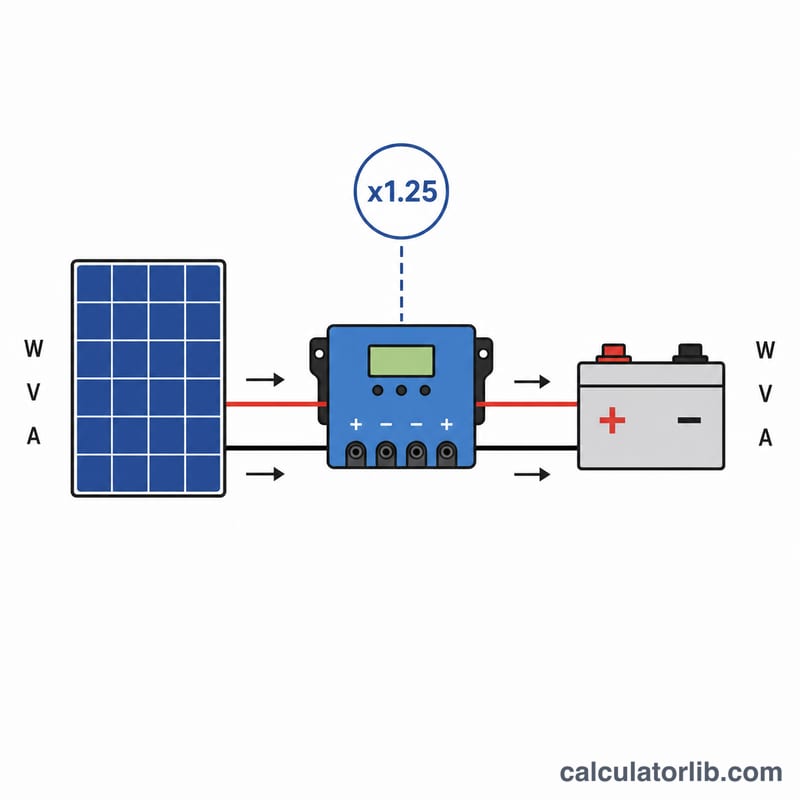
Enter the combined wattage of all panels feeding the controller, choose your battery bank voltage (12 V, 24 V, or 48 V), and set a safety factor. A 1.25 multiplier (25% headroom) is the industry standard recommended by the U.S. National Electrical Code to account for sustained loads and irradiance spikes. The result is the minimum controller current rating in amps.
The Formula Explained
The raw array current is power divided by voltage: $$I = \frac{W}{V}$$ The controller rating is this current multiplied by the safety factor: $$I_{\text{controller}} = \frac{\text{Panel Power (W)}}{\text{Battery Voltage (V)}} \times \text{Safety Factor}$$ Higher battery voltage means lower current for the same wattage, which is why 24 V and 48 V systems can use smaller, cheaper controllers and thinner wiring.
Worked Example
Suppose you have 400 W of panels charging a 12 V battery bank. Array current is \(400 \div 12 = 33.33\) A. Applying the 1.25 safety factor gives $$33.33 \times 1.25 = 41.67 \text{ A}$$ You would select a controller rated at 45 A or higher (the next standard size up).
FAQ
Should I use 1.25 as the safety factor? Yes — 1.25 (25% margin) is the standard for continuous solar charging. Some installers use higher factors in very sunny climates.
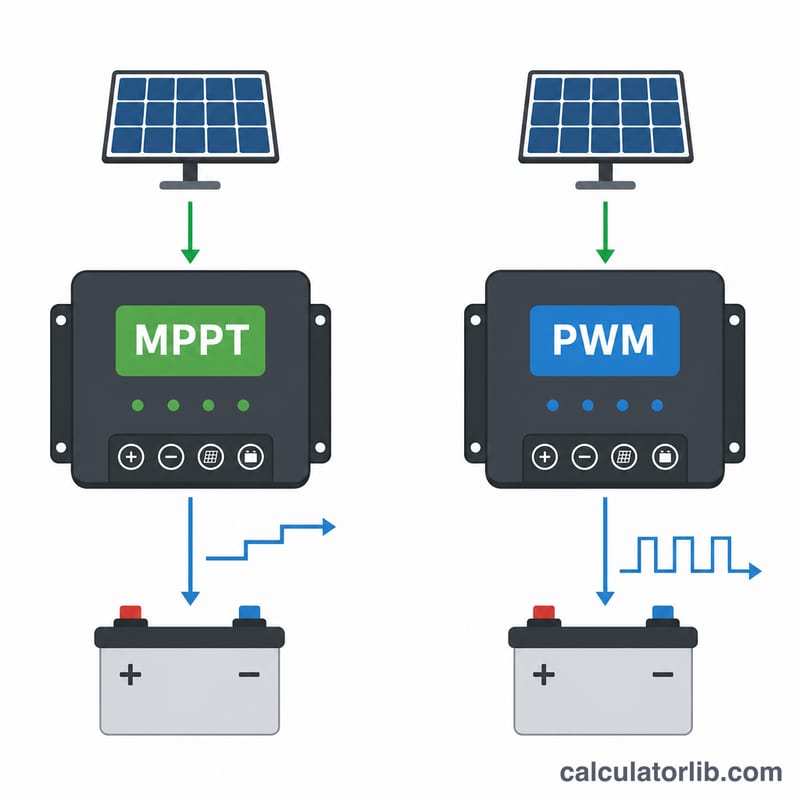
Does this work for MPPT and PWM controllers? The output current sizing applies to both. MPPT controllers may convert higher panel voltage to charging current, so always verify against the manufacturer's current rating.
Why does battery voltage matter? For a fixed panel wattage, doubling the battery voltage halves the charging current, allowing a smaller controller.