What Is the Refrigerant Charge Calculator?
This tool estimates the total refrigerant charge for a split-system HVAC unit or heat pump. Manufacturers ship condensing units pre-charged for a standard line set length (often 15 or 25 ft). When the installed liquid line is longer, additional refrigerant must be added based on a per-foot rate from the equipment data plate. This calculator adds the factory base charge, the line-set adjustment, and any other corrections, then reports the result in ounces, pounds, and grams.
How to Use It
Enter the liquid line length in feet, the manufacturer charge-per-foot rate (commonly \(0.6\,\text{oz/ft}\) for 3/8" liquid line), the factory base charge if you want a complete total, and any other adjustment. The base charge and rate come from the unit nameplate or installation manual — always defer to those numbers.
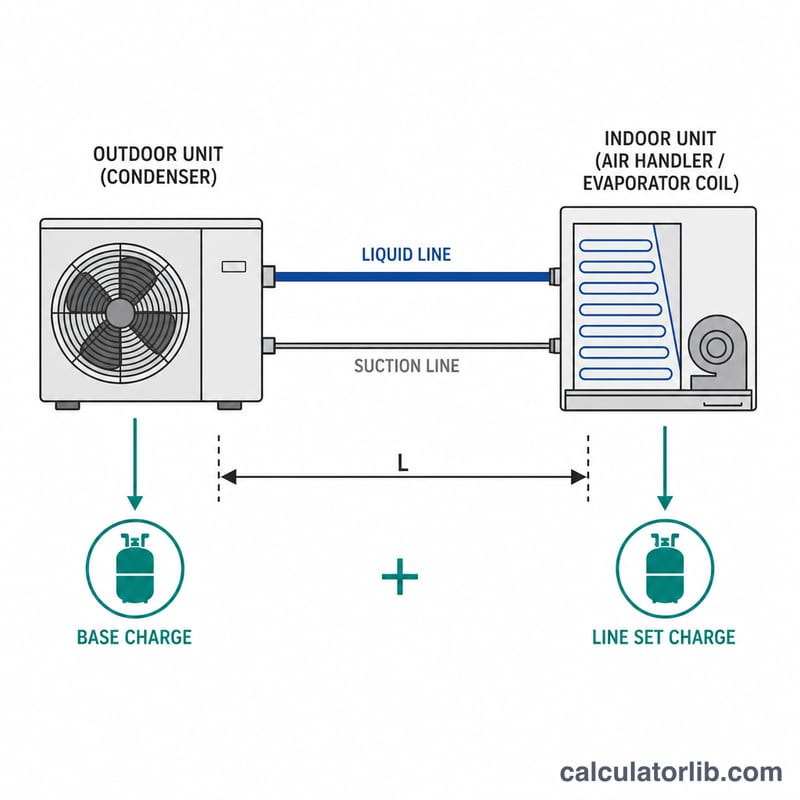
The Formula
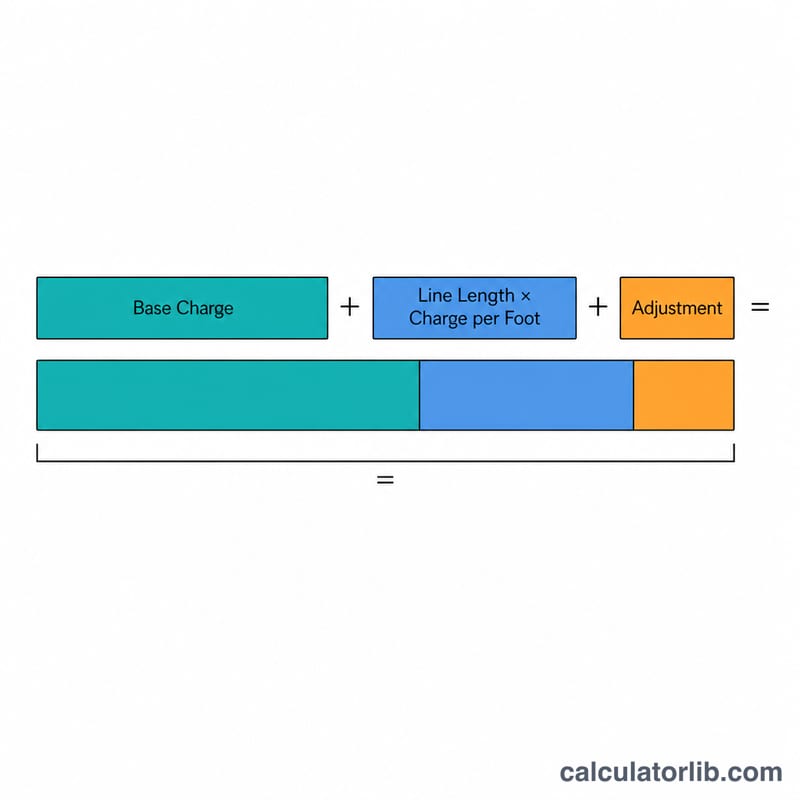
The total charge is:
$$Q_{total} = Q_{base} + (L \times r) + Q_{adj}$$where \(Q_{base}\) = factory base charge in oz, \(L\) = liquid line length in ft, \(r\) = charge per foot in oz/ft, and \(Q_{adj}\) = any other adjustment in oz. Conversions use \(Q_{lb} = Q_{oz}/16\) and \(Q_{g} = Q_{oz}\times 28.3495\).
Worked Example
A unit ships with a \(64\,\text{oz}\) base charge and the data plate specifies adding \(0.6\,\text{oz/ft}\) beyond the standard set. For a \(25\,\text{ft}\) line:
$$Q_{total} = 64 + (25 \times 0.6) + 0 = 79\,\text{oz}$$That equals \(79 / 16 = 4.94\,\text{lb}\) or about \(2240\,\text{g}\).
Typical Liquid Line Charge per Foot by Diameter
When a line set is longer than the length the outdoor unit is factory-charged for, extra refrigerant is added in proportion to the liquid line's volume. The table lists commonly published approximations of added charge per foot of liquid line, by outside diameter (OD) of the copper tube.
| Liquid line OD | Approx. added charge (oz per ft) |
|---|---|
| 1/4" | about 0.2 – 0.3 |
| 5/16" | about 0.3 – 0.45 |
| 3/8" | about 0.5 – 0.7 |
| 1/2" | about 1.0 – 1.3 |
These are approximate ranges, not exact specifications. The true value depends on the refrigerant (for example R-410A, R-22 or R-454B, which have different liquid densities), on the tube wall thickness, and on the manufacturer's published figures.
The unit nameplate and the manufacturer's installation manual always override this table. They also state the factory-charged line length, any maximum line length, and whether to charge by weight, subcooling or superheat. Use the manual's oz/ft figure in the calculator's Charge/ft field whenever it is available.
Charge Comparison for Different Line Set Lengths
These scenarios use a fixed 64 oz base charge and a 0.6 oz/ft rate (a figure in the range typical of 3/8" liquid lines). The formula is \(\text{Total} = 64 + L \times 0.6 + \text{Adj}\). Conversions use 16 oz = 1 lb and 1 oz ≈ 28.3495 g.
| Line length (ft) | Adjustment (oz) | Liquid line charge (oz) | Total (oz) | Total (lb) | Total (g) |
|---|---|---|---|---|---|
| 15 | 0 | 15 × 0.6 = 9 | 73 | 4.5625 | 2,069.5 |
| 25 | 0 | 25 × 0.6 = 15 | 79 | 4.9375 | 2,239.6 |
| 50 | 0 | 50 × 0.6 = 30 | 94 | 5.875 | 2,664.9 |
| 75 | 0 | 75 × 0.6 = 45 | 109 | 6.8125 | 3,090.1 |
| 50 | −15 | 50 × 0.6 = 30 | 64 + 30 − 15 = 79 | 4.9375 | 2,239.6 |
The last row shows a negative adjustment. For example, if the manufacturer states that the base charge already covers 25 ft of line, that 25 ft × 0.6 = 15 oz is subtracted so it is not counted twice. The result matches the 25 ft row, because both represent the same amount of added line.
Always confirm the actual figures against the nameplate and installation manual for your specific equipment and refrigerant. Final charging should be done by a qualified technician following the manufacturer's procedure.
FAQ
What charge-per-foot value should I use? Use the value from the manufacturer installation manual. A typical figure is \(0.6\,\text{oz/ft}\) for a 3/8" liquid line, but it varies by line diameter and refrigerant.
Do I subtract for shorter line sets? Some manuals require removing refrigerant when the line is shorter than the factory-charged length. Enter a negative value in "Other Adjustment" to model that.
Is this a substitute for weighing in charge? No. This is an estimate. Always verify with a scale, subcooling, and superheat readings per the manufacturer procedure.