What this solar loan calculator does
Most homeowners pay for solar panels with a loan, not cash. This calculator works out the fixed monthly payment on a standard amortizing solar loan, plus the total interest and the full amount you pay over the term. It also takes away your estimated monthly electricity savings, so you can see whether the system pays for itself while you are still paying off the loan. It uses ordinary loan maths and works with any currency.
How to use it
Enter the installed price of the system, any rebates or incentives you get upfront, and your down payment. Then add the annual interest rate (APR) and the loan term in years. Last, enter how much you expect to save on your electricity bill each month. If you are not sure, a quote from your installer usually includes an estimate.

The formula explained
First, the amount financed is \(P = C - R - D\), where \(C\) is the system cost, \(R\) is rebates and \(D\) is the down payment. The monthly payment then follows the standard annuity formula:
$$M = \frac{P\,r\,(1+r)^{n}}{(1+r)^{n}-1}$$Here \(r\) is the annual rate divided by 12 and by 100, and \(n\) is the number of monthly payments (years × 12). For an interest-free loan, the payment is simply \(M = P/n\). Total interest is \(M \times n - P\). The net monthly cost is \(M - S\), where \(S\) is your monthly savings.
Worked example
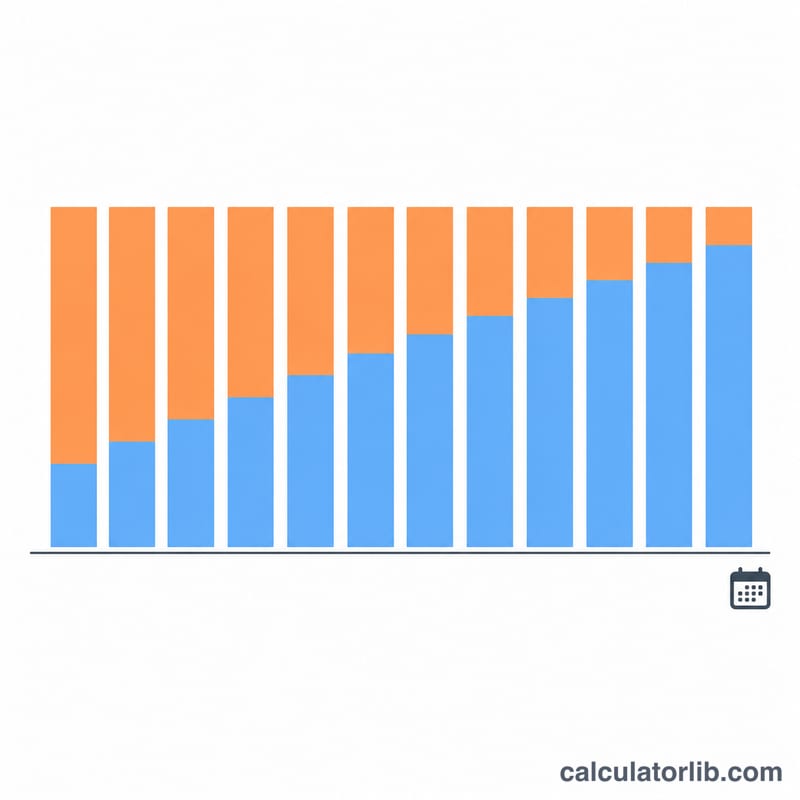
Say a $25,000 system has no rebate and you put $5,000 down. You finance the rest at 6% for 10 years, so \(P = 20{,}000\), \(r = 0.005\) and \(n = 120\):
$$M = \frac{20000 \times 0.005 \times 1.005^{120}}{1.005^{120}-1} = \frac{100 \times 1.8194}{0.8194} \approx 222.04$$Over the loan you pay about $26,644.92 in total, of which $6,644.92 is interest. With $150 a month in energy savings, the net monthly cost is about $72.04.

How Term and Rate Change Your Solar Loan Cost
The table below uses a loan principal of $20,000, which is the system cost minus any rebate and down payment. It assumes estimated energy savings of $150 per month. Each monthly payment comes from the standard annuity formula, with the monthly rate \(r = \text{APR}/1200\) and \(n = 12 \times\) the term in years:
$$M = P \cdot \frac{r(1+r)^{n}}{(1+r)^{n}-1}$$For the first row, \(r = 6/1200 = 0.005\) and \(n = 120\):
$$M = 20000 \cdot \frac{0.005 \times 1.005^{120}}{1.005^{120}-1} = 20000 \cdot \frac{0.005 \times 1.819397}{0.819397} \approx \$222.04$$Total paid is \(M \times n\), total interest is total paid minus \(P\), and net monthly cost is \(M - \$150\). Totals are calculated from the unrounded payment, so they can differ by a few cents from the rounded payment multiplied by the number of months.
| Term | APR | Monthly payment | Total paid | Total interest | Net monthly cost ($150 savings) |
|---|---|---|---|---|---|
| 10 years | 6% | $222.04 | $26,644.92 | $6,644.92 | $72.04 |
| 15 years | 6% | $168.77 | $30,378.85 | $10,378.85 | $18.77 |
| 20 years | 6% | $143.29 | $34,388.69 | $14,388.69 | −$6.71 |
| 20 years | 3.99% | $121.09 | $29,061.77 | $9,061.77 | −$28.91 |
| 25 years | 8% | $154.36 | $46,308.97 | $26,308.97 | $4.36 |
A longer term at the same rate lowers the monthly payment but raises total interest. At 6%, going from 10 to 20 years cuts the payment by about $79 a month, but adds $7,743.77 in interest. The rate has a large effect too. At the same 20-year term, 3.99% instead of 6% saves $5,326.92 in interest. The 25-year, 8% loan has a payment close to the 15-year, 6% loan, yet its total interest is more than two and a half times as much.
Interpreting Your Net Monthly Cost
Net monthly cost is your loan payment minus your estimated monthly energy savings. It describes your cash flow only for the months while the loan is being repaid.
- Positive value: each month you pay more on the loan than you save on energy. For example, +$72.04 means you are $72.04 a month worse off than without the system until the loan is repaid.
- Zero: the loan payment and your estimated savings are equal, so you break even each month.
- Negative value: your estimated savings are larger than the payment, so you have a monthly surplus. For example, −$28.91 means about $28.91 a month left over.
The savings figure is an estimate, not a fixed amount. It changes when utility rates rise or fall and when your electricity use changes. It also changes as the panels age: output typically drops by about 0.5% per year, though the exact rate depends on the panel model and the manufacturer's warranty. As a result, a break-even or surplus estimated in the first year can shift over the life of the loan.
Once the loan is paid off, there is no payment left to subtract. From then on, all of the energy savings, whatever they are at that point, count toward your cash flow. So comparing only monthly figures can understate the long-term difference between a short and a long term.
The calculation includes only the loan principal, interest rate, term and your savings estimate. It leaves out several costs: routine maintenance and cleaning, inverter replacement (inverters usually wear out before the panels do), monitoring or insurance costs, and dealer or origination fees. Fees added to the loan can raise the effective cost above the stated APR. Tax credits, rebates and incentives depend on your country and region, and they affect the result only through the rebate figure you enter.
This is general information, not financial advice. Check loan terms, fees and savings estimates with the lender and installer before you decide.
FAQ
Should I include tax credits as a rebate?
Only include it if it lowers the amount you borrow on day one. Many tax credits arrive later, when you file your tax return. Some solar loans assume you will use that credit to pay down the balance, and if you do not, your payment can go up.
Does this include dealer fees?
No. Some low-rate solar loans add a hidden dealer fee to the system price. If yours does, add the fee to the system cost to see your true payment.
What if my savings exceed the payment?
Then the net monthly cost is negative. This means the system is cash-flow positive from the first month.