What Is the Toilet Paper Cost Per Sheet Calculator?
The Toilet Paper Cost Per Sheet Calculator reveals the true unit price of toilet paper by looking past the sticker price. Packaging often advertises mega or double rolls, which makes direct comparison confusing. By reducing every option to a single cost per sheet, this tool lets you compare any brand, roll count, or pack size on equal footing and spot the best real value.
How to Use It
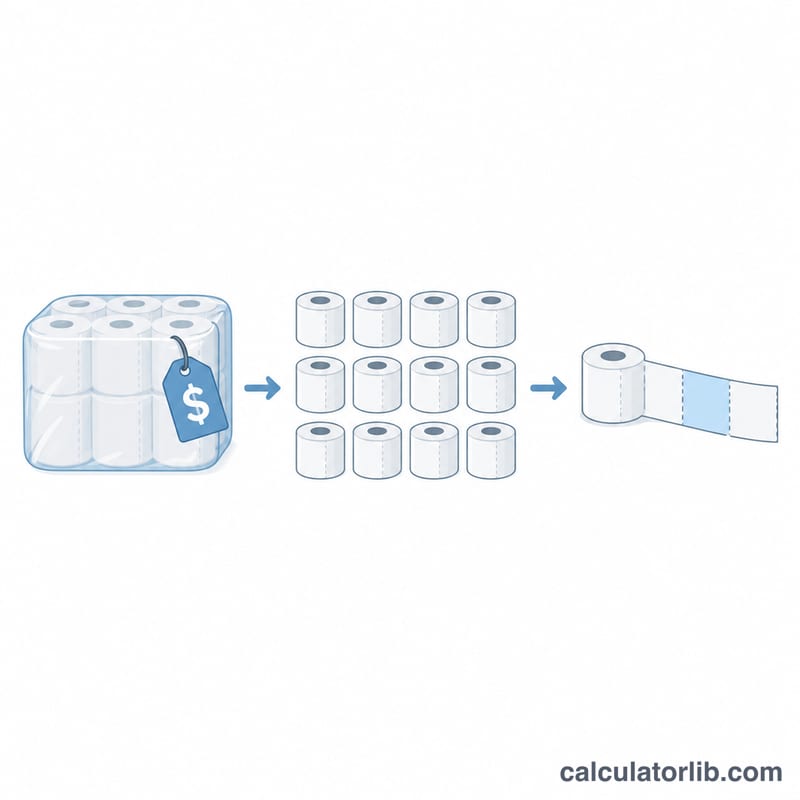
Enter three numbers from the product label or shelf tag: the pack price in dollars, the number of rolls in the pack, and the number of sheets on each roll. The calculator multiplies rolls by sheets to find the total sheets you are buying, then divides the price across them. It also reports the cost per 100 sheets and the cost per roll so you can compare however you prefer.
The Formula Explained
Let \(P\) = pack price in dollars, \(R\) = rolls per pack, and \(S\) = sheets per roll. The total sheets equal \(R \times S\), so the cost per sheet \(c\) is:
$$c = \frac{P}{R \times S}$$Because the denominator grows with both roll count and sheet count, a cheap-looking pack with thin rolls can easily cost more per sheet than a pricier pack with generous rolls.
Worked Example
Suppose a pack costs $10, contains 12 rolls, and each roll has 200 sheets. Total sheets are \(12 \times 200 = 2400\), so:
$$c = \frac{\$10}{12 \times 200} = \frac{\$10}{2400} \approx \$0.00417$$That is about 0.417 cents per sheet, or roughly $0.83 per roll.
Comparing Common Pack Sizes Side by Side
The table compares five hypothetical packs. The prices and sheet counts are examples chosen to show how the maths works. They are not real market prices and don't describe any particular brand or country. Each row uses the same formula, \(c = \frac{P}{R \times S}\), where \(P\) is the pack price, \(R\) is the number of rolls and \(S\) is the number of sheets per roll. Cost per roll is \(P \div R\), and cost per 100 sheets is \(c \times 100\).
| Pack (hypothetical) | Pack price | Rolls | Sheets per roll | Total sheets | Cost per roll | Cost per 100 sheets | Cost per sheet |
|---|---|---|---|---|---|---|---|
| A: 4 regular rolls | $3.49 | 4 | 200 | 800 | $0.87 | $0.44 | $0.00436 |
| B: 12 double rolls | $9.99 | 12 | 300 | 3,600 | $0.83 | $0.28 | $0.00278 |
| C: 24 mega rolls | $24.99 | 24 | 400 | 9,600 | $1.04 | $0.26 | $0.00260 |
| D: Bulk 30-roll pack | $27.99 | 30 | 300 | 9,000 | $0.93 | $0.31 | $0.00311 |
| E: Budget pack, thin rolls | $5.99 | 12 | 140 | 1,680 | $0.50 | $0.36 | $0.00357 |
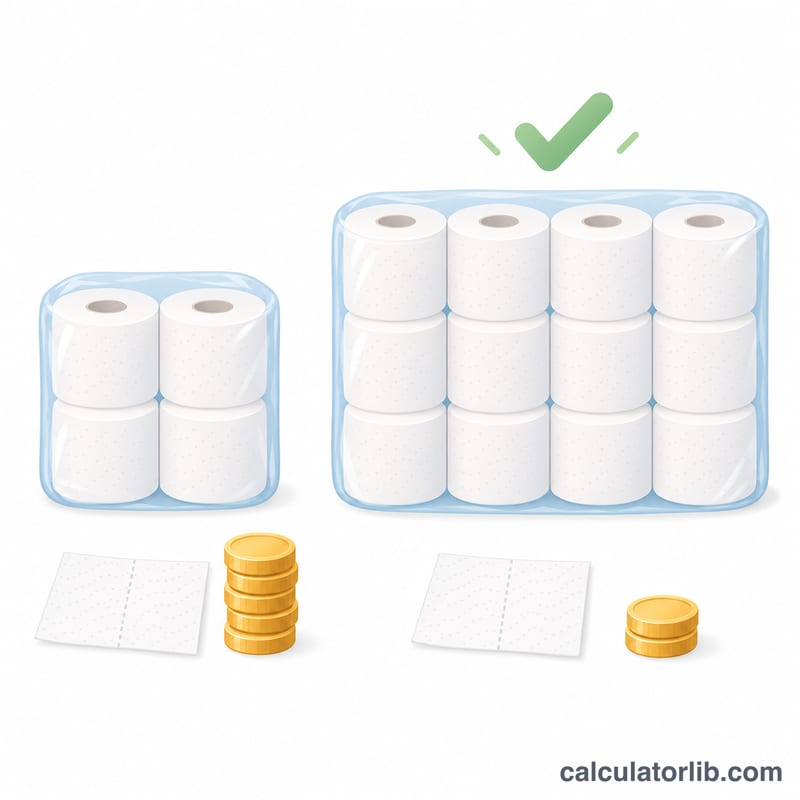
The trap is Pack E. It has the lowest sticker price for 12 rolls ($5.99 against $9.99 for Pack B) and the lowest cost per roll ($0.50). Each roll has only 140 sheets, though, so it works out to $0.00357 per sheet. That is about 28% more than Pack B (\(0.003565 \div 0.002775 \approx 1.28\)) and about 37% more than Pack C. Pack C has the highest cost per roll ($1.04) but is the cheapest per sheet, because each of its rolls holds twice as many sheets as a regular roll.
The bulk pack (D) has the most rolls, but it still costs more per sheet than the mega-roll pack (C). Buying in bulk doesn't guarantee the lowest price per sheet. Always compare cost per sheet or cost per 100 sheets, not cost per roll or pack price.
More Worked Examples
Both examples use made-up prices to show the method. Costs per sheet are rounded to five decimal places of a dollar, then converted to cents (1 dollar = 100 cents).
Example 1: Comparing two brands
Brand X: $12.49 for 12 rolls of 264 sheets.
Brand Y: $15.99 for 18 rolls of 286 sheets.
- Total sheets. Brand X: \(12 \times 264 = 3{,}168\). Brand Y: \(18 \times 286 = 5{,}148\).
- Cost per sheet.$$c_X = \frac{\$12.49}{12 \times 264} = \frac{\$12.49}{3168} \approx \$0.00394$$$$c_Y = \frac{\$15.99}{18 \times 286} = \frac{\$15.99}{5148} \approx \$0.00311$$Brand X costs about $0.00394 per sheet (0.394 cents). Brand Y costs about $0.00311 per sheet (0.311 cents).
- Cost per 100 sheets. Brand X: \(0.00394 \times 100 \approx \$0.394\), about 39.4 cents. Brand Y: \(0.00311 \times 100 \approx \$0.311\), about 31.1 cents.
- Percentage difference (using the unrounded values 0.0039426 and 0.0031061):$$\frac{0.0039426 - 0.0031061}{0.0031061} \times 100\% \approx 26.9\%$$Brand X costs about 26.9% more per sheet than Brand Y. Put the other way, Brand Y is about 21.2% cheaper than Brand X: \(0.0008365 \div 0.0039426 \approx 0.212\).
Brand Y has the higher shelf price, yet it is clearly the better value per sheet.
Example 2: Mega rolls vs regular rolls, adjusted for sheet size
Mega pack: $8.49 for 6 mega rolls of 352 sheets. Each sheet is 4.0 × 4.0 in.
Regular pack: $8.99 for 12 regular rolls of 187 sheets. Each sheet is 4.0 × 3.7 in.
- Total sheets. Mega: \(6 \times 352 = 2{,}112\). Regular: \(12 \times 187 = 2{,}244\).
- Cost per sheet.$$c_{\text{mega}} = \frac{\$8.49}{2112} \approx \$0.00402 \;(0.402\text{ cents})$$$$c_{\text{reg}} = \frac{\$8.99}{2244} \approx \$0.00401 \;(0.401\text{ cents})$$Per sheet, the two packs are almost identical: 40.2 cents against 40.1 cents per 100 sheets. The regular pack is very slightly ahead.
- Sheet area. Mega: \(4.0 \times 4.0 = 16.0\) sq in. Regular: \(4.0 \times 3.7 = 14.8\) sq in. There are 144 sq in in 1 sq ft.
- Total paper area. Mega: \(2112 \times 16.0 = 33{,}792\) sq in, and \(33{,}792 \div 144 \approx 234.67\) sq ft. Regular: \(2244 \times 14.8 = 33{,}211.2\) sq in, and \(33{,}211.2 \div 144 \approx 230.63\) sq ft.
- Cost per square foot.$$\text{Cost per ft}^2 = \frac{P}{R \times S \times A}$$Here \(A\) is the sheet area in square feet.$$\text{Mega: } \frac{\$8.49}{234.67} \approx \$0.0362 \;(3.62\text{ cents per ft}^2)$$$$\text{Regular: } \frac{\$8.99}{230.63} \approx \$0.0390 \;(3.90\text{ cents per ft}^2)$$
- Compare. \((0.03898 - 0.03618) \div 0.03618 \approx 0.077\). Measured by paper area, the regular pack costs about 7.7% more.
Cost per sheet makes the regular pack look marginally cheaper. Once you account for its smaller sheets, the mega pack gives more paper for the money. Use the area adjustment when the packaging lists sheet dimensions and they differ between the products you're comparing. Paper thickness (ply) isn't included in either measure.
FAQ
Why compare per sheet instead of per roll? Roll counts are inconsistent — one brand double roll may hold twice the sheets of another. Per sheet is the only apples-to-apples measure.
Does sheet size matter? Yes. This tool compares sheet counts, not physical sheet dimensions or ply, so also check sheet size and ply if brands differ a lot.
What if sheets per roll is not listed? It is almost always printed near the barcode or in the product details; estimate if needed, but accuracy depends on it.