What It Is
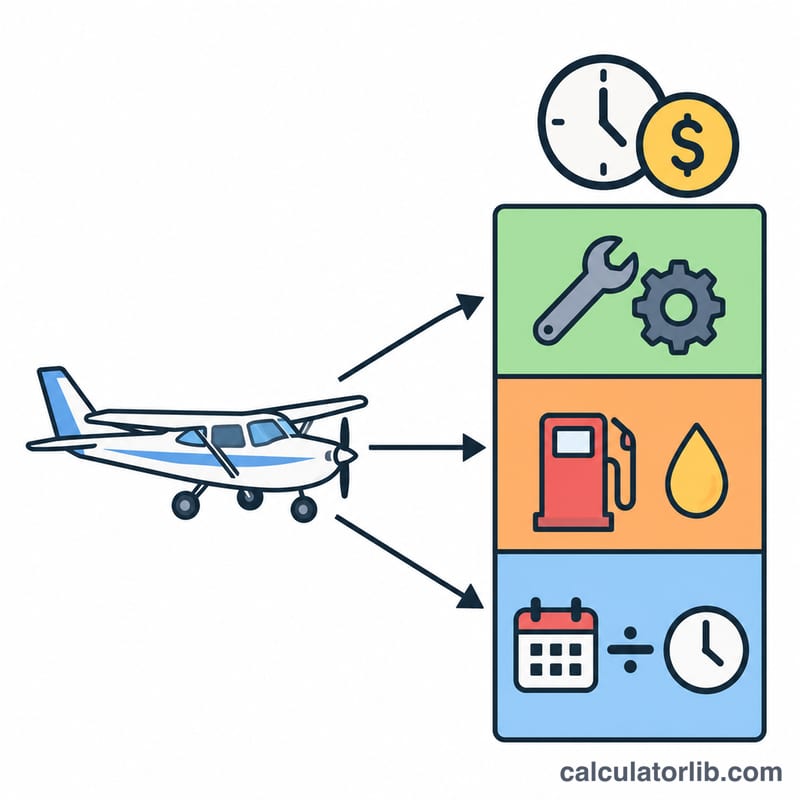
The Cost Per Flight Hour Calculator estimates the true hourly cost of operating an aircraft by blending two very different expense types. Fixed costs — insurance, hangar rent, loan payments, subscriptions and the annual inspection — accrue whether you fly one hour or one thousand. Variable costs — fuel, oil and maintenance reserves — only occur while the engine is running. Spreading fixed costs across your expected annual hours and adding the per-hour variable rate reveals what each hour aloft actually costs.
How To Use It
Enter your total annual fixed costs, the hours you expect to fly in a year, your average fuel burn in gallons per hour, the price you pay per gallon, and any other variable cost per hour such as oil and maintenance reserves. The calculator instantly returns your cost per flight hour along with the projected annual total.
The Formula Explained
The hourly cost combines fixed overhead and variable spend:
$$\text{CPH} = \frac{F}{H} + (B \times P) + V$$where \(F\) = annual fixed costs, \(H\) = annual flight hours, \(B\) = fuel burn in gallons per hour, \(P\) = fuel price per gallon, and \(V\) = other variable cost per hour. The first term shares fixed overhead across every hour flown, so flying more hours lowers your effective cost per hour.
Worked Example
Suppose fixed costs are $24,000 a year, you fly 200 hours, burn 12 gallons per hour at $6 a gallon, and spend $25 per hour on maintenance reserves:
$$\text{CPH} = \frac{24000}{200} + (12 \times 6) + 25 = 120 + 72 + 25 = \$217$$Your projected annual operating cost is \(217 \times 200 = \$43{,}400\).
How Annual Hours Change Your Cost Per Flight Hour
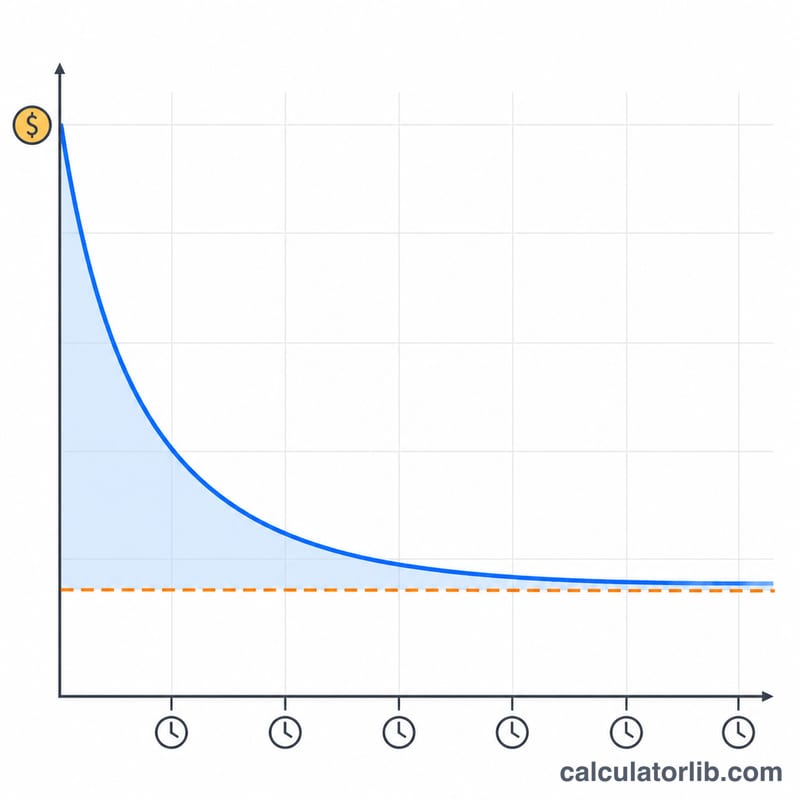
Fixed costs such as insurance, hangar or tie-down, the annual inspection, loan payments and subscriptions are paid whether the aircraft flies or not. Spreading them over more hours lowers the hourly cost. Fuel and other variable costs stay the same for every hour flown. The table uses the worked example's inputs: $24,000 a year in fixed costs, a fuel burn of 12 gal/hr at $6 per gallon, and $25/hr set aside for maintenance and engine reserves.
The variable cost per hour is the same in every row:
$$B \times P + V = 12 \times \$6 + \$25 = \$72 + \$25 = \$97\text{ per hour}$$Each row then applies the full formula:
$$\text{CPH} = \frac{F}{H} + B \times P + V$$| Annual hours (H) | Fixed cost per hour (F/H) | Variable cost per hour | Total cost per hour | Annual total (CPH × H) |
|---|---|---|---|---|
| 50 | $24,000 ÷ 50 = $480 | $97 | $577 | $28,850 |
| 100 | $24,000 ÷ 100 = $240 | $97 | $337 | $33,700 |
| 200 | $24,000 ÷ 200 = $120 | $97 | $217 | $43,400 |
| 400 | $24,000 ÷ 400 = $60 | $97 | $157 | $62,800 |
Going from 50 to 400 hours cuts the cost per hour from $577 to $157, a drop of about 73%. Over the same range, the total yearly spend more than doubles, from $28,850 to $62,800. Flying more makes each hour cheaper, but it never makes the aircraft cheaper to own overall. As hours rise, the fixed share keeps shrinking, and the cost per hour gets closer and closer to the $97 variable floor without ever reaching it. For a low-hour owner, cutting fixed costs (for example by sharing ownership or choosing cheaper storage) makes the biggest difference. For a high-hour operator, fuel price and fuel burn matter most.
Typical Fuel Burn by Aircraft Type
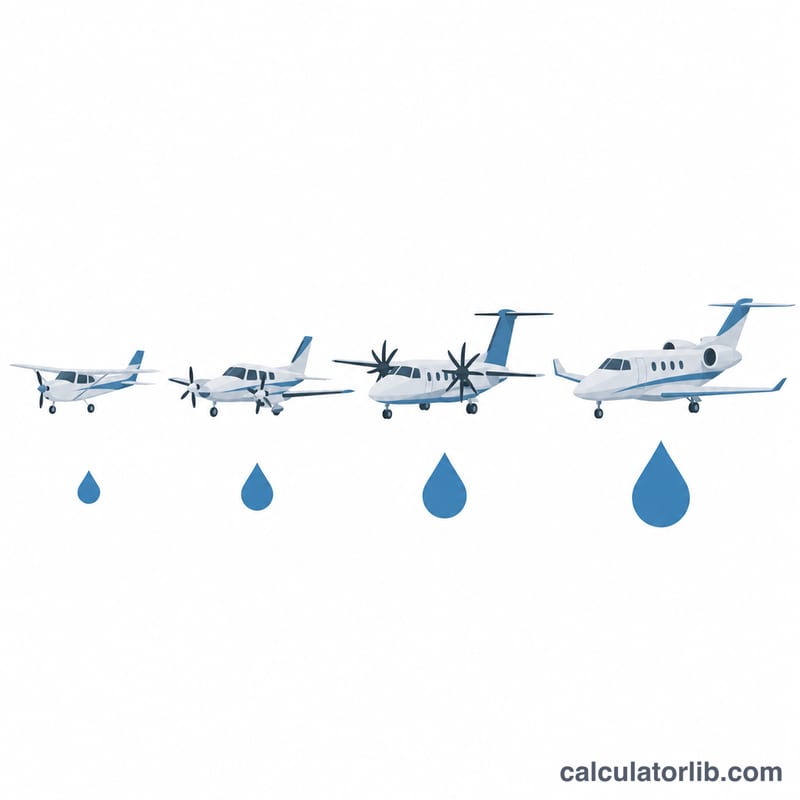
The table gives approximate cruise fuel burn for some common, well-documented general aviation aircraft. Use it as a starting point for the Fuel Burn (gal/hr) input. Figures are in US gallons per hour. Piston aircraft normally burn aviation gasoline (100LL avgas). Turboprops burn Jet A, which is usually priced differently from avgas, so use the matching fuel price.
| Category | Example aircraft | Fuel | Approx. cruise burn (gal/hr) |
|---|---|---|---|
| Two-seat trainer | Cessna 152 | Avgas | about 5–6 |
| Four-seat piston single | Cessna 172 | Avgas | about 8–9 |
| High-performance piston single | Cirrus SR22 | Avgas | about 14–18 |
| Light piston twin | Beechcraft Baron (both engines combined) | Avgas | about 25–30 |
| Single-engine turboprop | Daher TBM series / Pilatus PC-12 | Jet A | about 50–70 |
Actual fuel burn depends on power setting, cruise altitude and how the engine is leaned. Temperature, aircraft weight and the engine variant also make a difference. Takeoff, climb and taxi burn more fuel than cruise, so on short flights the average per hour is often higher than the cruise figure. Your own fuel receipts divided by Hobbs or tach hours give the most accurate number to enter. Each extra gallon per hour adds the fuel price to every hour flown. At $6 per gallon, going from 9 gal/hr to 12 gal/hr adds \(3 \times \$6 = \$18\) per hour.
FAQ
Why divide fixed costs by hours? Overhead is the same regardless of use, so spreading it over more hours reduces the per-hour burden.
What is a maintenance reserve? Money set aside each hour for future engine overhauls and unscheduled repairs, smoothing large bills into a predictable hourly rate.
Does flying more lower my cost per hour? Yes — fixed costs are shared across more hours, though your total annual spend still rises.