What Is a Truck Load Weight Calculator?
A truck load weight calculator helps carriers, shippers, and owner-operators check whether a loaded vehicle stays inside legal road weight limits. It combines the empty vehicle weight with the cargo weight to find the gross vehicle weight (GVW), then spreads that weight across the axles so you can judge both total and per-axle compliance before you ever reach a weigh station.
How to Use It
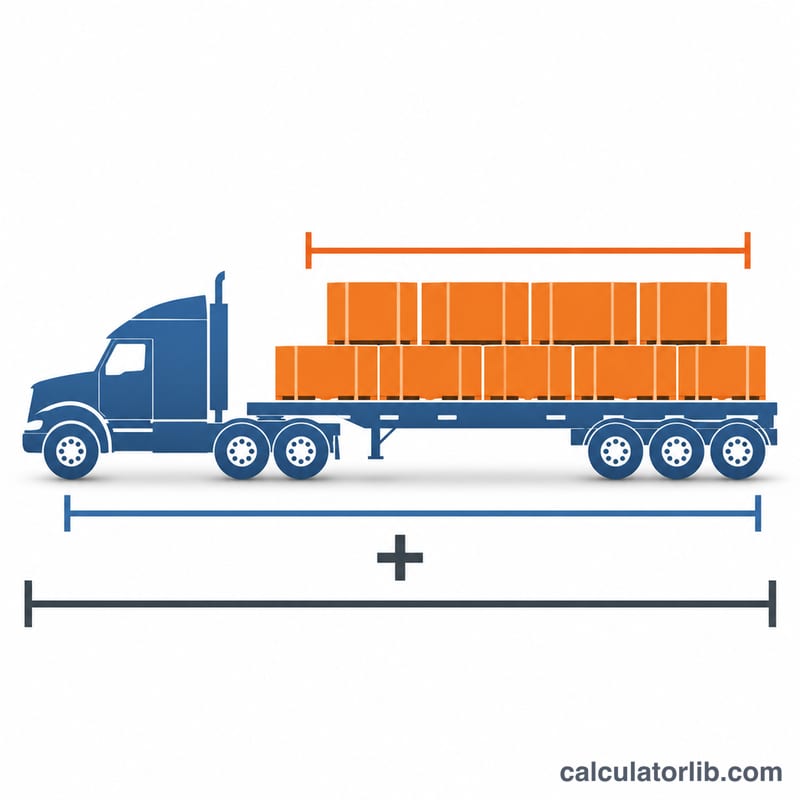
Enter the empty (tare) weight of the truck, the weight of the cargo you plan to haul, the number of load-bearing axles, and the legal GVW limit for your route or jurisdiction. The calculator instantly returns the gross vehicle weight, the average load carried by each axle, and how much capacity you still have before hitting the limit.
The Formula Explained
Gross vehicle weight is the sum of the tare weight and the cargo weight. The average axle load divides that total by the axle count \(n\):
$$\text{GVW} = \text{Tare} + \text{Cargo}$$ $$\text{Axle Load} = \frac{\text{GVW}}{n}$$Remaining legal capacity is the legal limit minus the GVW. A negative result means the truck is overloaded.
Worked Example
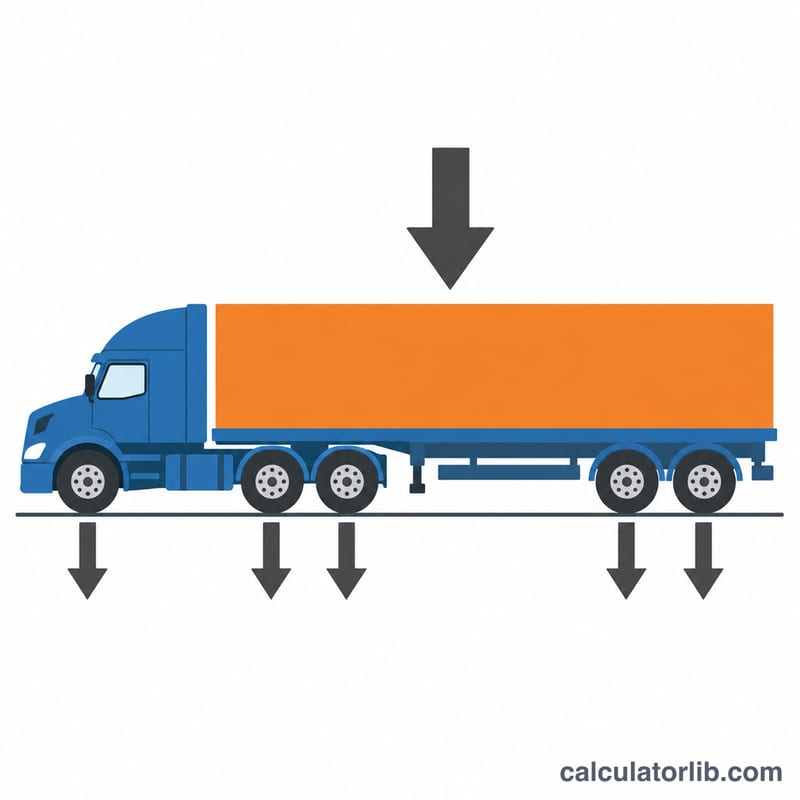
Suppose an empty truck weighs 8,000 kg, it carries 20,000 kg of cargo across 5 axles, and the legal limit is 36,000 kg:
$$\text{GVW} = 8000 + 20000 = 28000\ \text{kg}$$ $$\text{Axle Load} = \frac{28000}{5} = 5600\ \text{kg}$$ $$\text{Remaining} = 36000 - 28000 = 8000\ \text{kg}$$The truck is 8,000 kg under the limit and legal to drive.
Common Legal Weight Limits by Jurisdiction
The table below lists widely documented baseline limits for heavy goods vehicles. They are reference values only. Actual limits depend on vehicle configuration, axle spacing, tyre type, suspension, road class and permits. State, provincial, territorial or permit rules may differ from these figures, so always check the rules that apply to your route. Conversions use 1 kg = 2.20462 lb and are rounded.
| Jurisdiction / source | Limit type | kg | lb | Notes |
|---|---|---|---|---|
| United States: federal Interstate rules (23 U.S.C. 127; 23 CFR 658.17) | Gross vehicle weight | 36,287 | 80,000 | Federal cap on the Interstate System. The Bridge Formula may lower it. |
| United States: federal (23 CFR 658.17) | Single axle | 9,072 | 20,000 | States may have grandfathered or permit-based exceptions. |
| United States: federal (23 CFR 658.17) | Tandem axle | 15,422 | 34,000 | Applies to two axles spaced more than 40 in and no more than 96 in apart. |
| United States: Federal Bridge Formula (23 CFR 658.17) | Any group of two or more consecutive axles | Calculated (see below) | Depends on axle count and spacing. | |
| European Union: Directive 96/53/EC | 5- or 6-axle vehicle combination (standard) | 40,000 | 88,185 | Maximum weight for international traffic. Member states may allow more on national roads. |
| European Union: Directive 96/53/EC | Intermodal (3-axle tractor + 2/3-axle semi-trailer carrying a 40 ft ISO container) | 44,000 | 97,003 | Combined-transport operations only. |
| European Union: Directive 96/53/EC | Single non-driving axle | 10,000 | 22,046 | Per axle. |
| European Union: Directive 96/53/EC | Driving axle | 11,500 | 25,353 | Per axle. |
| United Kingdom: Road Vehicles (Construction and Use) Regulations 1986 | 6-axle articulated vehicle | 44,000 | 97,003 | Subject to conditions on axle weights and suspension or emissions. |
| Canada: federal-provincial Memorandum of Understanding on Interprovincial Weights and Dimensions | Single axle (dual tyres) | 9,100 | 20,062 | Baseline for interprovincial traffic. Many provinces allow higher limits on their own roads. |
| Canada: Memorandum of Understanding | Tandem axle | 17,000 | 37,479 | Gross limits vary by province and vehicle configuration. |
| Australia: General Mass Limits (Heavy Vehicle National Law) | Single axle (dual tyres) | 9,000 | 19,842 | Higher Mass Limits (HML) apply on approved routes. |
| Australia: General Mass Limits | Tandem axle (dual tyres) | 16,500 | 36,376 | Per axle group. |
| Australia: General Mass Limits | 6-axle semi-trailer combination | 42,500 | 93,696 | Up to 45,500 kg under HML on approved routes. |
The US Federal Bridge Formula sets the maximum weight \(W\) in pounds that any group of two or more consecutive axles may carry:
$$W = 500\left(\frac{LN}{N-1} + 12N + 36\right)$$Here \(L\) is the distance in feet between the outer axles of the group and \(N\) is the number of axles in the group. The formula applies only to US federal rules. Other countries control axle spacing through their own regulations.
Interpreting Your Result
The calculator gives three numbers: gross vehicle weight (GVW), average axle load, and remaining capacity against the legal GVW limit you entered. Each one tells you something different.
Positive remaining capacity means only the total is under the limit
Suppose a truck has a tare weight of 15,000 kg, carries 20,000 kg of cargo on 5 axles, and runs against the US federal limit of 36,287 kg (80,000 lb):
$$\text{GVW} = 15{,}000 + 20{,}000 = 35{,}000\ \text{kg}$$$$\text{Avg Axle Load} = \frac{35{,}000}{5} = 7{,}000\ \text{kg}$$$$\text{Remaining} = 36{,}287 - 35{,}000 = 1{,}287\ \text{kg}$$The remaining capacity of 1,287 kg is positive, so the gross weight is under the limit. That does not mean every axle is legal.
Axle groups have their own limits
The average axle load assumes the weight is spread evenly. Real loads rarely are. The steer axle, drive group and trailer tandem or tridem group each have separate limits. Under US federal rules, for example, a tandem group may carry 34,000 lb (15,422 kg). Cargo loaded too far forward or back can push one group over its limit while both the GVW and the 7,000 kg average stay comfortably under. Weighing each axle group on a certified scale is the only reliable way to confirm the distribution. Sliding the fifth wheel or the trailer tandem can shift weight between groups.
Axle spacing and the bridge formula
In the United States, the Federal Bridge Formula can make the allowed weight lower than 80,000 lb when the axles are close together. A short wheelbase concentrates the load on bridges, so it is allowed less weight than a long one. Other countries handle this through their own spacing and configuration rules. The flat limit you enter is only a ceiling.
Leave a margin
- Fuel and consumables: If the tare weight was measured with partly empty tanks, a full fill adds weight. Diesel weighs about 0.84 kg per litre, so 500 L adds roughly 420 kg.
- Scale differences: Results from private and enforcement scales can differ, and any enforcement tolerance depends on the jurisdiction. Do not plan on having one.
- Other added weight: Drivers, equipment, pallets, dunnage, and moisture picked up by the cargo all add to the gross.
Negative remaining capacity
A negative result means the calculated GVW is above the limit you entered, and the truck is over by that amount. You would need to remove cargo, split the load, use a vehicle with a higher legal rating, or get any permit that applies before the trip.
This is general information, not legal or compliance advice. Weight rules vary by jurisdiction and change over time, so check current limits with the relevant transport authority.
FAQ
Does this account for individual axle limits? It estimates the average load per axle. Real axle group limits for steer, drive, and tandem groups vary by law, so always verify group-specific caps.
Can I use pounds instead of kilograms? Yes. The math is unit-agnostic, so enter every value in the same unit and the results follow that unit.
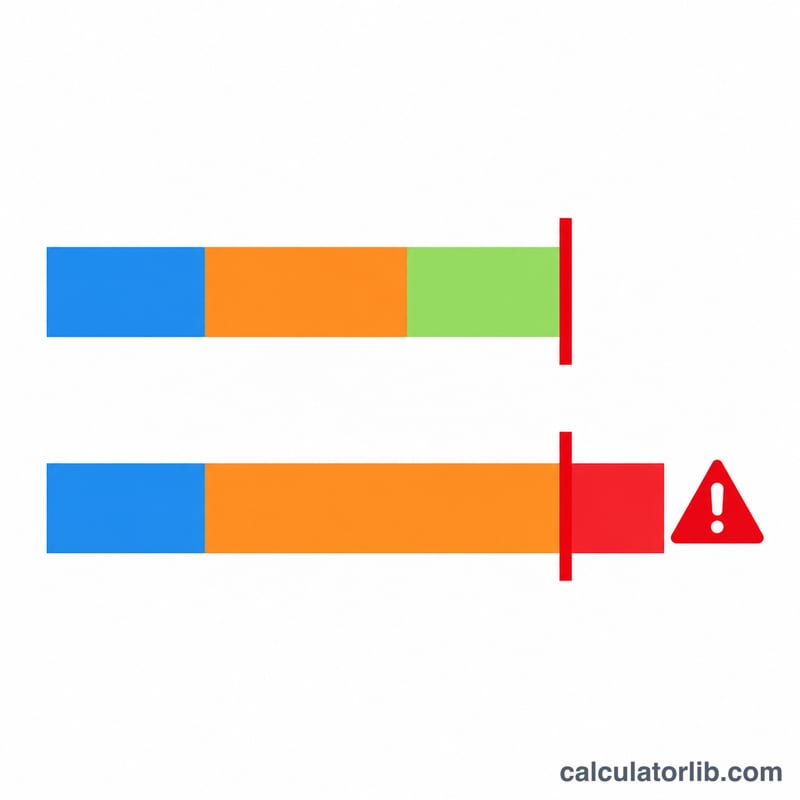
What does a negative remaining capacity mean? It means the gross weight exceeds the legal limit and the load must be reduced or redistributed.