What this calculator does
The Axle Weight Distribution Calculator estimates how a cargo load is shared between a vehicle front and rear axles, then compares each axle load against its legal or rated limit. Overloading a single axle is a common cause of roadside fines and premature tire, brake, and suspension wear, even when the total vehicle weight is legal. This tool helps drivers, fleet managers, and loaders position freight so no axle is over limit.
The formula explained
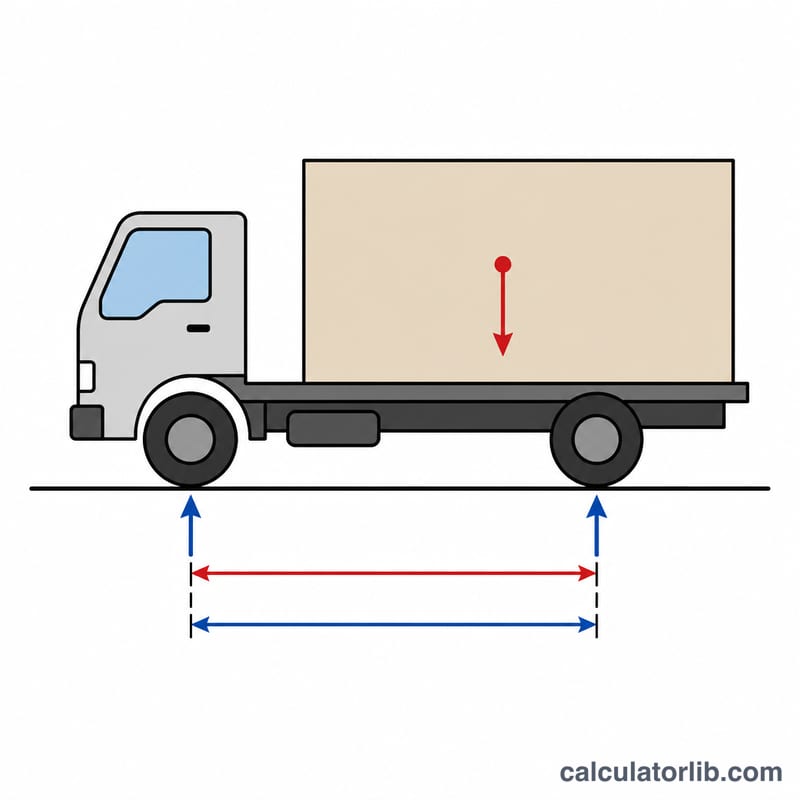
Treat the vehicle as a simple beam supported at two axles a distance \(L\) apart (the wheelbase). A cargo load \(W\) sitting a distance \(d\) from the front axle balances like a lever, so the share carried by each axle is:
$$W_{rear} = W \times \frac{d}{L}, \qquad W_{front} = W \times \frac{L-d}{L}$$Here \(W\) = cargo weight, \(d\) = distance of the cargo from the front axle, and \(L\) = axle spacing. Adding the empty (tare) weight already resting on each axle gives the total axle load, and the legal margin is \(\text{Margin} = \text{Limit} - \text{Load}\).
How to use it
Enter the wheelbase, the cargo weight, and how far the cargo center of gravity sits from the front axle. Add the empty weight already on each axle and each axle legal limit. The result shows the front and rear axle loads, the total weight, and how much spare capacity (margin) remains. A negative margin means that axle is overloaded.
Worked example
Suppose \(L = 12\) ft, \(W = 6000\) lb placed \(d = 4\) ft behind the front axle, with 4000 lb tare on the front axle and 6000 lb on the rear, and limits of 12000 lb and 20000 lb.
$$W_{rear} = 6000 \times \frac{4}{12} = 2000\,\text{lb}$$$$W_{front} = 6000 \times \frac{8}{12} = 4000\,\text{lb}$$Front load \(= 4000 + 4000 = 8000\) lb and rear load \(= 6000 + 2000 = 8000\) lb, for a total of 16,000 lb. Margins are \(12000 - 8000 = 4000\) lb front and \(20000 - 8000 = 12000\) lb rear, so the load is legal.
FAQ
Does moving cargo forward help? Yes. Moving the load closer to the front axle shifts weight off the rear axle, useful when the rear is over limit.
Why is the total legal but one axle is not? Axles have individual limits. Poor placement can overload one axle while the gross weight stays legal.
What units should I use? Any consistent set. The example uses feet and pounds, but the ratios work identically in meters and kilograms.