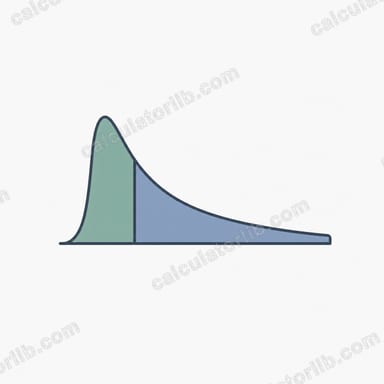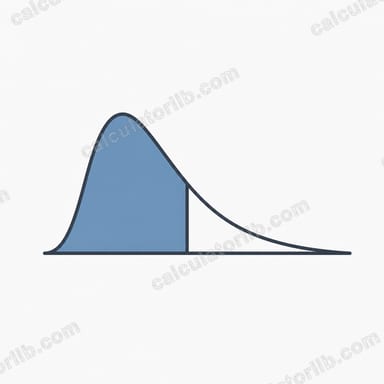

What is the F-distribution calculator?
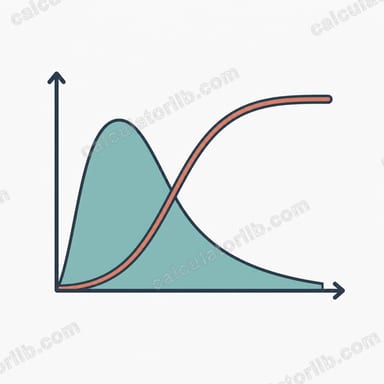
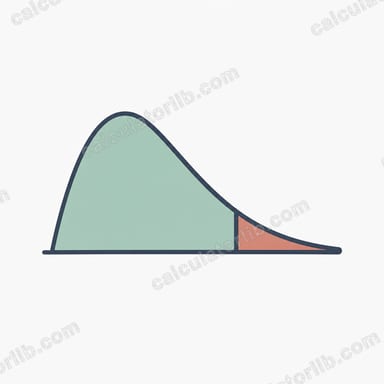
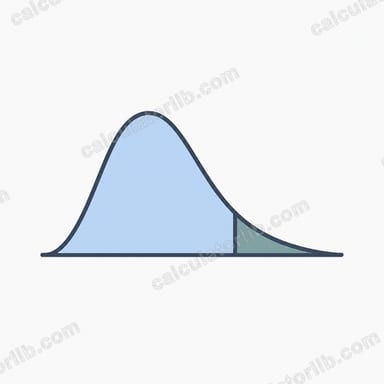
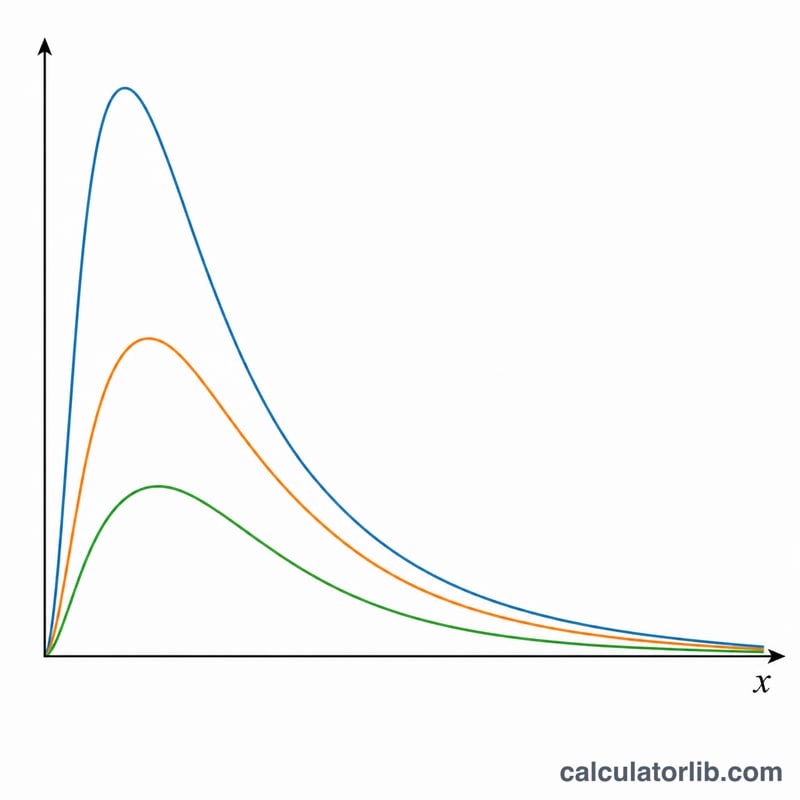
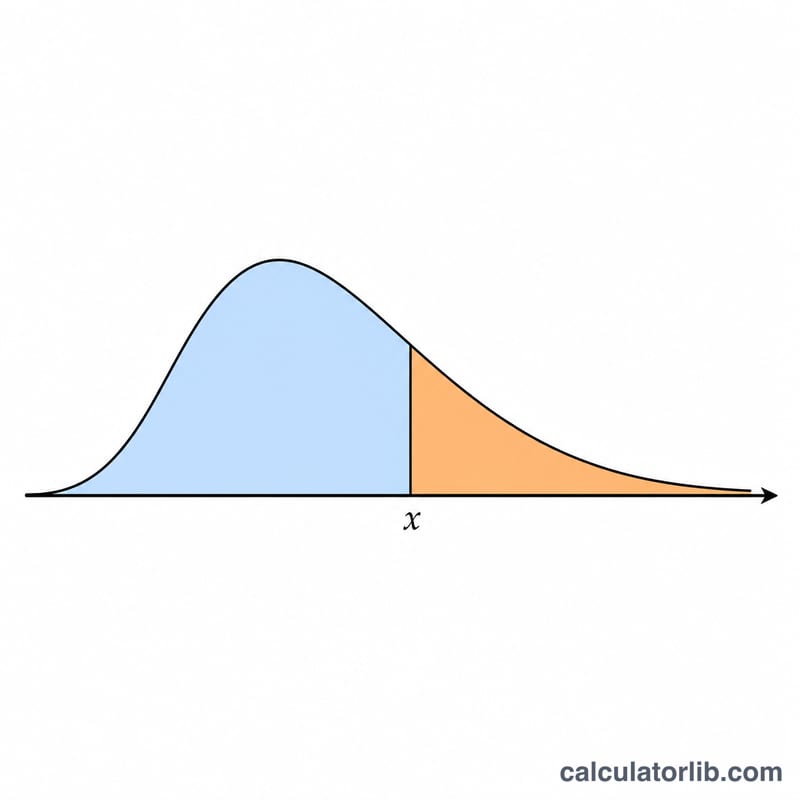
This tool evaluates the F-distribution (Fisher-Snedecor distribution) for a given percent point x and two degrees-of-freedom parameters: numerator v1 and denominator v2. It returns the probability density f(x), the lower cumulative probability P(X ≤ x), and the upper (tail) probability P(X > x). The F-distribution is universal in statistics and applies identically everywhere, with no country-specific assumptions.
How to use it
Enter the percent point x (must be 0 or greater), the numerator degrees of freedom v1 (greater than 0), and the denominator degrees of freedom v2 (greater than 0). Both df values may be non-integer. The calculator returns the density and the two cumulative probabilities, which always satisfy lower + upper = 1.
The formula explained
The density is $$f(x) = \frac{\sqrt{\dfrac{(v_1\,x)^{v_1}\,v_2^{\,v_2}}{(v_1\,x + v_2)^{v_1+v_2}}}}{x \cdot B\!\left(\dfrac{v_1}{2},\dfrac{v_2}{2}\right)},$$ where \(B\) is the Beta function and \(d_1 = v_1\), \(d_2 = v_2\). The cumulative distribution uses the regularized incomplete beta function: $$P(X \le x) = I_{z}\!\left(\dfrac{v_1}{2},\,\dfrac{v_2}{2}\right),\qquad z = \dfrac{v_1\,x}{v_1\,x + v_2}.$$ We compute the log-Gamma via the Lanczos approximation and the incomplete beta via a continued-fraction (Lentz's method).
Worked example
For \(x = 1\), \(v_1 = 2\), \(v_2 = 1\): \(B(1, 0.5) = 2\), so $$f(1) = \frac{2^1 \cdot 1^0 \cdot 3^{-1.5}}{2} = 3^{-1.5} \approx 0.19245.$$ For the CDF, \(z = 2/3\), and \(I_{2/3}(1, 0.5) = 1 - (1/3)^{0.5} \approx 0.42265\), so \(P(X > 1) \approx 0.57735\).
FAQ
Can the degrees of freedom be decimals? Yes. The F-distribution is well defined for any positive real df.
What happens at x = 0? The lower probability is 0 and the upper is 1. The density is +infinity if \(v_1 < 2\), equals 1 if \(v_1 = 2\), and is 0 if \(v_1 > 2\).
What is the upper cumulative probability used for? It is the p-value of an F-test: the chance of an F-statistic at least as large as x under the null hypothesis.