
What Is a Perfect Cube?
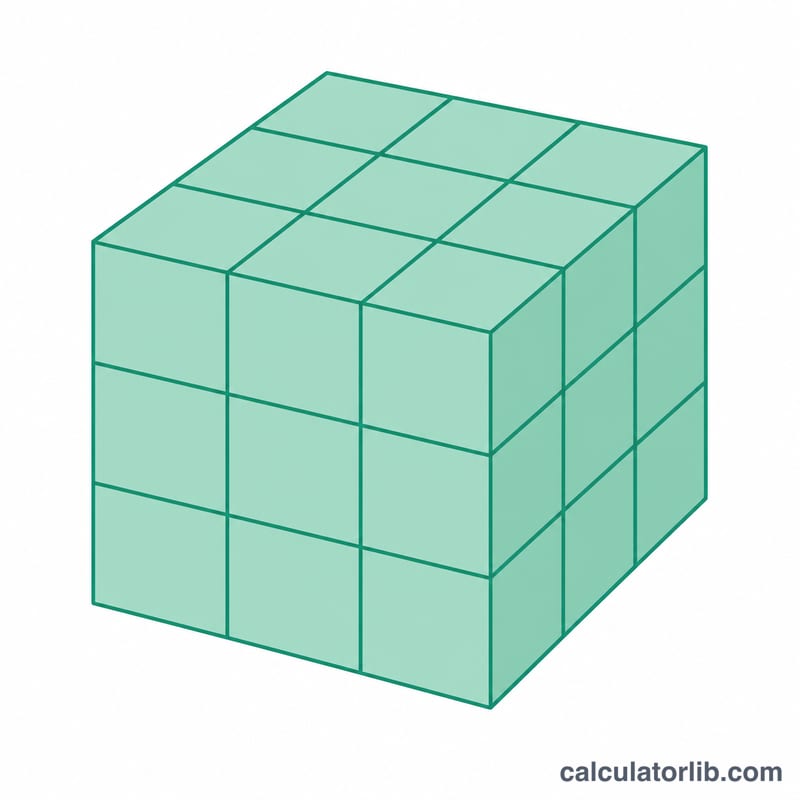
A perfect cube is an integer that can be written as another integer multiplied by itself three times — that is, \(n = k^3\) for some whole number \(k\). For example, 27 is a perfect cube because \(3 \times 3 \times 3 = 27\), and 1000 is a perfect cube because \(10^3 = 1000\). This calculator instantly tells you whether the number you enter is a perfect cube, gives its integer cube root if it is, and shows the closest perfect cube if it is not.
How to Use the Calculator
Type any whole number into the input box and submit. The tool computes the cube root, rounds it to the nearest integer, cubes that integer, and compares the result with your original number. If they match exactly, the number is a perfect cube. Negative numbers work too, since the cube of a negative number is negative (for example, \(-8 = (-2)^3\)).
The Formula Explained
The reliable way to test a perfect cube without floating-point error is: take the cube root, round it to the nearest integer \(k\), then check whether \(k^3\) equals the original number. In symbols, \(n\) is a perfect cube exactly when
$$\text{Perfect Cube} \iff \left(\operatorname{round}\!\left(\sqrt[3]{\left|\text{Number}\right|}\,\right)\right)^{3} = \left|\text{Number}\right|$$Rounding before cubing avoids tiny rounding errors that direct comparison of the raw cube root would introduce.
Worked Example
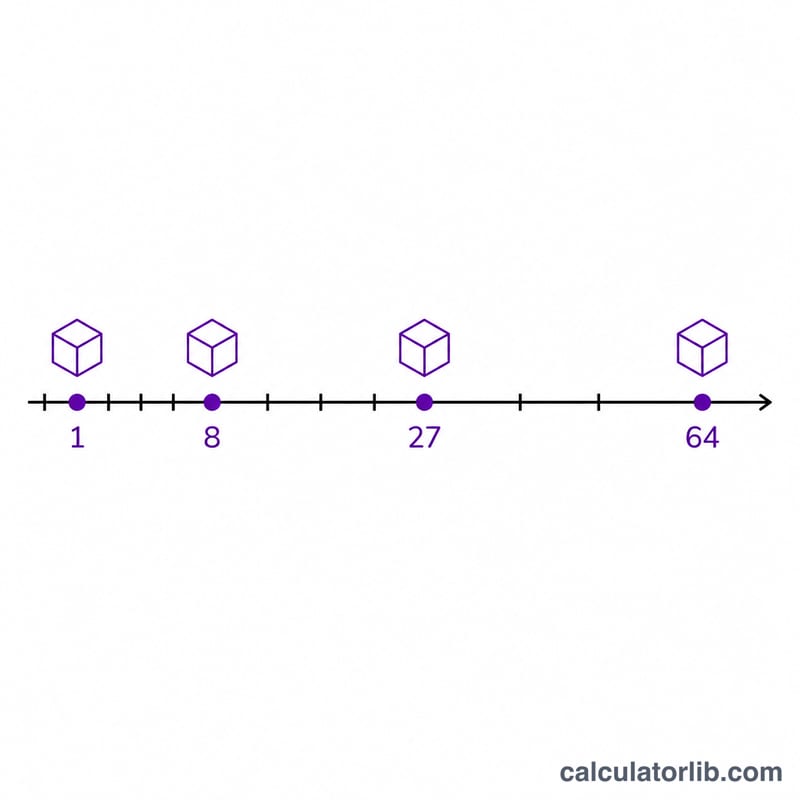
Take \(n = 64\). Its cube root is 4 exactly, and \(4^3 = 64\), so 64 is a perfect cube with root 4. Now take \(n = 100\). The cube root is about \(4.64\), which rounds to 5, but \(5^3 = 125 \neq 100\), so 100 is not a perfect cube — the nearest perfect cube is 125.
FAQ
Is 0 a perfect cube? Yes. \(0 = 0^3\), so zero is a perfect cube.
Can a negative number be a perfect cube? Yes. Unlike perfect squares, negative numbers can be perfect cubes — for example, \(-27 = (-3)^3\).
What are the first few perfect cubes? 0, 1, 8, 27, 64, 125, 216, 343, 512, 729 and 1000.