
What this calculator does
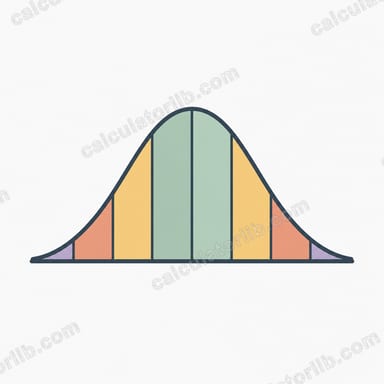
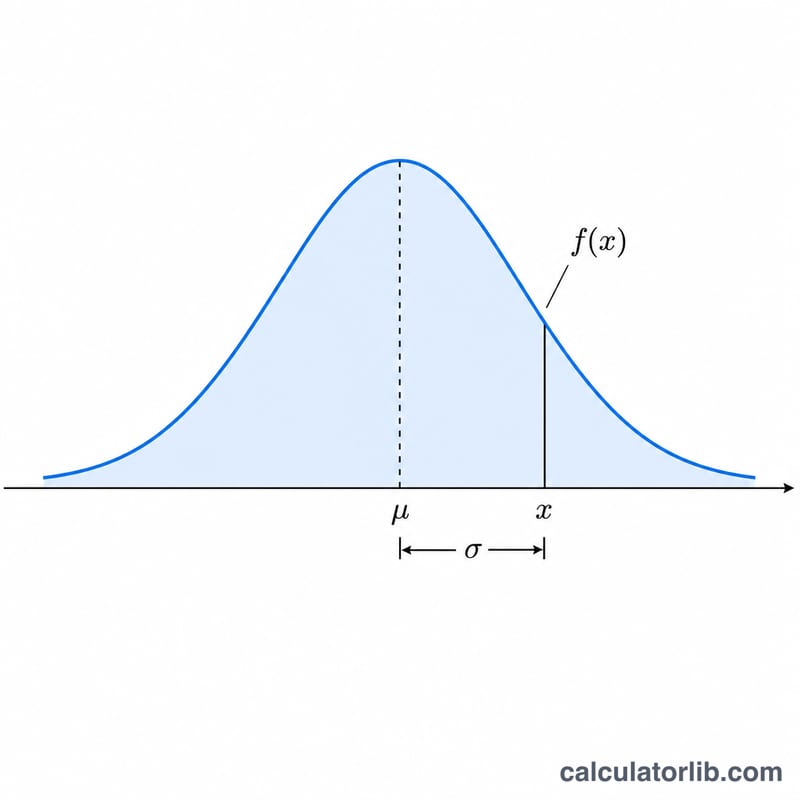
The Normal Distribution Calculator evaluates a normally distributed variable at a chosen point x, given a mean (mu) and a standard deviation (sigma). It returns three core quantities: the probability density \(f(x)\), the lower cumulative probability \(P(X \le x)\), and the upper cumulative probability \(P(X > x)\). This is a universal mathematics and statistics tool with no country-specific assumptions. With the defaults \(\mu = 0\) and \(\sigma = 1\) it works on the standard normal distribution.
How to use it
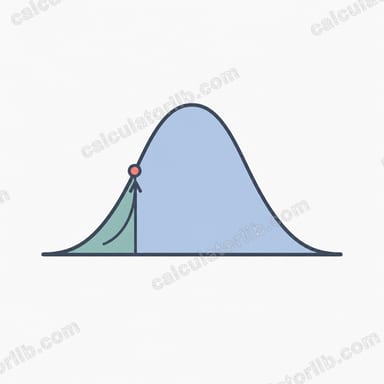
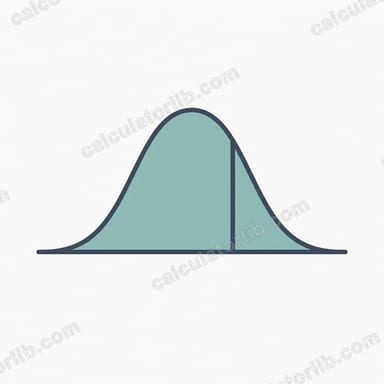
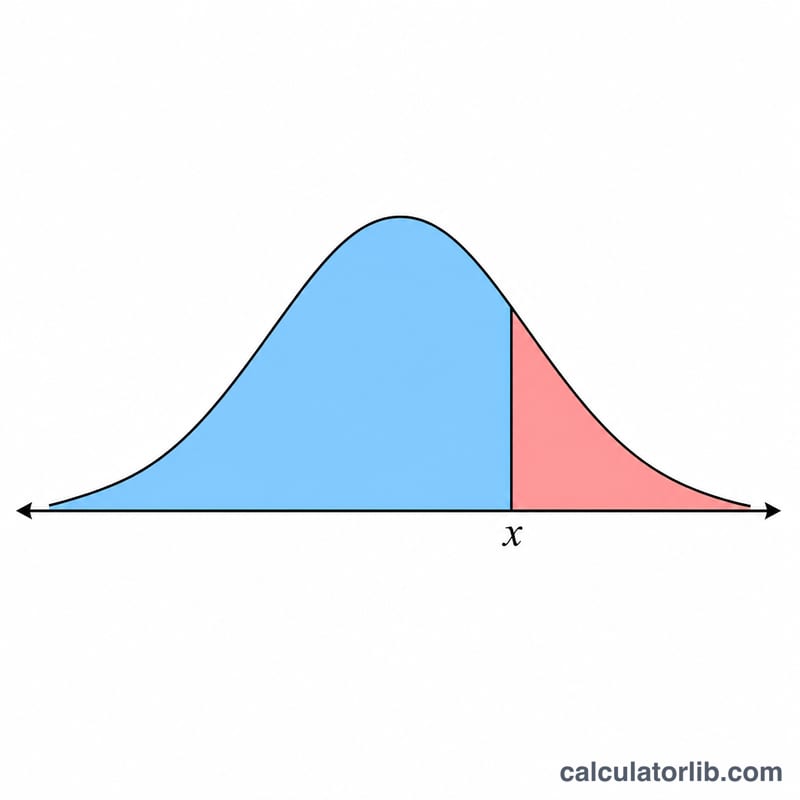
Enter the value x at which you want to evaluate the distribution, the mean mu, and the standard deviation sigma (which must be greater than 0). The calculator first standardizes the value using $$z = \frac{x - \mu}{\sigma}$$ then computes the density and both cumulative tails. The lower cumulative probability is the area under the curve to the left of x; the upper cumulative probability is the area to the right, and the two always add up to 1.
The formula explained
The probability density is $$f(x) = \frac{1}{\sigma\sqrt{2\pi}}\, e^{-\frac{\left(x - \mu\right)^2}{2\,\sigma^2}}$$ The lower cumulative probability is the cumulative distribution function $$\Phi(z) = \frac{1}{2}\left[1 + \operatorname{erf}\!\left(\frac{z}{\sqrt{2}}\right)\right]$$ where erf is the Gauss error function. Because the standard math library has no built-in erf, this tool uses the Abramowitz & Stegun 7.1.26 rational approximation, accurate to about \(10^{-7}\). The upper cumulative probability is simply \(1 - \Phi(z)\).
Worked example
Take an IQ-style distribution with \(\mu = 100\), \(\sigma = 15\), and evaluate at \(x = 130\). First $$z = \frac{130 - 100}{15} = 2$$ The density is $$f(130) = \frac{0.3989422804}{15} \cdot e^{-2} = 0.003599750$$ The lower cumulative probability \(\Phi(2) = 0.9772498681\), so the upper cumulative probability is \(0.0227501319\) - meaning roughly 2.28% of values exceed 130.
FAQ
What is z? z is the standardized score, the number of standard deviations x lies above (positive) or below (negative) the mean.
Why must sigma be positive? A standard deviation of zero or below makes the distribution undefined and causes division by zero, so sigma must be greater than 0.
Do f(x) and the probabilities add to 1? The two cumulative probabilities \(P(X \le x)\) and \(P(X > x)\) add to 1. The density \(f(x)\) is not a probability and is not part of that sum; it is the height of the curve at x.