
What is a reciprocal?
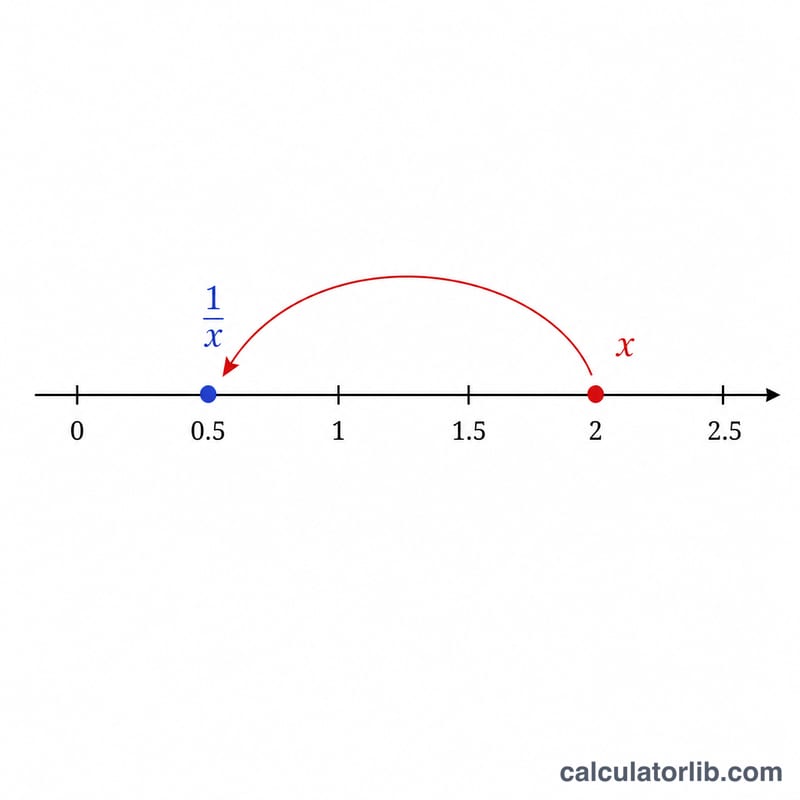
The reciprocal of a number — also called its multiplicative inverse — is the value that, when multiplied by the original number, gives 1. For any non-zero number \(x\), the reciprocal is simply \(1/x\). For example, the reciprocal of 4 is \(1/4 = 0.25\), because \(4 \times 0.25 = 1\).
How to use this calculator
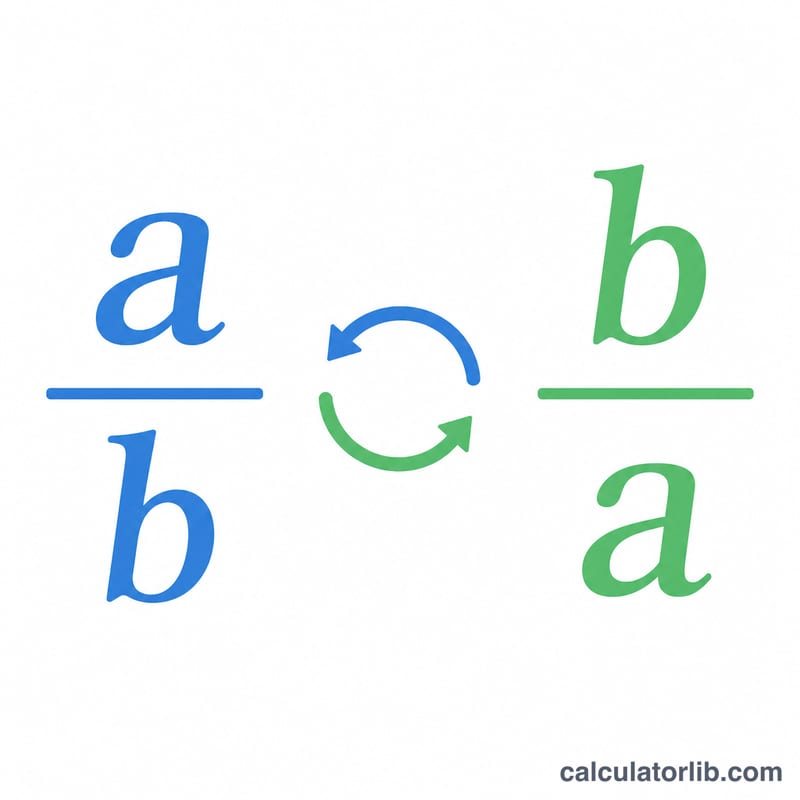
Enter a single number to get its reciprocal (\(1/x\)), or fill in the fraction fields (numerator \(a\) and denominator \(b\)) to find the reciprocal of a fraction. When you use the fraction inputs, the calculator flips them to give \(b/a\). If you enter zero, the result is undefined — division by zero is not allowed.
The formula explained
For a plain number: $$\text{Reciprocal} = \frac{1}{\text{Number }(x)}$$ For a fraction \(a/b\): $$\text{Reciprocal} = \frac{\text{Denominator }(b)}{\text{Numerator }(a)}$$ found by swapping the top and bottom. This works because \((a/b) \times (b/a) = 1\), satisfying the definition of a multiplicative inverse.
Worked example
Suppose you want the reciprocal of \(2/5\). Swap the numerator and denominator to get \(5/2 = 2.5\). Check: $$\frac{2}{5} \times \frac{5}{2} = \frac{10}{10} = 1 \checkmark$$ For a plain number such as 8, the reciprocal is \(1 \div 8 = 0.125\).
FAQ
Does every number have a reciprocal? Every number except zero. Zero has no reciprocal because \(1/0\) is undefined.
What is the reciprocal of 1? It is 1 itself, since \(1 \times 1 = 1\). The reciprocal of \(-1\) is \(-1\).
Can a reciprocal be a decimal? Yes — the reciprocal of 2 is 0.5, and the reciprocal of 0.25 is 4.