
What is the standard normal percentile calculator?
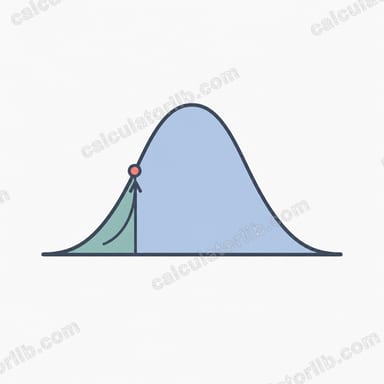
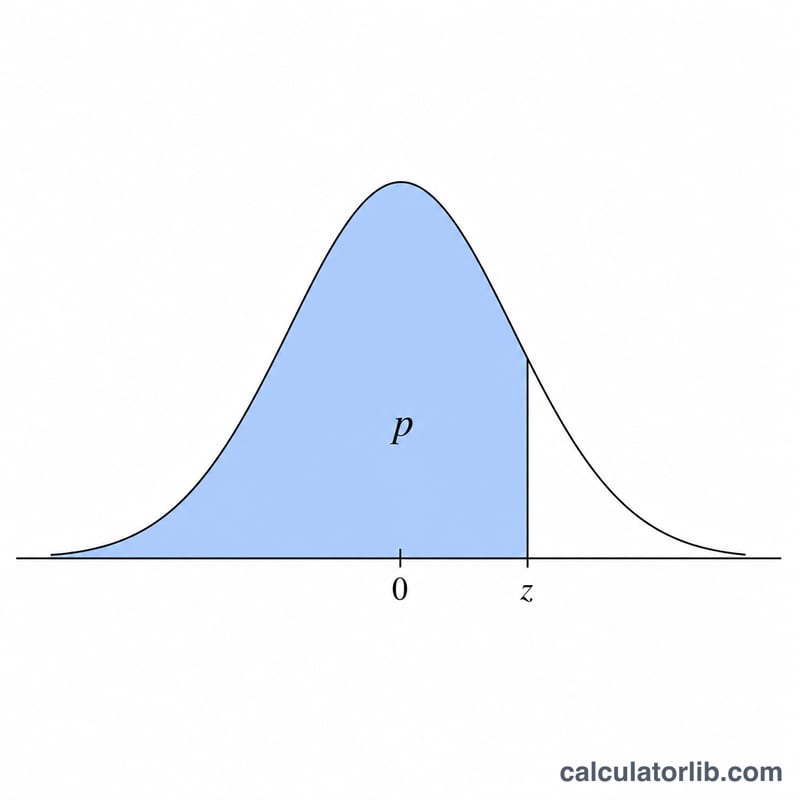
This tool computes the percent point (also called the percentile, quantile, or inverse-CDF z-value) of the standard normal distribution N(0,1). Given a cumulative probability, it returns the z value on the horizontal axis of the bell curve that cuts off that area. It is the inverse of the cumulative distribution function (CDF), often written \(z = \Phi^{-1}(p)\).
How to use it
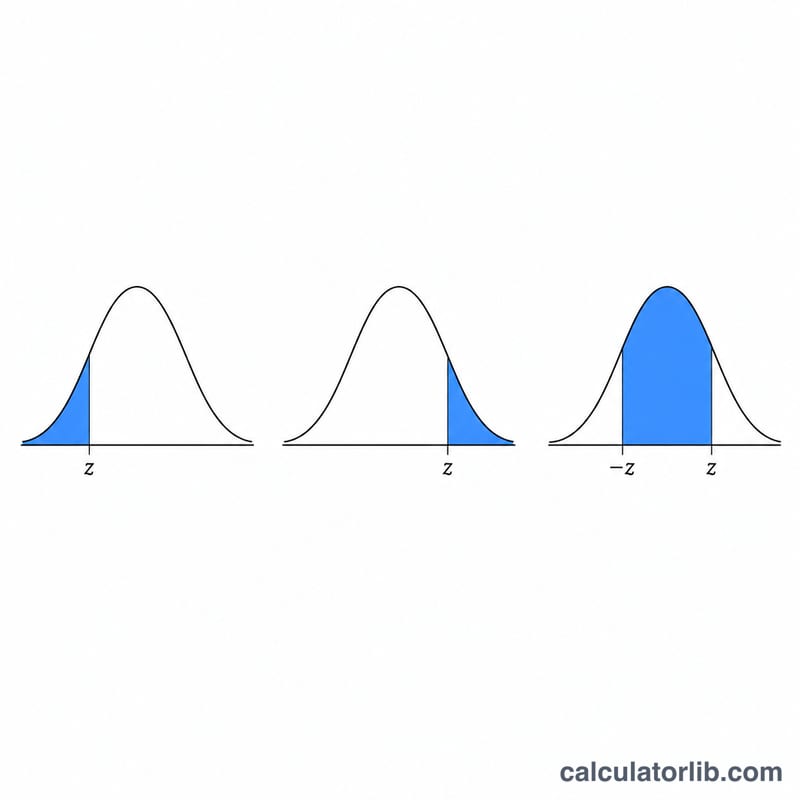
Pick how your probability should be read: Lower cumulative P (the area to the left of z), Upper cumulative Q (the area to the right), or Inner central two-sided (the symmetric central area between \(-z\) and \(+z\)). Then enter a probability strictly between 0 and 1. The calculator converts your input to a single lower-tail probability and returns the matching z.
The formula
The standard normal density is \(f(x) = \frac{1}{\sqrt{2\pi}}\cdot e^{-x^2/2}\) and the CDF is \(\Phi(x)\). We invert it: for lower mode \(p_{\text{lower}} = p\); for upper mode \(p_{\text{lower}} = 1 - p\); for inner mode \(p_{\text{lower}} = \frac{1 + p}{2}\) with \(z \ge 0\). Then $$z = \Phi^{-1}(p_{\text{lower}})$$ is evaluated with Acklam's high-accuracy rational approximation (about \(1\mathrm{e}{-9}\) relative error).
Worked example
Lower mode with \(p = 0.975\) gives $$z = \Phi^{-1}(0.975) \approx 1.959964$$ — the familiar 1.96 used in 95% confidence intervals. Inner mode with \(p = 0.95\) also yields 1.96, so the 95% central interval is \([-1.96, +1.96]\).
FAQ
Why must p be between 0 and 1? At \(p = 0\) or \(p = 1\) the z value is \(-\infty\) or \(+\infty\), so those are rejected.
How are upper and lower modes related? The upper-mode z equals the negative of the lower-mode z for the same probability: \(\Phi^{-1}(1-p) = -\Phi^{-1}(p)\).
Is it exact? No closed form exists, but Acklam's approximation is accurate to about nine significant figures, far beyond display needs.