
What this calculator does
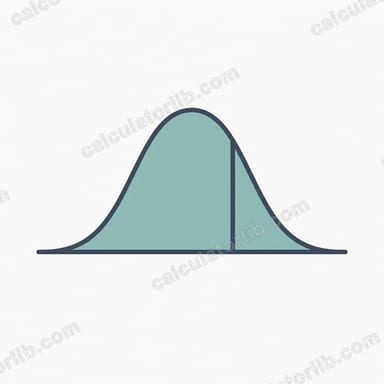
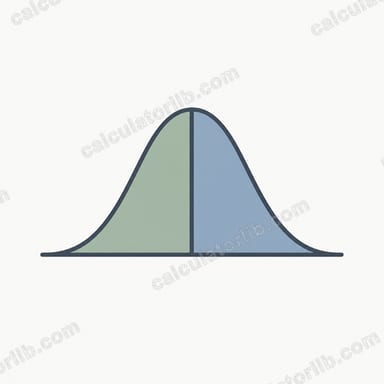
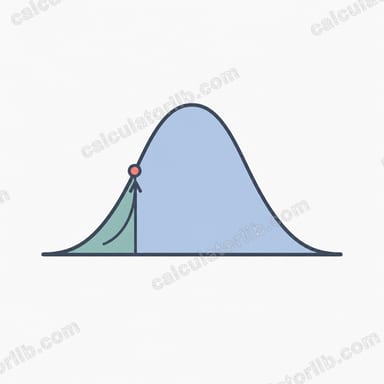
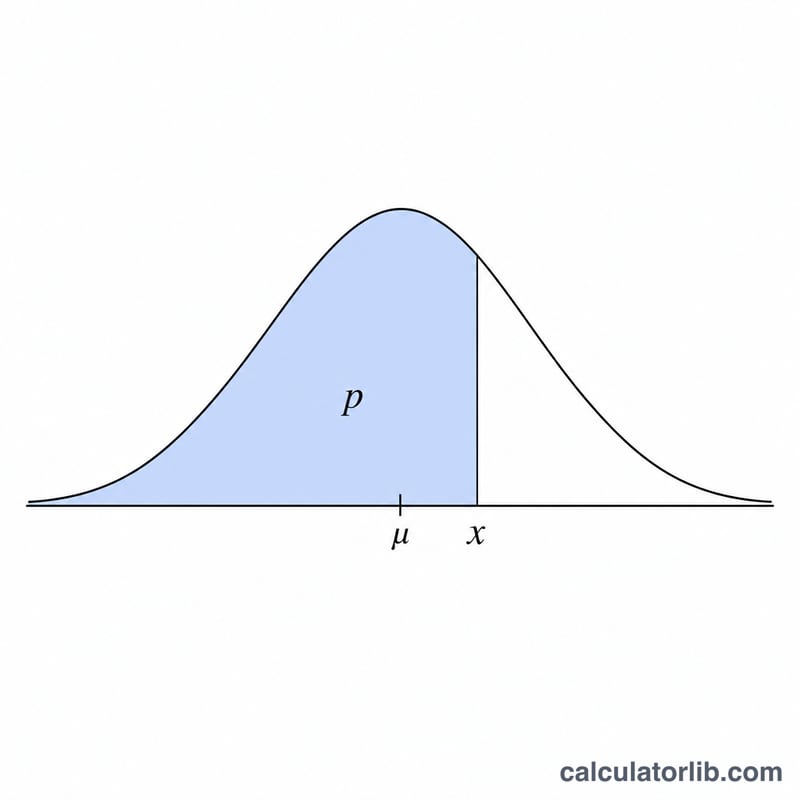
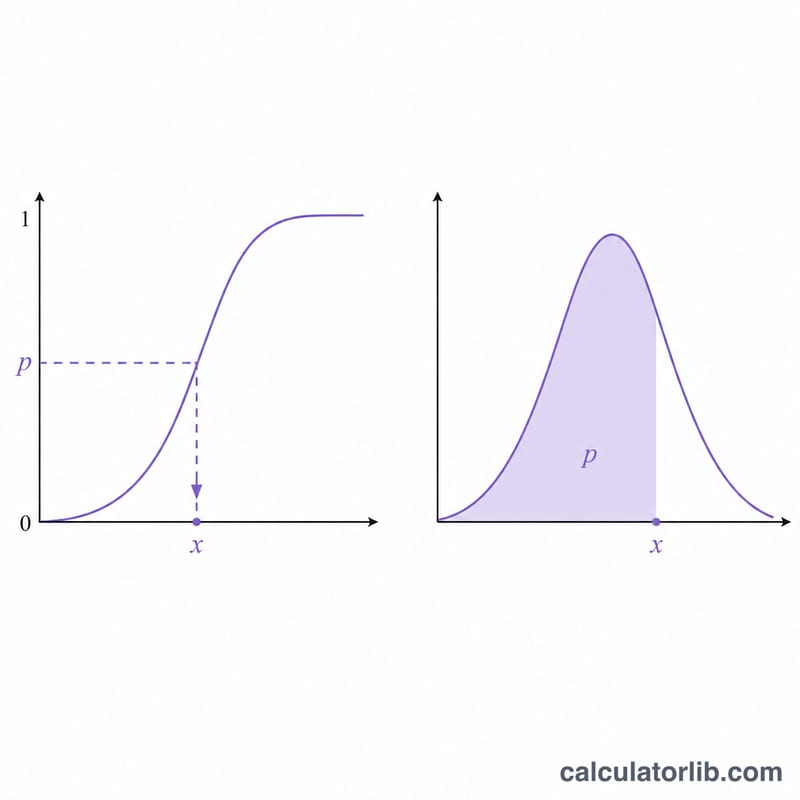
This tool computes the percentile point (also called the quantile or critical value) of a normal distribution. You give it a cumulative probability and it returns the value x on the distribution's axis such that the requested amount of probability lies below (or above) it. It is the inverse of the normal cumulative distribution function (CDF). With mean 0 and standard deviation 1 it returns the familiar standard-normal z-value. This is universal pure mathematics and applies the same everywhere.
How to use it
Pick a cumulative mode. Choose Lower cumulative P when your probability is the left-tail area P(X ≤ x), or Upper cumulative Q when it is the right-tail area P(X > x). Enter the probability strictly between 0 and 1. Then enter the distribution's mean and standard deviation (use 0 and 1 for the standard normal). The result shows the percentile point x and its standardized z-score.
The formula explained
Let \(\Phi\) be the standard normal CDF. First convert your input to a lower-tail probability: \(p_{lower} = P\) for lower mode, or \(p_{lower} = 1 - Q\) for upper mode. Then take the inverse normal CDF (probit): \(z = \Phi^{-1}(p_{lower})\). Finally un-standardize:
$$x = \mu + \sigma \cdot z$$We use the Acklam rational approximation refined with a Newton step for roughly 1e-9 accuracy.
Worked example
Upper mode, \(Q = 0.025\), \(\mu = 100\), \(\sigma = 15\). Convert: \(p_{lower} = 1 - 0.025 = 0.975\). Quantile: \(z = \Phi^{-1}(0.975) \approx 1.959964\). Un-standardize:
$$x = 100 + 15 \times 1.959964 \approx 129.40$$So about 2.5% of the distribution lies above 129.4.
FAQ
Why does z equal x sometimes? Only in the standard-normal case (\(\mu = 0\), \(\sigma = 1\)), where \(x = z\).
What happens at p = 0.5? In lower mode the quantile is exactly the mean, since \(z = 0\).
Can I enter 0 or 1? No. The quantile diverges to \(-\infty\) at 0 and \(+\infty\) at 1, so probability must be strictly between 0 and 1, and \(\sigma\) must be greater than 0.