What is the Number Line Plot Calculator?
This tool takes a single real number and places it as a point on a one-dimensional number line. It is a pure math visualization aid that helps learners see the magnitude and sign of a value relative to zero, and relative to a sensibly scaled axis. The number can be positive, negative, zero, fractional, or very large — the calculator chooses a clean axis automatically.
How to use it
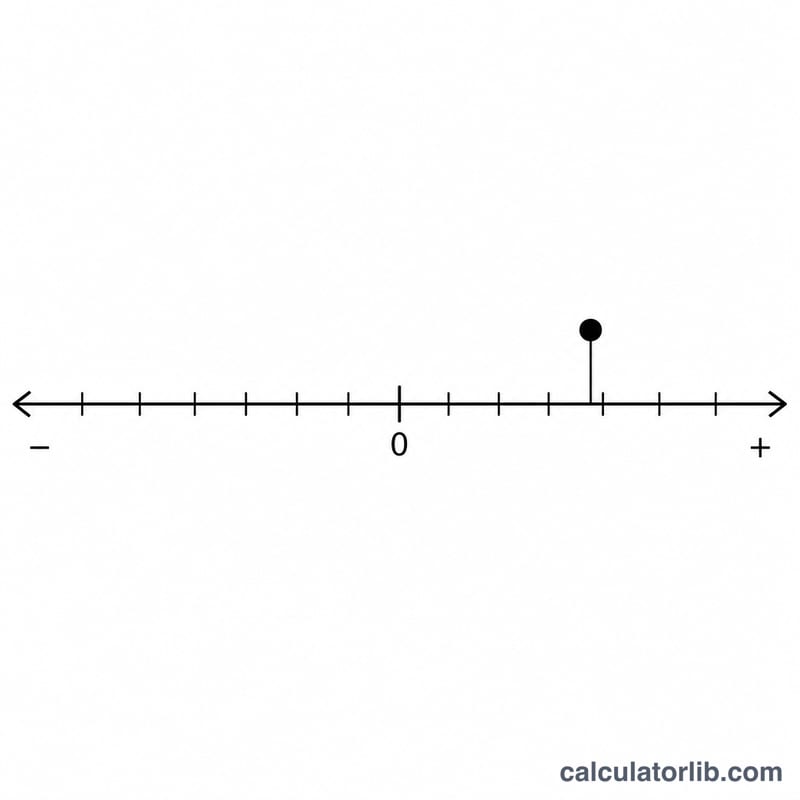
Enter your value and submit. The calculator returns the plotted value, the axis minimum and maximum, the tick spacing, and the normalized position (a fraction between 0 and 1 that tells you how far along the axis the marker sits). A drawn number line shows a red marker at exactly that fraction.
The scale algorithm explained
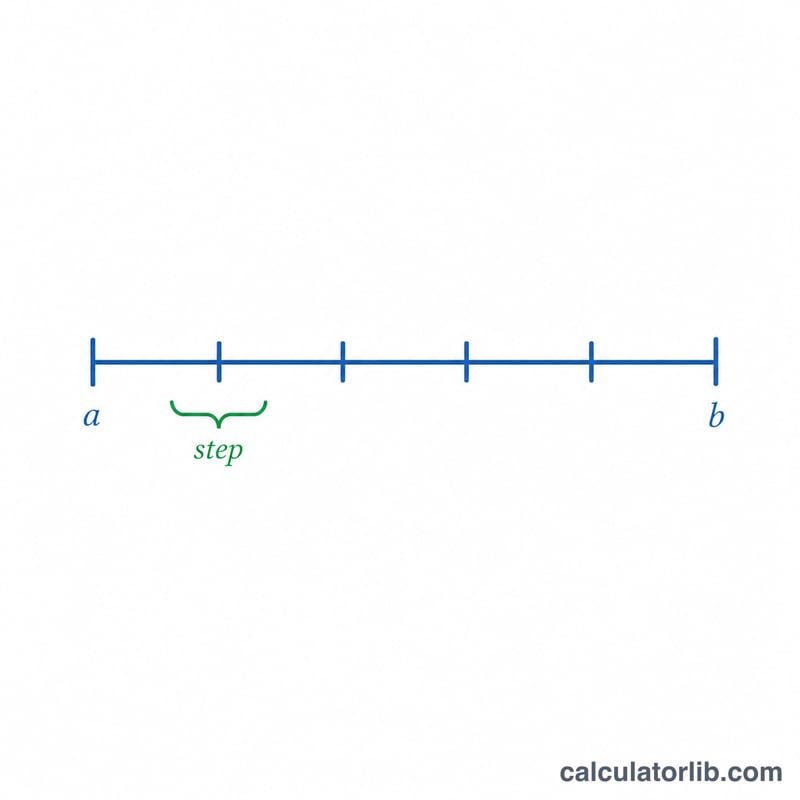
If the value is zero, a symmetric axis from -1 to 1 is used with ticks every 0.5 (this also avoids a zero-width axis). Otherwise the calculator works from the absolute value a. It computes exp = floor(log10(a)) and f = a / 10exp so that \(1 \le f < 10\), then rounds f up to the nearest of 1, 2, 5, or 10 to get a round bound that comfortably contains the value. Positive values get an axis from 0 to the bound; negative values get an axis from the negative bound up to 0. Tick spacing is bound divided by 5, giving five clean divisions. If the value lands exactly on the bound, the bound is bumped to the next nice number so the marker is not stuck on the edge.
Worked example
For value = 50: \(a = 50\), exp = 1, \(f = 5\), niceF = 5, bound = 50. Since 50 equals the bound, it bumps to 100. So axisMin = 0, axisMax = 100, tickStep = 20 (ticks at 0, 20, 40, 60, 80, 100). The normalized position is $$\frac{50 - 0}{100 - 0} = 0.5,$$ so the marker sits exactly halfway.
Axis Scaling Across Different Values
The tool picks a "nice" axis around the value you enter. It writes the magnitude as \(|\text{value}| = f \times 10^{\text{exp}}\) with \(1 \le f < 10\), rounds the mantissa \(f\) up to a round bound (2, 5 or 10, where an exact 2 or 5 moves up to the next bound), and spreads five tick intervals across the axis. Zero is a special case with the axis \(-1\) to \(1\) and step 0.5. The position is \(\text{Position}\% = \frac{\text{value} - \text{axisMin}}{\text{axisMax} - \text{axisMin}} \times 100\). Positive values start the axis at 0 and negative values end it at 0.
| value | axisMin | axisMax | tickStep | normalized position |
|---|---|---|---|---|
| 0 | -1 | 1 | 0.5 | 50% |
| 3 | 0 | 5 | 1 | 60% |
| -3 | -5 | 0 | 1 | 40% |
| 0.07 | 0 | 0.1 | 0.02 | 70% |
| 50 | 0 | 100 | 20 | 50% |
| 250 | 0 | 500 | 100 | 50% |
| 12,000 | 0 | 20,000 | 4,000 | 60% |
Worked check for -3: \(\frac{-3 - (-5)}{0 - (-5)} \times 100 = \frac{2}{5} \times 100 = 40\%\). Here \(\text{exp}=0\) and \(f=3\), which rounds up to 5, so the axis is \(-5\) to \(0\).
Worked check for 12,000: \(\text{exp}=4\) and \(f=1.2\), which rounds up to 2, so axisMax is \(2 \times 10^4 = 20{,}000\), the step is \(20{,}000 \div 5 = 4{,}000\), and the position is \(\frac{12000 - 0}{20000 - 0} \times 100 = 60\%\).
Key Terms
- Real number: any number that can sit on a continuous line, including integers, fractions, decimals, and irrational numbers such as \(\sqrt{2}\) or \(\pi\).
- Number line: a straight line on which each real number has exactly one position. Values increase to the right and decrease to the left.
- Sign: whether the value is positive (right of zero), negative (left of zero), or zero.
- Absolute value: the distance of a number from zero, written \(|x|\). Both 3 and -3 have an absolute value of 3.
- Axis minimum / maximum (axisMin, axisMax): the values at the left and right ends of the plotted axis, chosen automatically so the point sits inside the range.
- Tick step: the spacing between labeled tick marks on the axis, for example 20 on an axis from 0 to 100.
- Normalized position: where the marker sits along the axis as a percentage, from 0% at axisMin to 100% at axisMax.
- Exponent (exp): the power of ten in scientific notation, \(\text{exp} = \lfloor \log_{10}|x| \rfloor\). For 250 it is 2, and for 0.07 it is -2.
- Mantissa (f): the scaled magnitude \(f = |x| / 10^{\text{exp}}\), always from 1 up to (but not including) 10. For 250 it is 2.5, and for 0.07 it is 7. The tool rounds \(f\) up to a round bound to set the axis limits.
FAQ
Can I plot a negative number? Yes. A value of -3 produces an axis from -5 to 0 with the marker 40% from the left end.
What does normalized position mean? It is the fraction (0 to 1) of the way along the axis where the marker sits — 0 is the left end, 1 is the right end.
Is this region-specific? No. It is universal mathematics and works for any real number.