
What this calculator does
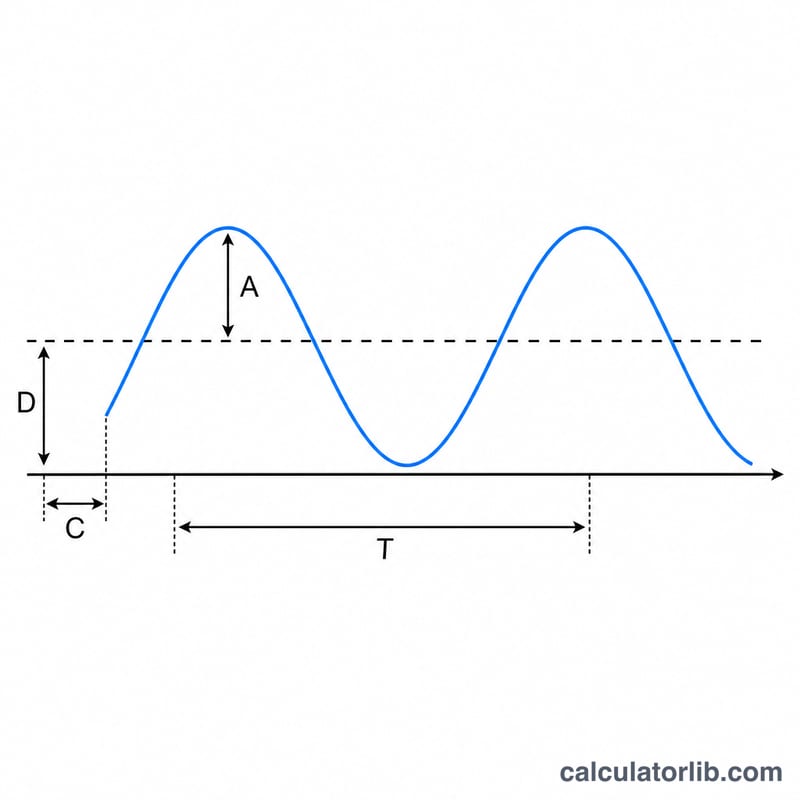
This Sine Function Calculator evaluates the general transformed sine wave \(y = A \cdot \sin(B(x - C)) + D\) at any input value x. Beyond the single output value, it also reports the wave's key characteristics: amplitude, period, and midline. It works for both radians and degrees, so you can use whichever convention your problem requires.
How to use it
Enter the four transformation parameters and the point at which you want to evaluate the function:
A stretches the wave vertically (amplitude). B compresses or stretches it horizontally and controls the period. C shifts the wave left or right (phase shift). D raises or lowers the whole wave (vertical shift / midline). Choose whether your x value is in radians or degrees, then read the computed y below.
The formula explained
Start with the base function \(\sin(\theta)\), which oscillates between \(-1\) and \(1\). Multiplying by A scales those bounds to \(\pm|A|\). Replacing the argument with \(B(x - C)\) speeds up the oscillation by a factor of B and slides it horizontally by C. Finally, adding D lifts the entire curve so it oscillates around the line \(y = D\) instead of \(y = 0\). The period of one complete cycle is $$T = \frac{2\pi}{|B|}$$ (or \(360/|B|\) in degrees).
Worked example
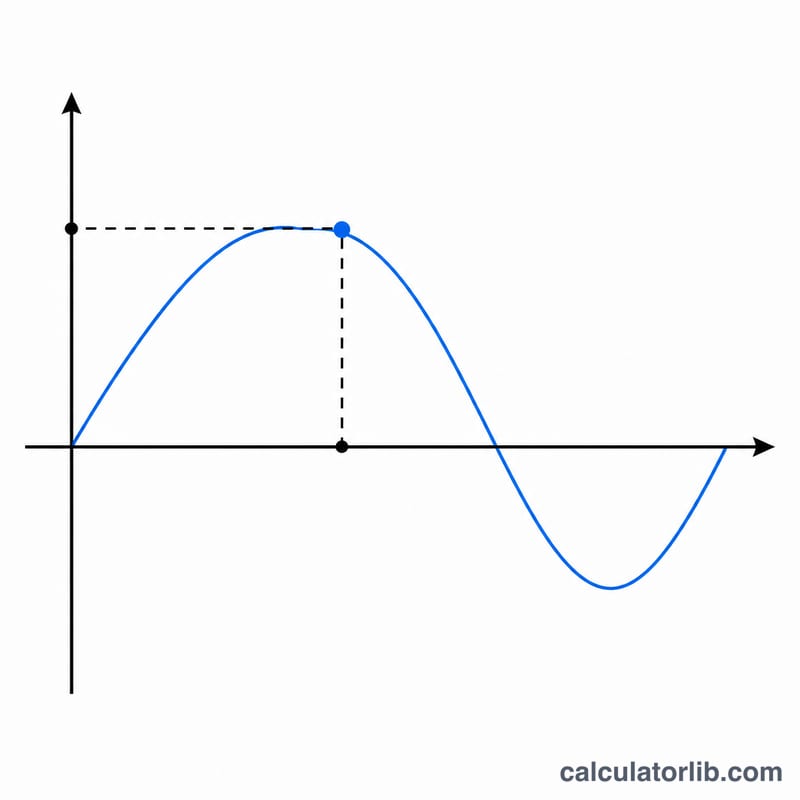
Let \(A = 2\), \(B = 1\), \(C = 0\), \(D = 0\), and \(x = \pi/2\) radians (\(\approx 1.5708\)). Then $$y = 2 \cdot \sin(1 \cdot (1.5708 - 0)) + 0 = 2 \cdot \sin(1.5708) = 2 \cdot 1 = 2.$$ The amplitude is \(|2| = 2\) and the period is \(2\pi/|1| \approx 6.283185\).
FAQ
What is the difference between B and the period? B is the frequency factor; the period is \(2\pi/|B|\). A larger B means a shorter period (more cycles in the same span).
Why does C subtract inside the parentheses? Writing \(B(x - C)\) makes C the exact horizontal shift in x-units. A positive C shifts the graph to the right.
Radians or degrees? Use the unit that matches your x and B. The calculator interprets \(B(x - C)\) in the unit you select and converts internally for the sine.