

What is the Powers of i Calculator?
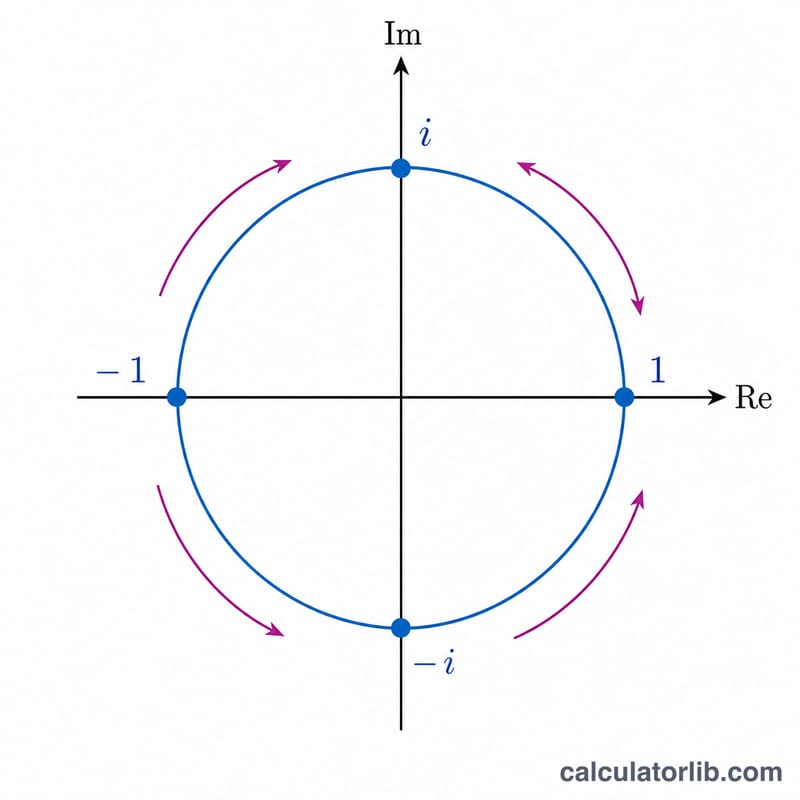
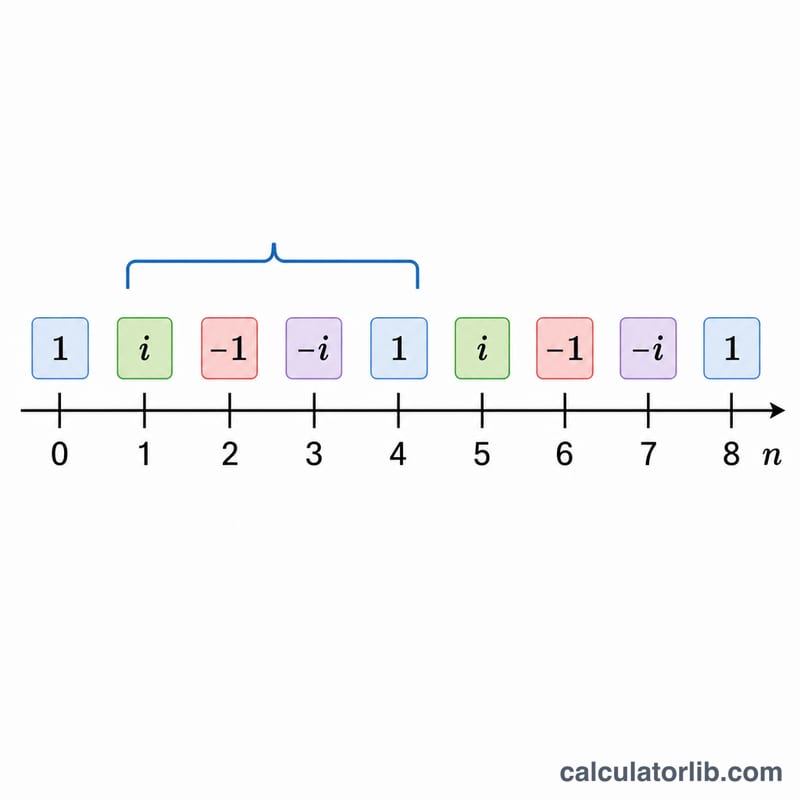
The imaginary unit i is defined by \(i^2 = -1\). When you raise i to successive integer powers, the results repeat in a cycle of four: \(i^0 = 1\), \(i^1 = i\), \(i^2 = -1\), \(i^3 = -i\), and then \(i^4 = 1\) again. This calculator takes any integer exponent n — positive, zero, or negative — and instantly returns \(i^n\) as one of the four values 1, i, −1, or −i, along with its real and imaginary parts.
How to use it
Type the exponent n into the input box and submit. The calculator computes n mod 4 (adjusted so negative numbers behave correctly) and maps the remainder to the corresponding value. A remainder of 0 gives 1, 1 gives i, 2 gives −1, and 3 gives −i.
The formula explained
Because \(i^4 = 1\), multiplying by \(i^4\) never changes a value. So \(i^n\) depends only on n modulo 4. To handle negative exponents cleanly, the tool uses a true modulo:
$$i^{\text{Exponent (n)}} = i^{\,((\,n \bmod 4)\,+\,4)\,\bmod\,4}$$For example, \(i^{-1} = 1/i = -i\), which corresponds to remainder 3.
Worked example
Compute \(i^{13}\). Divide 13 by 4: the remainder is 1 (since \(13 = 4\times 3 + 1\)). Therefore
$$i^{13} = i^1 = i$$with real part 0 and imaginary part 1.
FAQ
What is \(i^0\)? Any nonzero number raised to the power 0 is 1, so \(i^0 = 1\).
Does it work for negative exponents? Yes. For instance \(i^{-2} = -1\) and \(i^{-1} = -i\), handled by the adjusted modulo.
Why does it cycle every 4? Because \(i^2 = -1\) means \(i^4 = (i^2)^2 = (-1)^2 = 1\), returning to the start.