
What It Does
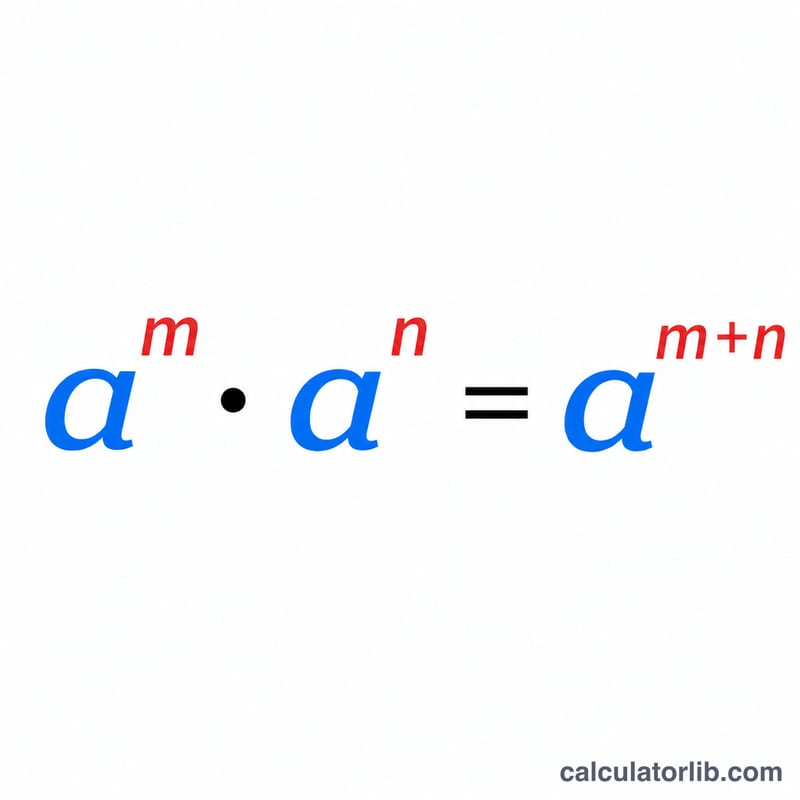
This calculator applies the product of powers rule: when you multiply two exponential terms that share the same base, you keep the base and simply add the exponents. The rule is written as \(a^m \times a^n = a^{(m+n)}\). It works for any real base and any integer or decimal exponents.
How to Use It
Enter the common base \(a\), then the two exponents \(m\) and \(n\). The calculator returns the combined exponent \((m + n)\) and evaluates the final numeric value. This is useful for algebra homework, simplifying expressions, scientific notation, and quick mental-math checks.
The Formula Explained
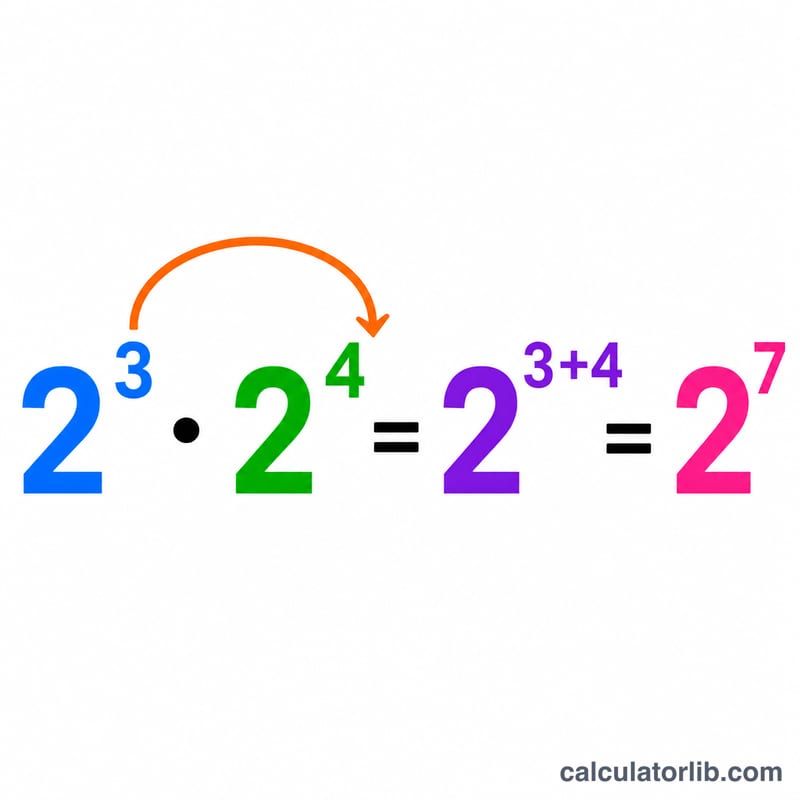
Exponents represent repeated multiplication. For example, \(a^3\) means \(a \times a \times a\). So $$a^3 \times a^4 = (a \times a \times a) \times (a \times a \times a \times a) = a^7$$ Counting the factors shows why you add the exponents: \(3 + 4 = 7\). This holds for negative and fractional exponents too.
Worked Example
Suppose \(a = 2\), \(m = 3\), \(n = 4\). The combined exponent is \(3 + 4 = 7\), so the answer is $$2^7 = 128$$ The calculator displays both the simplified exponent (7) and the evaluated value (128).
FAQ
Does this work with negative exponents? Yes. For example \(5^2 \times 5^{-3} = 5^{-1} = 0.2\).
What if the bases are different? The product rule only applies when the bases are identical. With different bases you cannot simply add exponents.
Can the base be a fraction or decimal? Yes, any real base works, such as 0.5 or 1.5.