
What This Calculator Does
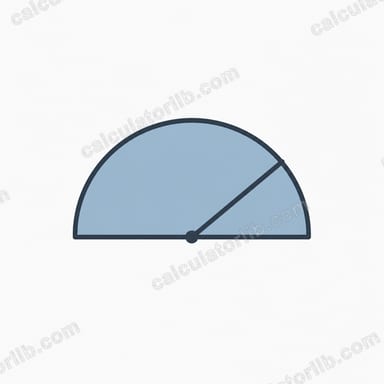
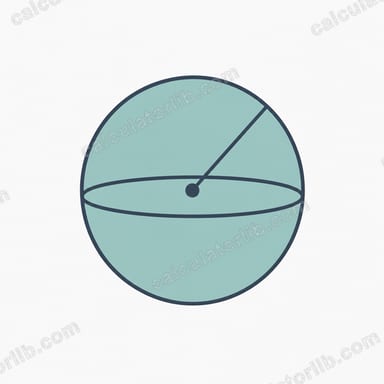
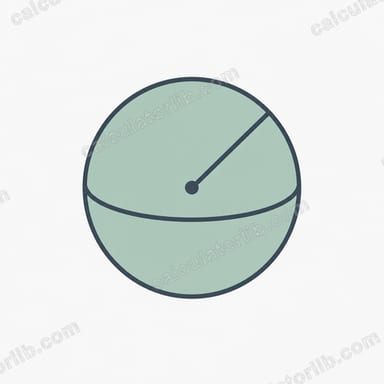
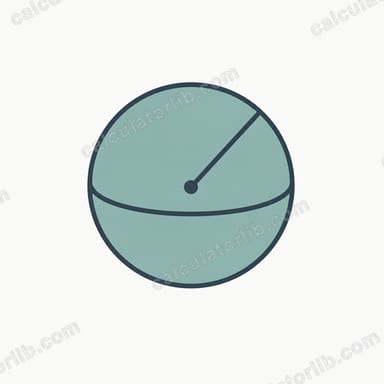
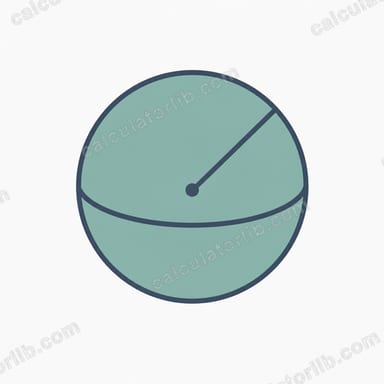
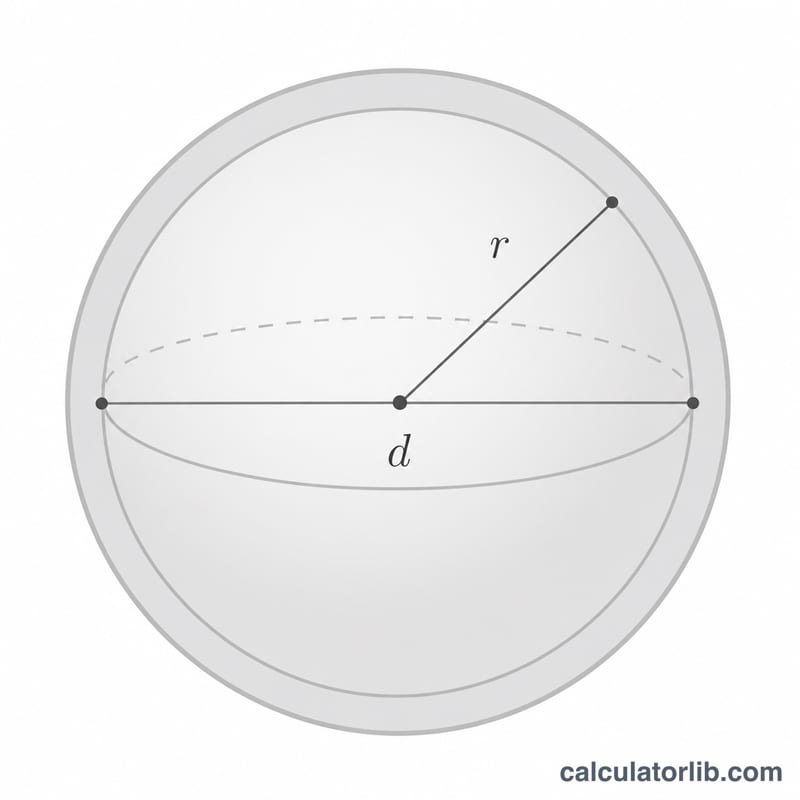
The Circle to Sphere Volume Calculator turns the radius of a circle into the volume of the three-dimensional sphere it would generate when rotated about its diameter. Enter a single radius and instantly get the sphere's volume, along with its diameter and surface area. It works for any unit (cm, m, inches) — the answer is simply in the cubed version of whatever unit you supply.
How to Use It
Type the radius into the input box and submit. If you only know the diameter, divide it by two first. The calculator returns the volume in cubic units, plus the diameter (\(2r\)) and surface area (\(4\pi r^{2}\)) as handy reference values.
The Formula Explained
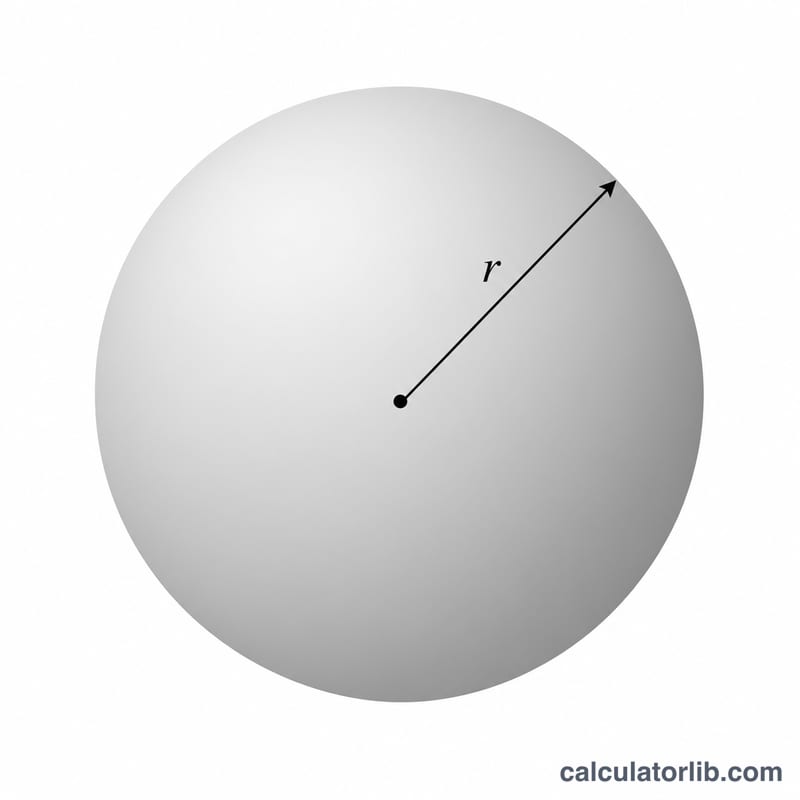
A sphere's volume is given by $$V = \frac{4}{3}\pi r^{3}$$. The radius is cubed because volume is a three-dimensional measure, then scaled by \(\pi\) and the constant factor \(\frac{4}{3}\), which arises from integrating the cross-sectional areas of the circle across the sphere. Doubling the radius multiplies the volume by eight (\(2^{3}\)).
Worked Example
For a radius of 5 units: \(r^{3} = 125\), so $$V = \frac{4}{3} \times \pi \times 125 \approx 4.18879 \times 125 \approx 523.60 \text{ cubic units}$$ The diameter is 10 and the surface area is \(4 \times \pi \times 25 \approx 314.16\) square units.
FAQ
What units does the result use? Whatever unit you enter the radius in, raised to the third power. A radius in cm gives volume in cm³.
Why is the radius cubed? Volume is three-dimensional, so each linear dimension contributes a factor of the radius — hence \(r \times r \times r = r^{3}\).
Can I use the diameter instead? Yes — just halve the diameter to get the radius before entering it.