
What this calculator does
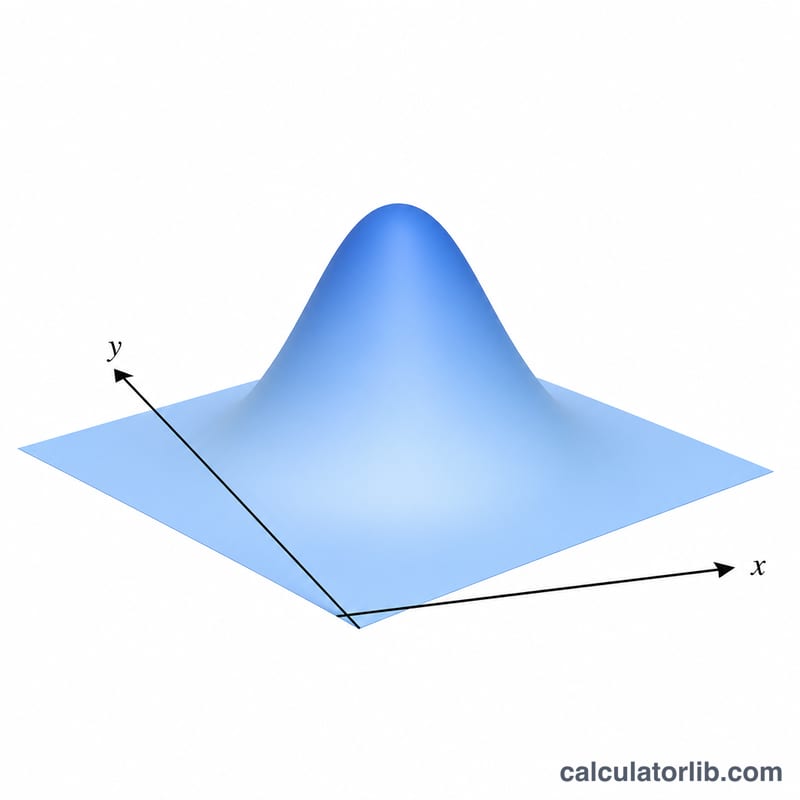
This tool evaluates the standard bivariate normal distribution, a two-dimensional Gaussian with zero means, unit variances on both axes, and a single free parameter: the correlation coefficient ρ. Given a point (x, y) it returns two numbers: the joint probability density \(f(x, y, \rho)\) at that point, and the upper-tail (orthant) cumulative probability \(Q(x, y, \rho) = P(U_1 > x \text{ AND } U_2 > y)\). Because every input is already a standardized, dimensionless score, the calculator is universal and needs no unit conversion.
How to use it
Enter the percentile point x, the percentile point y, and the correlation ρ. Here "percentile point" means a z-like standardized threshold (a coordinate), not a 0-1 percentile. The correlation must satisfy \(-1 < \rho < 1\); the values \(\pm 1\) are rejected because the density becomes singular (division by zero in \(\sqrt{1-\rho^{2}}\)).
The formulas explained
The density is the closed-form Gaussian shown above:
$$\varphi(x,y;\rho) = \frac{1}{2\pi\sqrt{1-\rho^{2}}}\,\exp\!\left(-\frac{x^{2}-2\rho\,x\,y+y^{2}}{2\left(1-\rho^{2}\right)}\right)$$The orthant probability uses Sheppard's identity: when \(\rho = 0\) the variables are independent and \(Q = Q_1(x)\cdot Q_1(y)\), where \(Q_1(t)\) is the univariate upper-tail standard normal function. For nonzero \(\rho\) we add a correction integral from 0 to \(\rho\), evaluated here with 24-node Gauss–Legendre quadrature for accuracy.
$$\begin{gathered} Q(x,y;\rho) = Q_1(x)\,Q_1(y) + \frac{1}{2\pi}\int_{0}^{\rho}\frac{\exp\!\left(-\dfrac{x^{2}-2r\,x\,y+y^{2}}{2(1-r^{2})}\right)}{\sqrt{1-r^{2}}}\,dr \\[1.5em] \text{where}\quad \left\{ \begin{aligned} x &= \text{Percentile point x} \\ y &= \text{Percentile point y} \\ \rho &= \text{Correlation }\rho \\ Q_1(t) &= \tfrac{1}{2}\,\operatorname{erfc}\!\left(\tfrac{t}{\sqrt{2}}\right) \end{aligned} \right. \end{gathered}$$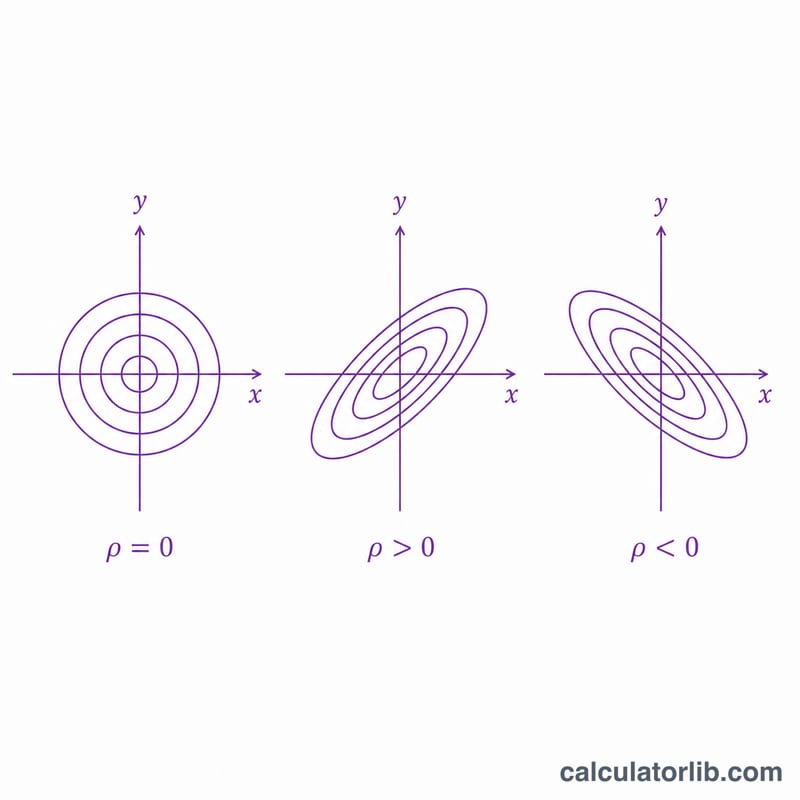
Worked example
For \(x = 2\), \(y = 0.7\), \(\rho = 0.8\): \(1 - \rho^{2} = 0.36\), \(\sqrt{\phantom{x}} = 0.6\), prefactor \(= 1/(2\pi\cdot 0.6) = 0.265258\). Exponent numerator \(= 4 - 2\cdot 0.8\cdot 2\cdot 0.7 + 0.49 = 2.25\), divided by 0.72 gives 3.125. So \(f = 0.265258 \cdot e^{-3.125} \approx 0.011655\). The upper probability \(Q \approx 0.0212\) — higher than the independence value 0.0055 because positive correlation pushes both variables up together.
How Correlation Changes the Orthant Probability
The orthant probability \(Q(x,y;\rho)=P(U_1>x,\,U_2>y)\) measures the chance that two standard normal variables simultaneously exceed their thresholds. Holding the cut-points fixed at \(x=1\) and \(y=1\) and sweeping the correlation \(\rho\) isolates the pure effect of dependence. When \(\rho=0\) the variables are independent and \(Q\) factors into the product of the two univariate upper tails, \(Q_1(x)\,Q_1(y)\). For a standard normal, \(Q_1(1)=P(U>1)\approx 0.158655\), so the independence benchmark is \(0.158655^2\approx\) 1) for standard normal">0.158655\(^2 = 0.025172\).
| \(\rho\) | Density \(f(1,1;\rho)\) | Orthant \(Q(1,1;\rho)\) | Independence \(Q_1(1)Q_1(1)\) |
|---|---|---|---|
| \(-0.8\) | 0.0476 | 0.0049 | 0.0252 |
| \(-0.4\) | 0.0780 | 0.0145 | 0.0252 |
| \(0\) | 0.0585 | 0.0252 | 0.0252 |
| \(0.4\) | 0.1063 | 0.0438 | 0.0252 |
| \(0.8\) | 0.2643 | 0.0826 | 0.0252 |
The pattern is monotone: positive correlation makes joint exceedance more likely (large values tend to occur together), so \(Q\) rises above the independence value; negative correlation pulls the two variables in opposite directions, so joint exceedance becomes rarer and \(Q\) falls below \(Q_1 Q_1\). At \(\rho=0\) the orthant probability exactly equals the product \(0.0252\), confirming the independence factorization.
Interpreting the Density and Orthant Probability
The density \(f\) is not a probability. The value \(\varphi(x,y;\rho)\) is a probability density per unit area in the \((x,y)\) plane; only its integral over a region returns a probability. The surface attains its maximum at the origin \((0,0)\), where the exponential term equals 1 and
$$f(0,0;\rho)=\frac{1}{2\pi\sqrt{1-\rho^{2}}}.$$For \(\rho=0\) this peak is \(1/(2\pi)\approx 0.159\), comfortably below 1. As \(\rho\to\pm 1\) the factor \(1/\sqrt{1-\rho^2}\) diverges, so the peak density can exceed 1 — that is normal for a density, since it concentrates probability mass onto the line \(y=\rho x\).
The orthant probability \(Q\) is a genuine probability and always lies in \([0,1]\). It is the volume under the density surface over the quadrant \(\{U_1>x,\,U_2>y\}\). Useful structural facts:
- Independence (\(\rho=0\)): \(Q(x,y;0)=Q_1(x)\,Q_1(y)\), the product of the two univariate upper tails.
- Symmetry in arguments: by exchanging the roles of the two coordinates, \(Q(x,y;\rho)=Q(y,x;\rho)\).
- Reflection identity: \(Q(-x,-y;\rho)=Q(x,y;\rho)+ \Phi(-x)+\Phi(-y)-1\) (equivalently expressible through the bivariate CDF), and reversing the sign of one argument flips the effective correlation: \(P(U_1>x,\,U_2
- Limiting behavior \(\rho\to 1^{-}\): the variables become perfectly comonotone, \(U_2\approx U_1\), so \(Q(x,y;\rho)\to Q_1(\max(x,y))\) — both exceedances coincide.
- Limiting behavior \(\rho\to -1^{+}\): the variables become perfectly countermonotone, \(U_2\approx -U_1\). Joint upper exceedance is then possible only when both thresholds can be cleared simultaneously, giving \(Q\to\max\!\big(0,\;1-\Phi(x)-\Phi(y)\big)\), which is 0 whenever \(x+y\ge 0\).
Because there is no closed form for \(Q\) with general \(\rho\), it is evaluated numerically — typically through Owen's T function or a one-dimensional integral over \(\rho\) using Gauss–Legendre quadrature, both of which reproduce the values shown in the comparison table to high precision.
Definitions & Glossary
- Standardized score (\(x\), \(y\))
- A z-like coordinate measuring how many standard deviations a value sits from its mean. The inputs \(x\) and \(y\) are already standardized, so each marginally follows the standard normal \(N(0,1)\) distribution.
- Correlation coefficient \(\rho\)
- The linear (Pearson) correlation between the two standard normal variables, with \(-1<\rho<1\). It is the single parameter governing how strongly the two coordinates move together; \(\rho=0\) means independence here, while \(\rho\to\pm1\) means a near-deterministic linear relationship. An observed \(\rho\) can be estimated from paired data with a Pearson correlation calculator.
- Joint density \(f(x,y;\rho)\)
- The standard bivariate normal probability density, \(\varphi(x,y;\rho)=\dfrac{1}{2\pi\sqrt{1-\rho^2}}\exp\!\left(-\dfrac{x^2-2\rho xy+y^2}{2(1-\rho^2)}\right)\). It describes probability per unit area, not a probability itself.
- Orthant probability \(Q(x,y;\rho)\)
- The upper-tail joint probability \(P(U_1>x,\,U_2>y)\) — the volume under the density surface over the upper-right quadrant defined by the two thresholds. Always between 0 and 1.
- Univariate upper tail \(Q_1(t)\)
- The standard normal survival function \(Q_1(t)=P(U>t)=1-\Phi(t)\), the area in the right tail beyond \(t\). For example \(Q_1(1)\approx 0.1587\). At \(\rho=0\), \(Q=Q_1(x)Q_1(y)\).
- Complementary error function (\(\operatorname{erfc}\))
- A special function related to the normal tail by \(Q_1(t)=\tfrac{1}{2}\operatorname{erfc}\!\left(t/\sqrt{2}\right)\). It provides a numerically stable way to compute the univariate tail probabilities used in \(Q\).
- Gauss–Legendre quadrature
- A numerical integration scheme that approximates a definite integral by a weighted sum of the integrand at optimally chosen nodes. Because \(Q(x,y;\rho)\) has no elementary closed form, it is commonly evaluated by integrating the density (or a function of \(\rho\)) with this method to obtain accurate results.
FAQ
Why can't ρ be exactly 1? At \(\rho = \pm 1\) the two variables are perfectly dependent and the distribution collapses onto a line; the density has no finite value off that line.
What does Q represent? It is the probability mass in the upper-right "orthant" beyond both thresholds: \(P(U_1 > x, U_2 > y)\).
What happens for large x or y? The density decays toward 0 and Q approaches 0, since it is increasingly unlikely both standardized variables exceed large positive thresholds.