What this calculator does
The Lathe Cutting Speed Calculator converts a recommended cutting speed into the spindle speed (RPM) you should dial into your lathe. Every workpiece material has a suggested surface cutting speed, measured in surface feet per minute (SFM). Because a larger diameter travels farther per revolution, the RPM needed to hit that surface speed depends on the diameter of the part.
The formula explained
Spindle speed is calculated with:
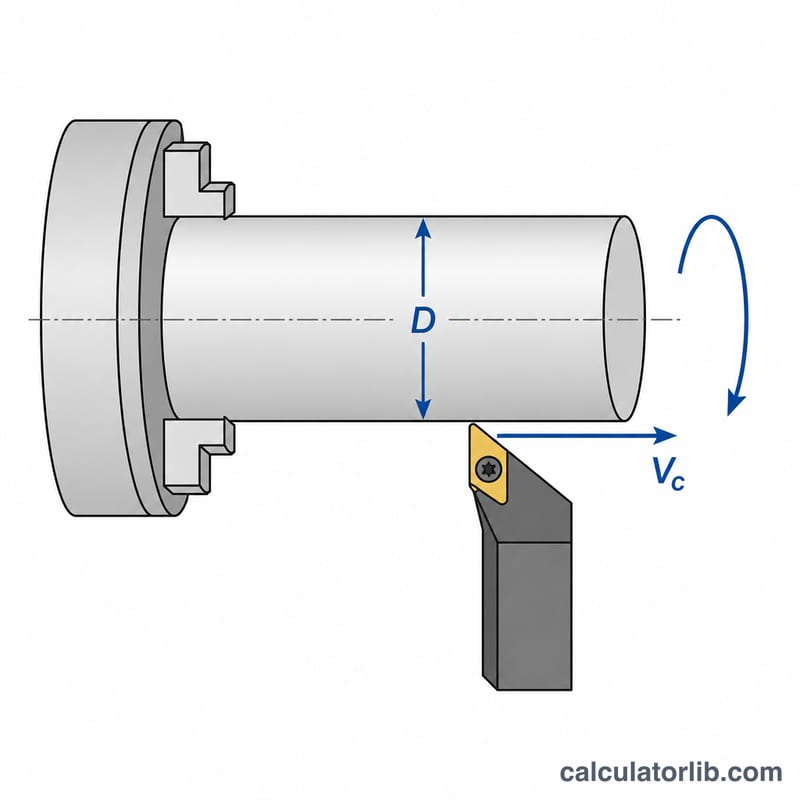
$$N = \frac{12 \times V_c}{\pi \times D}$$where \(N\) = spindle speed in RPM, \(V_c\) = cutting speed in surface feet per minute, and \(D\) = workpiece diameter in inches. The factor \(12\) converts feet to inches so the units cancel, and \(\pi \times D\) is the circumference the tool sweeps in one revolution.
How to use it
Look up the recommended cutting speed for your material and tooling, enter it as \(V_c\), then enter the current diameter of the workpiece at the cut. The calculator returns the spindle RPM. Recheck the RPM whenever the working diameter changes significantly, such as during heavy roughing passes.
Worked example
For a cutting speed of \(100\) SFM on a \(1\)-inch diameter bar:
$$N = \frac{12 \times 100}{\pi \times 1} = \frac{1200}{3.1416} \approx 382\ \text{RPM}$$So you would set the lathe to roughly 382 RPM.
Recommended Cutting Speeds (SFM) by Material
The table below lists typical recommended surface cutting speeds, expressed in surface feet per minute (SFM) — a US customary unit used in the Machinery's Handbook and most North American shop references. These are general starting ranges for single-point turning of common workpiece materials with high-speed steel (HSS) versus carbide tooling. Actual values depend on the specific alloy and temper, depth of cut, feed rate, rigidity, coolant, and tool coating, so treat them as a starting point and adjust to the finish and tool life you observe. Carbide tolerates far higher speeds than HSS because it retains hardness at higher temperatures.
| Workpiece material | HSS (SFM) | Carbide (SFM) |
|---|---|---|
| Aluminum alloys | 200–400 | 600–1000+ |
| Brass (free-machining) | 150–300 | 400–700 |
| Mild / low-carbon steel | 80–120 | 300–600 |
| Alloy steel | 50–90 | 200–400 |
| Stainless steel (austenitic) | 40–70 | 150–350 |
| Cast iron (gray) | 60–100 | 200–400 |
Once you pick a cutting speed \(V_c\) for your material and tool, convert it to spindle speed with \(N = \dfrac{12 \times V_c}{\pi \times D}\), where \(D\) is the workpiece diameter in inches and the constant 12 converts feet to inches. The next section shows how that RPM varies with diameter.
RPM Across Common Diameters and Speeds
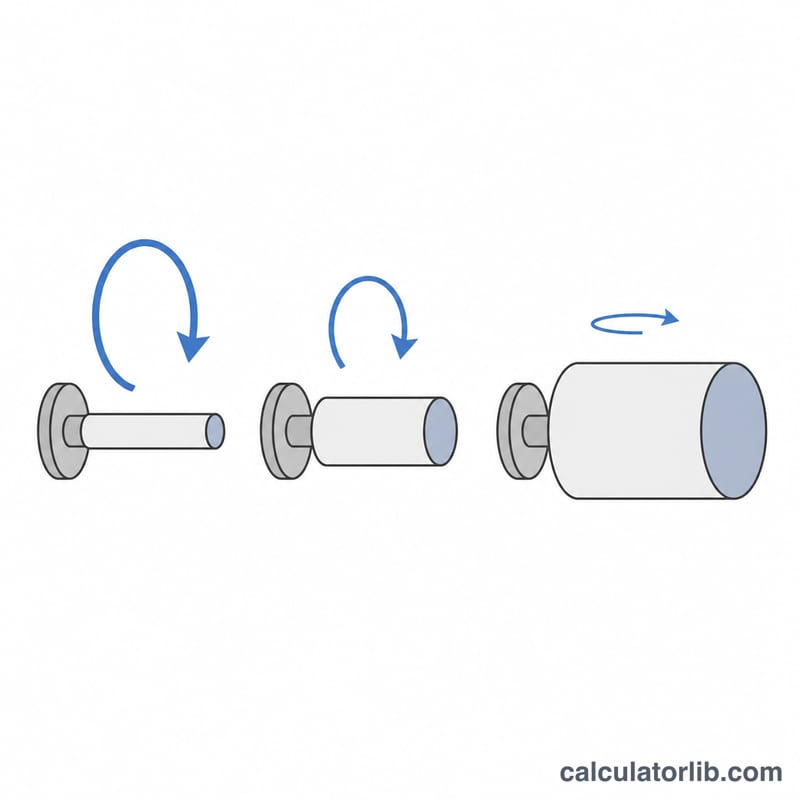
Spindle speed is inversely proportional to diameter: for a fixed cutting speed, halving the diameter doubles the required RPM. That is why small drills and small-diameter turning demand high spindle speeds, while large-diameter facing runs slowly. The table applies \(N = \dfrac{12 \times V_c}{\pi \times D}\) (with \(V_c\) in SFM and \(D\) in inches) for two representative speeds — \(V_c = 100\) SFM (typical of HSS on steel) and \(V_c = 300\) SFM (typical of carbide on steel or HSS on aluminum). Values are rounded to the nearest whole RPM.
| Diameter D (in) | RPM at \(V_c = 100\) SFM | RPM at \(V_c = 300\) SFM |
|---|---|---|
| 0.25 | 1528 | 4584 |
| 0.5 | 764 | 2292 |
| 1 | 382 | 1146 |
| 2 | 191 | 573 |
| 4 | 95 | 286 |
Worked example for the 1 in bar at 100 SFM:
$$N = \frac{12 \times 100}{\pi \times 1} = \frac{1200}{3.1416} \approx 382 \text{ RPM}$$And for a 0.5 in diameter at 300 SFM:
$$N = \frac{12 \times 300}{\pi \times 0.5} = \frac{3600}{1.5708} \approx 2292 \text{ RPM}$$Because RPM scales as \(1/D\), a 0.25 in feature needs four times the spindle speed of a 1 in feature at the same cutting speed — confirming why small drills spin so fast and large workpieces run slow.
FAQ
What is SFM? Surface feet per minute is how fast the workpiece surface passes the cutting edge, independent of diameter.
Does a bigger diameter need higher or lower RPM? Lower. As \(D\) grows, the same surface speed is reached at fewer revolutions per minute.
Can I use it for drilling or milling? Yes, the same relationship applies; use the tool or hole diameter as \(D\).