What Is a Stoichiometry Calculator?
A stoichiometry calculator converts a known amount of one substance in a chemical reaction into the amount of another, using the mole ratios set by a balanced chemical equation. Because atoms are conserved, the coefficients in a balanced equation tell you exactly how many moles of each species react or form relative to one another. This tool handles the three-step mass-to-mass conversion so you can quickly predict how much product forms from a given reactant, or how much reactant you need.
The Formula Explained
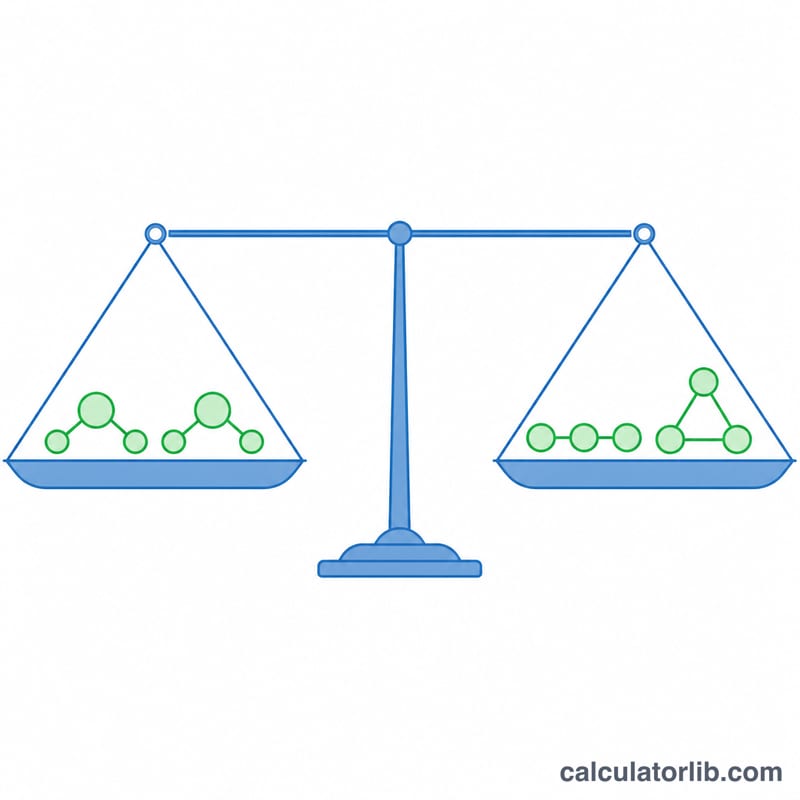
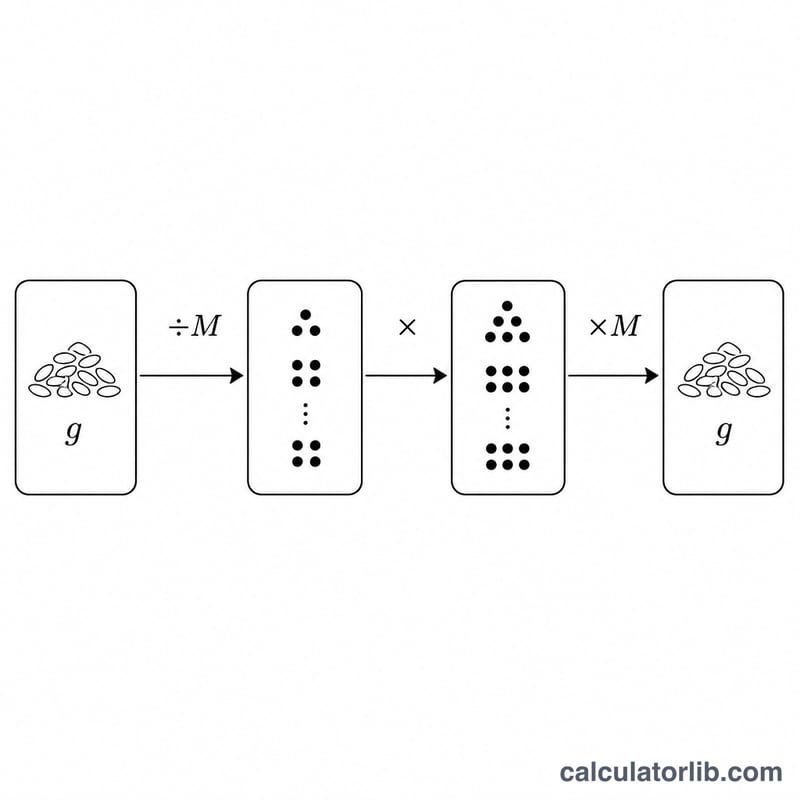
The core relationship converts mass to moles, scales by the mole ratio, and converts back to mass:
$$m_{\text{product}} = \frac{m_{\text{given}}}{M_{\text{given}}} \times \frac{n_{\text{product}}}{n_{\text{given}}} \times M_{\text{product}}$$Here \(m_{\text{given}}\) = mass of the known substance in grams, \(M_{\text{given}}\) = its molar mass in g/mol, \(n_{\text{given}}\) and \(n_{\text{product}}\) = the balanced-equation coefficients, and \(M_{\text{product}}\) = the molar mass of the target substance.
How to Use It
Enter the mass and molar mass of the substance you know, the coefficients of both substances taken directly from your balanced equation, and the molar mass of the product you want. The calculator returns the moles of the given substance, the moles of product, and the final mass of product.
Worked Example
For \(\text{N}_2 + 3\,\text{H}_2 \rightarrow 2\,\text{NH}_3\), how much ammonia forms from 6 g of hydrogen? First find moles of hydrogen:
$$n_{\text{given}} = \frac{6}{2.016} = 2.976\,\text{mol}$$Apply the 2:3 mole ratio, then convert to mass:
$$n_{\text{product}} = 2.976 \times \frac{2}{3} = 1.984\,\text{mol}$$$$m_{\text{product}} = 1.984 \times 17.031 = 33.79\,\text{g}$$So 6 g of hydrogen yields about 33.79 g of ammonia.
Common Molar Masses (g/mol)
The molar mass of a substance is the sum of the standard atomic masses of every atom in its chemical formula, expressed in grams per mole (g/mol). The values below use IUPAC standard atomic weights and are the numbers most often needed when setting up mass-to-mole conversions in stoichiometry problems.
| Substance | Formula | Molar mass (g/mol) |
|---|---|---|
| Hydrogen gas | H₂ | 2.016 |
| Nitrogen gas | N₂ | 28.014 |
| Oxygen gas | O₂ | 31.998 |
| Ammonia | NH₃ | 17.031 |
| Water | H₂O | 18.015 |
| Carbon dioxide | CO₂ | 44.009 |
| Methane | CH₄ | 16.043 |
| Sodium chloride | NaCl | 58.44 |
| Calcium carbonate | CaCO₃ | 100.09 |
| Carbon (element) | C | 12.011 |
For example, CO₂ is built from one carbon atom (12.011) and two oxygen atoms (2 × 15.999 = 31.998), giving \(12.011 + 31.998 = 44.009\) g/mol. Because atomic weights are periodic-table constants (not tied to any single country), these molar masses are the same in every laboratory; small differences you may see in textbooks come only from rounding.
FAQ
Where do the coefficients come from? From your balanced chemical equation — the numbers in front of each formula.
Does this account for a limiting reactant? No. It assumes the given substance is fully consumed; run the calculation for each reactant to identify the limiting one.
Can I go from product back to reactant? Yes. Just enter the product as the given substance and the reactant as the target.