What is the Mash Water Calculator?
The Mash Water Calculator helps all-grain brewers split their total brewing water into two key volumes: the strike water added at mash-in and the sparge water used to rinse the grain bed. Getting these volumes right keeps your mash thickness in the ideal range and helps you hit your target batch size in the kettle.
The formula explained
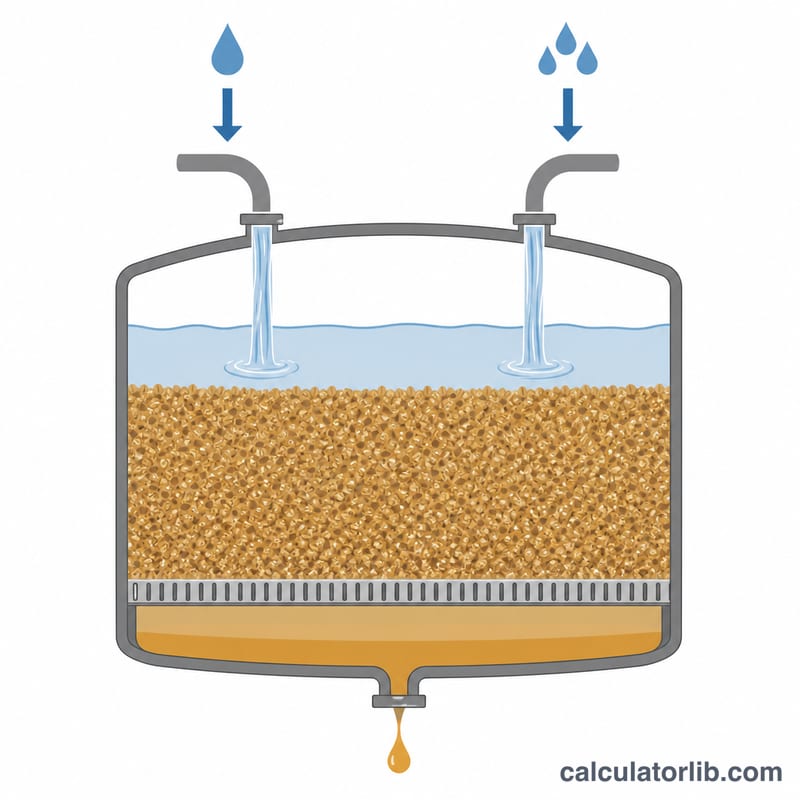
Strike water is simply the grain weight multiplied by your chosen mash ratio:
$$\text{Strike} = W \times R$$where \(W\) = grain weight in kg and \(R\) = mash ratio in liters per kg. Grain soaks up water during the mash, so total water must cover both the batch and that loss:
$$\text{Sparge} = (B + W \times A) - \text{Strike}$$Here \(B\) = target batch size in liters and \(A\) = grain absorption rate in liters per kg (typically about \(1\,\text{L/kg}\)).
How to use it
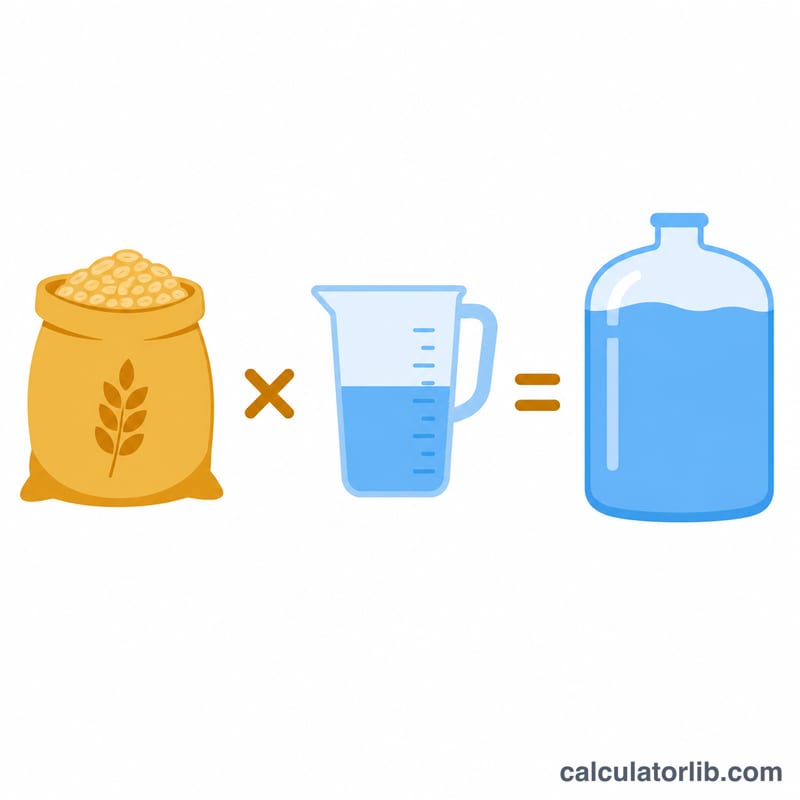
Enter your grain weight, preferred mash ratio (thicker mashes use \(2.5\text{–}3\,\text{L/kg}\)), your target batch size, and the grain absorption rate. The calculator returns strike, sparge, and total water so you can measure each addition precisely.
Worked example
With \(5\,\text{kg}\) of grain, a ratio of \(3\,\text{L/kg}\), a \(23\,\text{L}\) batch, and \(1\,\text{L/kg}\) absorption:
$$\text{Strike} = 5 \times 3 = 15\,\text{L}$$$$\text{Total} = 23 + 5 \times 1 = 28\,\text{L}$$$$\text{Sparge} = 28 - 15 = 13\,\text{L}$$Typical Mash Ratios & Absorption Rates
The values below are widely used homebrewing conventions drawn mainly from US and UK all-grain brewing literature (for example John Palmer's How to Brew and popular online tools such as Brewer's Friend and BeerSmith). They are practical starting points, not fixed physical constants — actual absorption and workable ratios vary with your grain bill, crush, and equipment. Because much of this literature is US-based, ratios are often quoted in quarts per pound (qt/lb); the metric equivalents shown use \(1\ \text{qt/lb} \approx 2.086\ \text{L/kg}\).
Single-infusion mash ratios
| Consistency | Mash ratio (L/kg) | ≈ qt/lb | Effect on the mash | Convention / source |
|---|---|---|---|---|
| Thin | ~2.0 | ~0.96 | More dilute; tends to favour β-amylase and a more fermentable (drier) wort, and leaves more water for sparging. | General homebrewing convention (Palmer, How to Brew) |
| Standard | ~2.6–3.2 | ~1.25–1.5 | Balanced range used for most single-infusion mashes; good compromise between fermentability and body. | Common single-infusion default (Brewer's Friend / Palmer) |
| Thick | ~3.5+ | ~1.7+ | Less dilute; can favour body and less-fermentable wort, buffers enzymes at higher rest temperatures, and is typical for decoction mashes. Leaves little water for sparging. | General homebrewing convention (decoction / thick-mash practice) |
Grain absorption
| Quantity | Typical value (L/kg) | Commonly cited range (L/kg) | Convention / source |
|---|---|---|---|
| Grain absorption | ~1.0 | ~0.8–1.25 | General homebrewing convention (≈ 0.5 qt/lb; comparable to default absorption figures in tools like BeerSmith and Brewer's Friend) |
Use these as guidance and adjust to your own system: measuring the actual volume left in your tun after a few brews gives a far better absorption figure than any generic default.
Strike & Sparge Across Common Batch Scenarios
Each row below is computed with this calculator's model. Strike water comes from the grain weight and mash ratio; total water adds the water the grain will soak up; and sparge water is simply whatever total water is not already in the mash tun:
$$\text{Strike (L)} = \text{Grain (kg)} \times \text{Mash Ratio (L/kg)}$$$$\text{Total Water (L)} = \text{Batch (L)} + \big(\text{Grain (kg)} \times \text{Absorption (L/kg)}\big)$$$$\text{Sparge (L)} = \text{Total Water} - \text{Strike Water}$$This simplified model treats batch as the volume of wort you want to collect and ignores kettle boil-off and equipment dead-space, so add your own losses on top. Worked example for the first row (4 kg, 2.6 L/kg, 19 L, 1.0 L/kg):
$$\text{Strike} = 4 \times 2.6 = 10.4\ \text{L}$$$$\text{Total} = 19 + (4 \times 1.0) = 23\ \text{L}$$$$\text{Sparge} = 23 - 10.4 = 12.6\ \text{L}$$| Grain (kg) | Mash ratio (L/kg) | Batch (L) | Absorption (L/kg) | Strike (L) | Total water (L) | Sparge (L) | Notes |
|---|---|---|---|---|---|---|---|
| 4 | 2.6 | 19 | 1.0 | 10.4 | 23 | 12.6 | Small standard batch |
| 5 | 3.0 | 23 | 1.0 | 15 | 28 | 13 | Typical 23 L (6 gal) batch |
| 6 | 3.2 | 23 | 1.0 | 19.2 | 29 | 9.8 | Higher ratio shrinks the sparge |
| 7 | 2.6 | 28 | 1.0 | 18.2 | 35 | 16.8 | Larger batch, thin mash → ample sparge |
| 6 | 4.0 | 19 | 1.0 | 24 | 25 | 1.0 | Very thick mash into a small batch → almost no sparge |
| 7 | 4.5 | 19 | 1.0 | 31.5 | 26 | -5.5 | Negative → not feasible: strike water alone exceeds the total needed, so lower the ratio or raise the batch/collected volume |
The last two rows show the practical limit: as the mash ratio climbs (a thick mash) into a fixed batch size, the sparge volume falls toward zero and can go negative. A negative sparge is a sign to reduce the mash ratio, increase the batch/collected volume, or plan a no-sparge (full-volume) mash instead.
FAQ
What mash ratio should I use? Most single-infusion mashes work well between \(2.6\) and \(3.2\,\text{L/kg}\). Thinner mashes convert faster; thicker mashes protect enzymes.
Does this include boil-off? No. This model covers grain absorption only. If you have significant boil-off, add it to your batch size before entering it.
Why is my sparge water low or negative? A very high mash ratio can use most of your water at strike, leaving little for sparging. Lower the ratio or raise the batch size.