What is dough hydration?
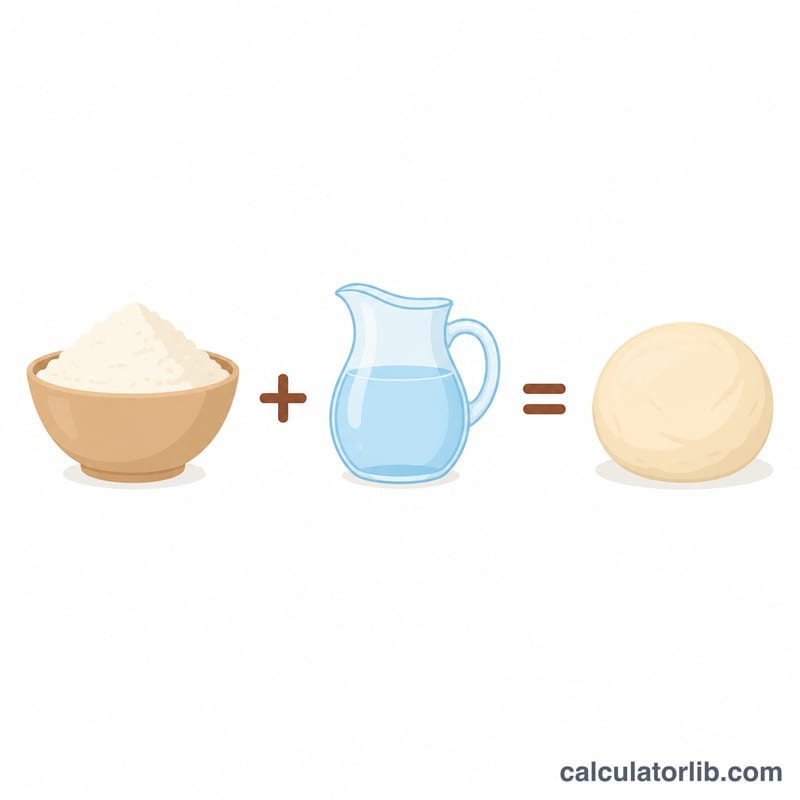
Dough hydration is the ratio of water to flour in a bread or pizza dough, expressed as a percentage using the baker percentage system. In this system flour is always 100%, and every other ingredient is measured relative to the flour weight. A dough at 70% hydration has 70 grams of water for every 100 grams of flour. Hydration is one of the most important variables a baker controls because it shapes the crumb, the crust, and how the dough feels in the hands.
The formula
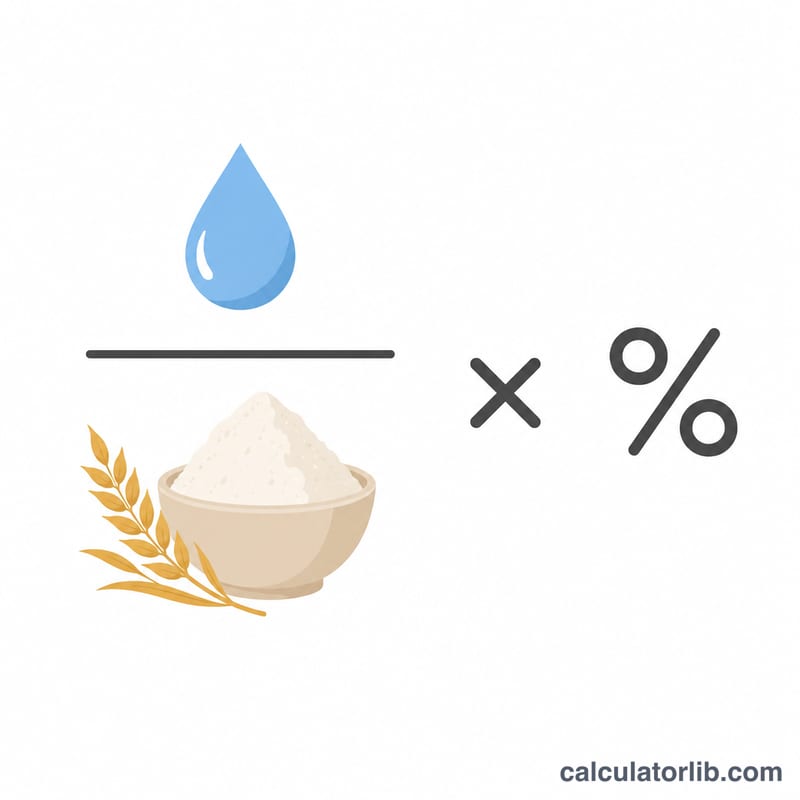
Hydration is calculated with a simple ratio:
$$H = \frac{W}{F} \times 100$$where \(H\) = hydration percentage, \(W\) = water weight in grams, and \(F\) = flour weight in grams. The total dough weight is \(T = F + W\).
How to use this calculator
Weigh your flour and water on a kitchen scale in grams and enter both values. The calculator divides the water weight by the flour weight and multiplies by 100 to give the hydration percentage, then shows the total dough weight so you can scale a recipe up or down.
Worked example
Suppose a recipe uses 1000 g of flour and 700 g of water. The hydration is:
$$H = \frac{700}{1000} \times 100 = 70\%$$This is a typical hydration for a rustic sourdough loaf, giving an open crumb without being unmanageably wet.
Typical Hydration Levels by Dough Type
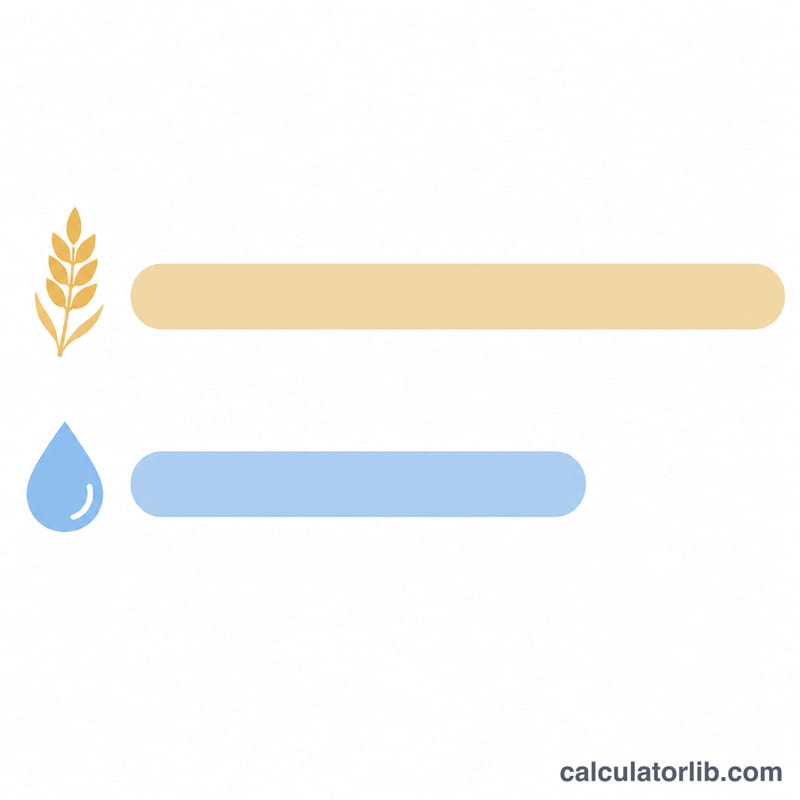
Baker's percentage expresses water as a percentage of flour weight: \(\text{Hydration \%} = \frac{ \text{Water (g)} }{ \text{Flour (g)} } \times 100\). The ranges below are common starting points, not strict rules. Individual bakers, flours and recipes vary.
| Dough type | Typical hydration | Handling difficulty | Texture and crumb |
|---|---|---|---|
| Bagels | ~50-57% | Easy to shape, stiff to knead | Dense, tight, chewy crumb |
| Sandwich bread | ~60-65% | Easy | Soft, even, fine crumb |
| Pizza (Neapolitan) | ~58-65% | Easy to moderate | Soft, airy rim with a tender interior |
| Pizza (New York) | ~60-65% | Easy to moderate | Chewy, foldable crust with a moderately open crumb |
| French baguette | ~65-70% | Moderate | Open, irregular crumb with a crisp crust |
| Sourdough country loaf | ~70-80% | Moderate to hard; sticky, needs stretch-and-folds | Open, glossy crumb with a chewy crust |
| Ciabatta | ~75-85% | Hard; very slack and sticky | Very open crumb with large irregular holes |
| Focaccia | ~75-90% | Moderate in practice, since it is baked in an oiled pan rather than shaped freeform | Airy, open, moist crumb |
Hydration Comparison: Same Flour, Different Water
This table keeps flour fixed at 500 g and changes only the water. Total dough weight is flour plus water, before any salt, yeast or other ingredients.
| Flour (g) | Water (g) | Hydration | Total dough (g) | Expected dough feel and crumb |
|---|---|---|---|---|
| 500 | 300 | 60% | 800 | Firm and easy to handle; tight, fine crumb |
| 500 | 325 | 65% | 825 | Soft and smooth; moderate, even crumb |
| 500 | 350 | 70% | 850 | Slightly tacky; fairly open crumb |
| 500 | 375 | 75% | 875 | Sticky and extensible; open crumb, benefits from stretch-and-folds |
| 500 | 400 | 80% | 900 | Very sticky and slack; large, open holes |
| 500 | 425 | 85% | 925 | Very wet and loose, almost batter-like; needs strong flour and careful handling; very open, moist crumb |
Example: \(\frac{350}{500} \times 100 = 70\%\), and the total dough weight is \(500 + 350 = 850\) g.
Interpreting Your Hydration Result
- Below 60%: Stiff, dense dough with a tight crumb. This suits bagels and some enriched or pretzel-style doughs.
- 60-70%: Manageable, forgiving dough with a moderate crumb. This is a good range for beginners and for sandwich loaves, pizza and baguettes.
- 70-80%: Open crumb and sticky dough. It usually needs stretch-and-folds or other gentle strength building rather than heavy kneading.
- Above 80%: Very slack dough that needs strong, high-protein flour. It is often baked in a pan or shaped with wet hands and a light touch.
What changes effective hydration:
- Flour type: Whole wheat and other high-extraction flours absorb more water, so a given percentage feels stiffer than it would with white flour.
- Protein content: Higher-protein flour can hold more water and still keep its structure.
- Liquid ingredients: Milk, eggs, honey and similar ingredients contain water. If you want a precise figure, count their water share as part of the total water.
- Sourdough starter: A starter at 100% hydration contributes equal weights of flour and water, so add both to your totals.
Worked example with starter: 500 g flour, 350 g water and 100 g of 100% hydration starter. The starter holds 50 g flour and 50 g water. Total flour is \(500 + 50 = 550\) g and total water is \(350 + 50 = 400\) g. Hydration is \(\frac{400}{550} \times 100 \approx 72.7\%\), which is higher than the 70% you would get by ignoring the starter.
Enter total flour and total water into the calculator for the most accurate result. Adjust water in small steps, around 2-5% at a time, and note how the dough responds.
FAQ
What hydration should I use? Sandwich breads sit around 60-65%, most artisan loaves fall between 70-80%, and ciabatta or focaccia can exceed 80%.
Does hydration include liquids like milk or eggs? Strict baker percentage counts only water. For accuracy you can include the water content of other liquids, but many bakers approximate with water alone.
Why is higher hydration harder to work? More water makes the dough slacker and stickier, so it needs stronger flour, gentle handling, and often stretch-and-fold techniques instead of kneading.