What it is
The Wood Shrinkage Calculator estimates how much a board changes size across the grain when its moisture content changes. Wood is hygroscopic: it loses or gains water below the fiber saturation point (about 28-30%), and that movement shows up as shrinkage or swelling. Estimating it in advance helps you leave the right gaps in flooring, panels, and joinery.
The formula explained
The calculator uses the dimensional change coefficient method from the Wood Handbook:
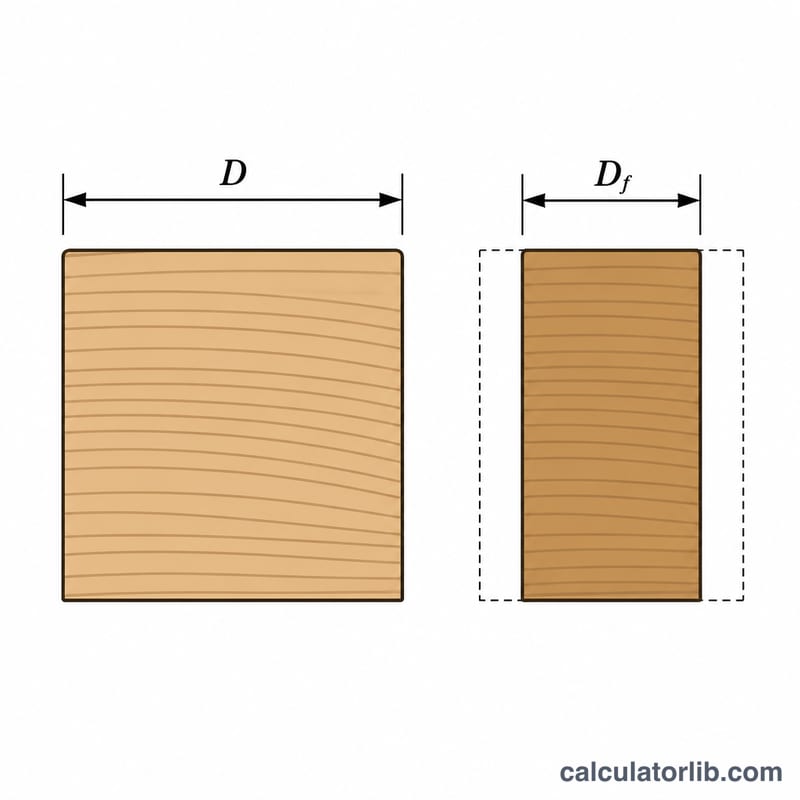
$$\Delta D = D \times C \times (M_i - M_f)$$where \(D\) = initial dimension across the grain, \(C\) = species dimensional change coefficient per percent of moisture change, \(M_i\) = initial moisture content in percent, and \(M_f\) = final moisture content in percent. A positive \(\Delta D\) means the wood shrinks; a negative value means it swells. The final dimension is \(D_f = D - \Delta D\).
How to use it
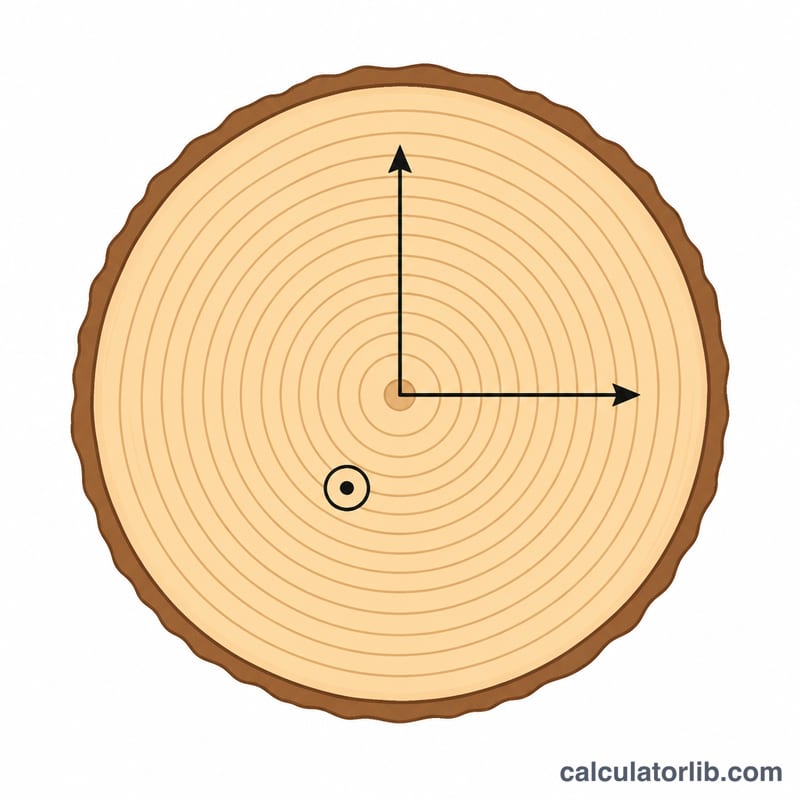
Enter the current board width, the species coefficient (tangential values are typically \(0.002\) to \(0.003\), radial values are smaller), and the initial and final moisture content. The result shows the size change and the finished dimension. Keep both moisture values below the fiber saturation point, since wood does not move above it.
Worked example
A \(12\text{ in}\) board with coefficient \(0.00265\) dries from \(12\%\) to \(6\%\):
$$\Delta D = 12 \times 0.00265 \times (12 - 6) = 0.1908\,\text{in}$$So the board shrinks about \(0.19\) in and ends at \(D_f = 12 - 0.1908 = 11.8092\,\text{in}\), roughly \(1.59\%\) of its original width.
FAQ
Does this work for swelling too? Yes. If the final moisture content is higher than the initial value, \(\Delta D\) is negative and the board grows.
Where do I find the coefficient? Species tables in the Wood Handbook list tangential and radial dimensional change coefficients; use the tangential value for flatsawn boards.
Why across the grain? Movement along the grain (length) is negligible, so this model applies to width and thickness.