
What is the Import Duty Calculator?
The Import Duty Calculator estimates the customs duty owed when goods cross an international border. Customs authorities charge duty as a percentage of the dutiable value of a shipment, and this tool turns that idea into a fast, repeatable estimate so importers, small businesses and online shoppers can budget landed costs before ordering.
How to use it
Enter the customs value of your goods, then add freight (shipping) and insurance if they are included in the dutiable base. Finally enter the tariff rate that applies to the product classification. The calculator returns the dutiable value, the estimated duty, and the total landed cost.
The formula explained
Most jurisdictions assess duty on the CIF value (Cost, Insurance and Freight). The dutiable base is:
$$\text{Dutiable Value} = \text{Value} + \text{Freight} + \text{Insurance}$$The duty is then a simple percentage of that base, where \(V\) = goods value, \(F\) = freight, \(I\) = insurance and \(r\) = tariff rate:
$$\text{Duty} = (V + F + I) \times \frac{r}{100}$$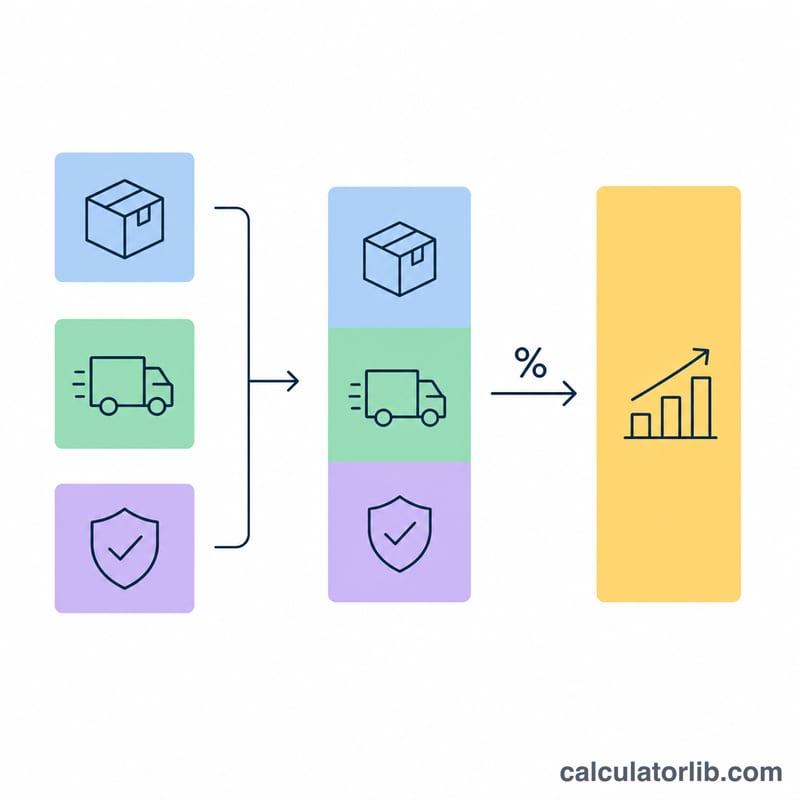
Worked example
Suppose goods are worth 10,000 with 500 freight and 100 insurance, at a 5% tariff rate. The dutiable value and duty are:
$$\text{Dutiable Value} = 10000 + 500 + 100 = 10600$$$$\text{Duty} = 10600 \times \frac{5}{100} = 530$$The total landed cost becomes \(10600 + 530 = 11130\).
Definitions & Glossary
Customs duty is charged on a dutiable value multiplied by a duty rate. The terms below define each input and show how it feeds the formula \( \text{Total Cost} = V\left(1 + \frac{r}{100}\right) \), where \(V\) is the dutiable value and \(r\) is the duty rate. Whether the base is CIF or FOB depends on the importing country, so confirm the rule for your jurisdiction.
- CIF value (Cost, Insurance, Freight) — the goods value plus international shipping plus insurance to the port of entry. In this calculator it is \(V = \text{goods value} + \text{shipping} + \text{insurance}\). Most jurisdictions that follow the WTO Customs Valuation Agreement on a CIF basis (for example the European Union and many others) assess duty on this figure.
- FOB value (Free On Board) — the goods value at the exporter's port, excluding international freight and insurance. The United States generally assesses duty on the transaction (FOB-type) value, excluding international freight and insurance. To model an FOB base here, enter 0 for shipping and insurance so \(V\) equals the goods value alone.
- Dutiable value (customs value) — the amount duty is actually calculated on. It is the \(V\) in the formula: CIF where the country taxes freight and insurance, FOB where it does not.
- Tariff / duty rate — the percentage \(r\) applied to the dutiable value. An ad valorem rate (used here) is a percentage of value; some tariffs are instead specific (a fixed charge per unit or weight), which this calculator does not model.
- HS code (Harmonized System code) — the international product classification code (administered by the World Customs Organization) that determines which duty rate \(r\) applies to your goods. The calculator does not look this up; you supply the rate that corresponds to your HS code.
- Country of origin — where the goods were produced. It can change the applicable rate \(r\) through trade agreements, preferential tariffs, or additional duties, even for the same HS code.
- Total landed cost — the dutiable value plus the duty, i.e. the \( \text{Total Cost} = V\left(1 + \frac{r}{100}\right) \) output. Note this covers the customs duty only; real landed cost may also include import taxes such as VAT/GST, brokerage, and inland freight, which are outside this formula.
Duty Across Common Scenarios
The table holds the goods value fixed at $10,000 and varies two things: the valuation base (CIF vs FOB) and the duty rate \(r\). The CIF rows add $800 shipping and $200 insurance, giving a dutiable value \(V = 10000 + 800 + 200 = 11000\); the FOB rows use shipping and insurance of 0, so \(V = 10000\). Duty is \(V \cdot \frac{r}{100}\) and total landed cost is \(V\left(1 + \frac{r}{100}\right)\). Which base applies is set by the importing country, not by choice.
| Base | Duty rate \(r\) | Dutiable value \(V\) | Duty | Total landed cost |
|---|---|---|---|---|
| CIF (freight + insurance included) | 0% | $11,000 | $0 | $11,000 |
| CIF (freight + insurance included) | 5% | $11,000 | $550 | $11,550 |
| CIF (freight + insurance included) | 12% | $11,000 | $1,320 | $12,320 |
| FOB (freight + insurance excluded) | 0% | $10,000 | $0 | $10,000 |
| FOB (freight + insurance excluded) | 5% | $10,000 | $500 | $10,500 |
| FOB (freight + insurance excluded) | 12% | $10,000 | $1,200 | $11,200 |
Worked substitution for the CIF 12% row: \( \text{Total Cost} = 11000 \times \left(1 + \frac{12}{100}\right) = 11000 \times 1.12 = 12320 \). The gap between the CIF and FOB rows at the same rate is the duty charged on the $1,000 of freight and insurance — for example $1,320 vs $1,200 at 12%, a difference of $120. These figures are customs duty only and exclude any VAT/GST or handling fees your country may add on top.
FAQ
Does duty include shipping? Many customs systems use the CIF value, so freight and insurance are added to the base. Include them only if your country charges duty on CIF rather than FOB.
Are taxes like VAT included? No. This tool estimates duty only. Import VAT or sales tax is usually calculated separately, often on the value plus duty.
How do I find my tariff rate? Rates depend on the product HS code and country of origin. Check your national customs tariff schedule or a trade agreement that may lower the rate.