What is the Salt Dough Calculator?
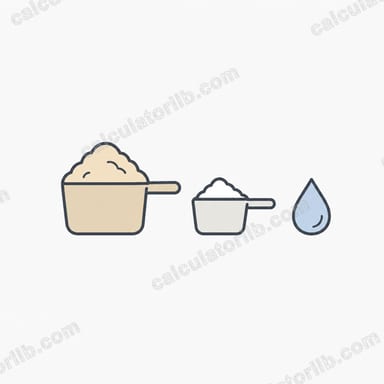
Salt dough is a simple, no-cook modelling material made from flour, salt and water. This calculator uses the classic 2:1:1 ratio by weight — two parts flour to one part salt to one part water — to tell you exactly how much salt and water you need for any amount of flour, and how to scale the recipe across several batches.
How to use it
Enter the weight of flour you want to start with (in grams) and the number of batches you plan to make. The calculator returns the salt and water needed per batch, the totals for all batches, and the combined dough weight so you know how much modelling material you will end up with.
The formula explained
Because the ratio is 2:1:1, salt and water each weigh half as much as the flour: salt = flour \(\times 0.5\) and water = flour \(\times 0.5\). One batch of dough therefore weighs flour + salt + water = flour \(\times 2\). Multiplying each ingredient by the number of batches gives the totals, and adding them gives the total dough weight.
$$\text{Total Dough} = (F + S + W)\times B$$$$\text{where}\quad \left\{ \begin{aligned} F &= \text{Flour (g)} \\ S &= 0.5\times\text{Flour (g)} \\ W &= 0.5\times\text{Flour (g)} \\ B &= \text{Batches} \end{aligned} \right.$$
Worked example
With 200 g of flour: salt \(= 200 \times 0.5 = 100\) g, water \(= 200 \times 0.5 = 100\) g. One batch weighs 400 g. For 3 batches you need 600 g flour, 300 g salt and 300 g water, for a total of 1,200 g of dough.
$$\text{Total Dough} = 2 \times 200 \times 3 = 1{,}200 \text{ g}$$
Salt Dough Batch Sizes at a Glance
The classic salt dough uses a 2:1:1 ratio by weight: two parts flour to one part salt to one part water. Salt and water are each half the flour weight (water is measured as 1 g per 1 ml), so one batch weighs \(2 \times \text{flour}\). The table shows common flour amounts and the totals for 1 and 3 batches.
| Flour (g) | Salt (g) | Water (g/ml) | Dough per batch (g) | Total dough, 1 batch (g) | Total dough, 3 batches (g) |
|---|---|---|---|---|---|
| 100 | 50 | 50 | 200 | 200 | 600 |
| 200 | 100 | 100 | 400 | 400 | 1,200 |
| 250 | 125 | 125 | 500 | 500 | 1,500 |
| 500 | 250 | 250 | 1,000 | 1,000 | 3,000 |
| 1000 | 500 | 500 | 2,000 | 2,000 | 6,000 |
Worked example: with 250 g flour and 3 batches, each batch needs 125 g salt and 125 ml water. Total dough = \(2 \times 250 \times 3 = \)1500 g.
Grams to Cups Conversion for Salt Dough Ingredients
If you do not have a scale, use these approximate US-cup equivalents: plain flour about 120 g per cup, fine table salt about 290 g per cup, and water about 237 g (237 ml) per cup. A US tablespoon is about 15 ml and 16 tablespoons make a cup.
| Flour | Salt (half the flour weight) | Water (half the flour weight) | Dough made |
|---|---|---|---|
| ½ cup (60 g) | 30 g ≈ 1⅔ tbsp | 30 ml ≈ 2 tbsp | about 120 g |
| 1 cup (120 g) | 60 g ≈ 3⅓ tbsp | 60 ml ≈ ¼ cup (4 tbsp) | about 240 g |
| 2 cups (240 g) | 120 g ≈ 6⅔ tbsp (just over ⅖ cup) | 120 ml ≈ ½ cup | about 480 g |
| 4 cups (480 g) | 240 g ≈ ⅚ cup | 240 ml ≈ 1 cup | about 960 g |
Volume measures are approximate. Flour can weigh noticeably more or less per cup depending on whether it was scooped, spooned or sifted, and salt density varies with grain size (coarse salt is lighter per cup). Note that recipes written as 2 cups flour : 1 cup salt : 1 cup water by volume contain proportionally more salt than 2:1:1 by weight, because a cup of salt is much heavier than half a cup-weight of flour. For consistent results, weigh the ingredients.
Practical Tips for Making Salt Dough
- Make about 10% extra. Trimmings, cutter offcuts and mistakes use up dough, so scale your flour up by roughly a tenth.
- Adjust texture gradually. If the dough is crumbly, add water a teaspoon at a time; if it is sticky, add a little flour. Small changes go a long way.
- Knead for 5 to 10 minutes until smooth and elastic. Good kneading dissolves the salt and gives a smoother surface.
- Roll to an even thickness of about 5 to 6 mm for ornaments, so pieces dry and bake at the same rate and resist cracking or warping.
- Store unused dough airtight. Wrap it in plastic or keep it in an airtight container in the fridge; it generally keeps for a few days without drying out. Let it come to room temperature before rolling.
- Keep it out of reach of children and pets as food. Salt dough is not edible and the high salt content can be harmful if eaten.
FAQ
Can I add oil? A tablespoon of oil makes the dough smoother but is optional and not counted in the ratio.
How do I bake it? Bake at about 100°C (200°F) for 2–3 hours per centimetre of thickness, or air-dry over several days.
Why measure by weight? Weight gives consistent results regardless of how packed your flour is, unlike cup measurements.