What this calculator does
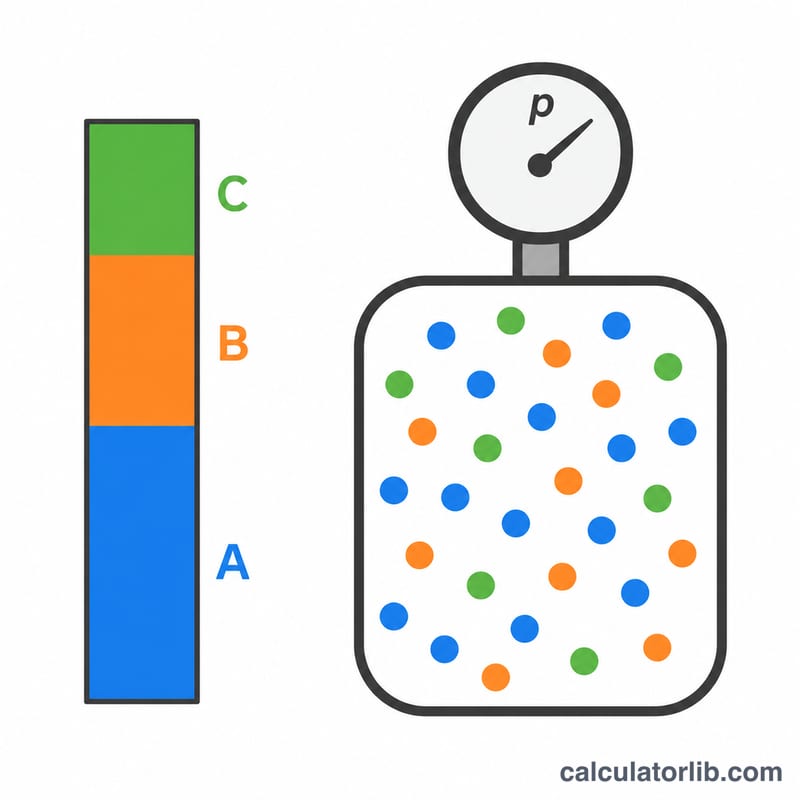
The Gas Mixture Ratio Calculator turns the amounts of gas you blend into the numbers people actually quote: the percentage of each component, the ratio between the components, and the partial pressure each gas exerts inside the vessel. Enter volumes in litres, cubic metres, standard flow rates or plain "parts" — only the proportions matter, so any consistent unit works. It is pure physics, so it applies anywhere in the world; no national standard is assumed.
The formula explained
For ideal gases, volume fraction equals mole fraction, so a blend by volume is also a blend by moles:
$$x_i = \frac{V_i}{V_A + V_B + V_C} \times 100\%$$where \(V_i\) = volume or parts of component \(i\) and the denominator is the total of all components. Dalton law then gives each partial pressure from the same fraction:
$$p_i = x_i \times P_{total}$$The A:B ratio is simply \(V_A / V_B\), the "parts of A per part of B" figure used when filling cylinders.
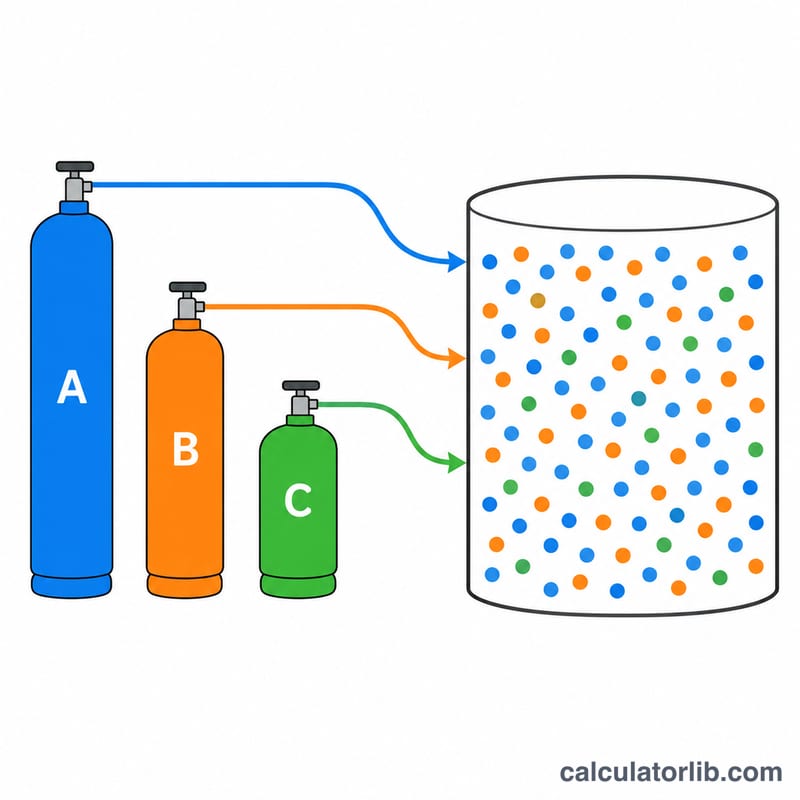
Percentages are volume (and therefore mole) fractions under the ideal gas assumption. Partial pressures follow Dalton law and are expressed in the same unit as the total pressure you entered.
How to use it
Type the amount of Gas A, Gas B and (optionally) Gas C, leaving Gas C at 0 for a two-gas blend. Then enter the total pressure of the finished mixture. The hero figure is the share of Gas A; the table lists every component share plus its partial pressure in the same unit you entered.
Worked example
Blend 21 parts oxygen, 78 parts nitrogen and 1 part argon at a total pressure of 101.325 kPa:
$$x_{A} = \frac{21}{21 + 78 + 1} \times 100\% = 21\%$$$$p_{A} = 0.21 \times 101.325 = 21.28\,\text{kPa}$$Nitrogen takes 79.03 kPa and argon 1.01 kPa, and the oxygen-to-nitrogen ratio is \(21/78 = 0.269\) parts per part — essentially dry air.
Common Gas Mixtures and Their Compositions
The blends below are widely documented standard mixtures. Each row is given three ways: the nominal composition in percent by volume, the simplest whole-number parts ratio you can type into the calculator, and the Dalton partial pressure of each component at a total pressure of 101.325 kPa (one standard atmosphere). Enter the parts in Gas A / B / C and 101.325 in Total Pressure to reproduce any row.
| Mixture | Composition (% by volume) | Simplest parts ratio | Partial pressures at 101.325 kPa | Where it is used |
|---|---|---|---|---|
| Dry air (standard reference composition) | 78.08% N2, 20.95% O2, 0.93% Ar, ~0.04% CO2 | ≈ 78 : 21 : 1 (N2 : O2 : Ar + CO2) | N2 79.11 kPa, O2 21.23 kPa, Ar 0.94 kPa, CO2 0.04 kPa | Baseline for every air-balance blend; values are for dry air, and the CO2 figure is a rounded present-day global value that keeps rising |
| Nitrox EAN32 | 32% O2, 68% N2 | 8 : 17 | O2 32.42 kPa, N2 68.90 kPa | Recreational and technical diving; the "EANx" naming convention comes from the diving training agencies, not from a national gas standard |
| Nitrox EAN36 | 36% O2, 64% N2 | 9 : 16 | O2 36.48 kPa, N2 64.85 kPa | Diving; shallower maximum operating depth than EAN32 for the same oxygen limit |
| Trimix 21/35 | 21% O2, 35% He, 44% N2 | 21 : 35 : 44 | O2 21.28 kPa, He 35.46 kPa, N2 44.58 kPa | Technical diving; the two numbers in the name are O2 and He, with nitrogen as the balance |
| 50% nitrous oxide / 50% oxygen (sold in the UK and Europe under the trade name Entonox) | 50% N2O, 50% O2 | 1 : 1 | N2O 50.66 kPa, O2 50.66 kPa | Medical analgesia; brand names and product licences for this blend differ by country |
| Heliox 80/20 | 80% He, 20% O2 | 4 : 1 | He 81.06 kPa, O2 20.27 kPa | Commercial/deep diving and some clinical airway work |
| Welding shield gas C25 | 75% Ar, 25% CO2 | 3 : 1 | Ar 75.99 kPa, CO2 25.33 kPa | GMAW of carbon steel. "C25" is the designation used in the US system (AWS A5.32); the comparable European designation under EN ISO 14175 is an M21 mixture (Ar with 15–25% CO2) |
| Pure argon | 100% Ar | 1 : 0 | Ar 101.33 kPa | GTAW/TIG of aluminium and most non-ferrous metals |
| Argon + 2% oxygen | 98% Ar, 2% O2 | 49 : 1 | Ar 99.30 kPa, O2 2.03 kPa | Spray-transfer GMAW of stainless steel; the small oxygen addition stabilises the arc |
| Oxy-acetylene neutral flame | ≈50% O2, ≈50% C2H2 at the torch | 1 : 1 | O2 50.66 kPa, C2H2 50.66 kPa | A delivery ratio set at the torch, not a bottled premix. MAPP-type and propane fuel gases need considerably more oxygen per volume of fuel (roughly 2.5 : 1 and 4 : 1 respectively), so follow the torch manufacturer's setting |
| Methane span gas, 50% LEL | 2.5% CH4, 97.5% air | 1 : 39 | CH4 2.53 kPa, air 98.79 kPa | Calibrating combustible-gas detectors; methane's lower explosive limit is 5% by volume, so 2.5% is half of it |
| Incubator CO2 blend | 5% CO2, 95% air | 1 : 19 | CO2 5.07 kPa, air 96.26 kPa | Cell culture and CO2-sensor span checks |
Partial pressures scale linearly with total pressure, so a blend's percentages stay the same while its partial pressures change with the pressure you enter. Rounding note: a simplest-parts ratio that has been rounded (such as 78 : 21 : 1 for air) reproduces the percentages only to the precision shown.
Interpreting Your Result
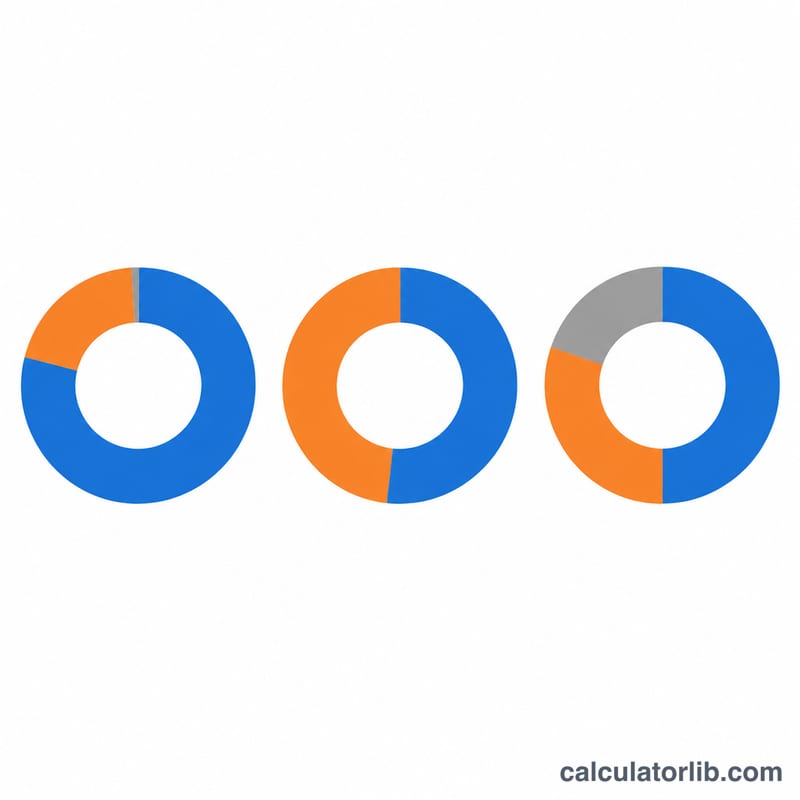
Percent by volume and percent by mole are the same number for ideal gases. Because equal volumes of ideal gases at the same temperature and pressure contain equal numbers of molecules, mixing 32 parts oxygen with 68 parts nitrogen gives a mixture that is 32% O2 both by volume and by mole fraction. Real gases deviate slightly from this, and the deviation grows with pressure — at cylinder filling pressures of 200–300 bar, helium and oxygen compress by noticeably different amounts, which is why blenders working at high pressure apply real-gas (compressibility) corrections instead of relying on gauge readings alone. At ordinary ambient pressures the ideal assumption is accurate enough for practical work.
Partial pressure, not percentage, drives the physics. Dalton's law gives each component
$$p_A = P_{total} \times \frac{V_A}{V_{total}}$$and it is \(p_A\) that determines how much gas dissolves into a liquid (Henry's law: dissolved concentration is proportional to the partial pressure above the liquid), how fast a pressure-dependent reaction proceeds, and what an electrochemical or paramagnetic sensor reads. A sensor calibrated in air does not "see" 21% — it sees the oxygen partial pressure. Hence the same 21% oxygen behaves very differently at different total pressures:
- At 101.325 kPa (1 atm): \(101.325 \times 0.21 = 21.28\) kPa O2
- At 303.975 kPa (3 atm): \(303.975 \times 0.21 =\) 63.83 kPa O2 — three times the dose from an unchanged percentage
This is also why a percentage-only specification is incomplete whenever the mixture will be used at a pressure other than the one it was defined at.
The A:B ratio is the figure used for partial-pressure blending. When a mixture is made by adding components in sequence rather than by flow metering, the simplest parts ratio tells you how to divide the final pressure between them: 8 : 17 means 8/25 of the total pressure comes from gas A and 17/25 from gas B. For a 200 bar fill that is 64 bar of A topped to 200 bar with B. Dalton's law makes the pressure increments and the volume parts interchangeable, which is what lets a single ratio serve both methods.
Two arithmetic checks on any result. The component percentages must sum to 100% (small differences of 0.01–0.1% are rounding only), and the partial pressures must sum to the total pressure you entered. If either sum is off by more than rounding, an input was mistyped — most often a parts value entered in the wrong field or a total pressure given in the wrong unit (1 atm = 101.325 kPa = 1.01325 bar = 14.696 psi).
What the result does and does not tell you. These numbers describe the composition and the pressure physics of the blend, nothing more. They do not tell you whether a mixture is safe, legal or suitable for a given use. Flammability limits, oxygen-compatibility and cleaning requirements, maximum permitted partial pressures, analysis and labelling duties, and purity grades are all set by the applicable equipment specification or regulatory standard — for example the welding-gas designations in AWS A5.32 (United States) versus EN ISO 14175 (Europe), medical-gas monographs in the national pharmacopoeia that applies where you are, pressure-equipment and cylinder rules that differ by jurisdiction, and the oxygen exposure limits published by individual diving training agencies. Those documents, not this calculator, govern what you may actually mix, store and breathe.
This section is general technical information, not professional, medical or safety advice. Breathing gases, medical gases and high-pressure cylinder work should be prepared and verified by appropriately trained and certified people using analysed gas and the procedures required where you operate.
FAQ
Do I need the same unit for every gas? Yes. Mixing litres with cubic feet distorts the fractions; convert first, or just use relative parts.
Can I use masses instead of volumes? Not directly. Mass fractions differ from volume fractions because molar masses differ; divide each mass by its molar mass to get moles, then enter those moles as the parts.
How accurate is the ideal gas assumption? Within a fraction of a percent for common gases near ambient conditions. At high pressure or near condensation, real-gas compressibility shifts partial pressures slightly.