What this calculator does
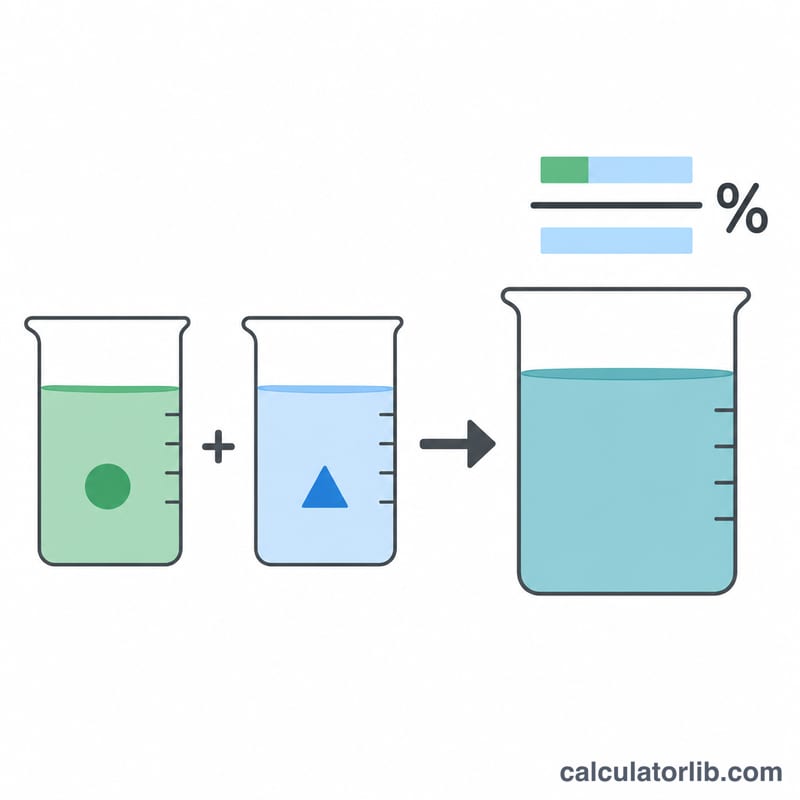
The Antifreeze Mixture Calculator tells you the final coolant concentration (percent antifreeze by volume) when you combine a measured amount of antifreeze with a measured amount of water. It is useful for engine coolant, solar loops, and any glycol-based heat-transfer fluid where the mix ratio determines freeze protection and boil-over resistance.
How to use it
Enter the volume of pure (or concentrated) antifreeze and the volume of water you are adding. Use the same unit for both — litres, quarts, or gallons all work, since the result is a ratio. The calculator returns the antifreeze percentage, the matching water percentage, and the total mixture volume.
The formula explained
The concentration is simply the part divided by the whole: $$\text{final \%} = \frac{V_{\text{antifreeze}}}{V_{\text{antifreeze}} + V_{\text{water}}} \times 100$$ The denominator is the total mixture volume. Because it is a pure ratio, the units cancel and only consistency matters.
Worked example
Mix 5 litres of antifreeze with 5 litres of water. Total volume = 10 litres. Final concentration = $$\frac{5}{10} \times 100 = 50\%$$ A typical 50/50 mix gives roughly -37 C freeze protection for ethylene-glycol coolant.
Antifreeze Concentration vs. Freeze and Boiling Protection
The table below gives typical values for a conventional ethylene glycol coolant mixed with water, by volume. The figures are rounded approximations. Exact values vary by product, glycol type, additive package and the source table used, so check your coolant's data sheet.
| Coolant % (by volume) | Approx. freeze point | Approx. boiling point, atmospheric pressure |
|---|---|---|
| 20% | −8 °C (18 °F) | 102 °C (216 °F) |
| 30% | −15 °C (5 °F) | 104 °C (219 °F) |
| 40% | −25 °C (−13 °F) | 106 °C (223 °F) |
| 50% | −37 °C (−34 °F) | 108 °C (226 °F) |
| 60% | −50 °C (−58 °F) | 111 °C (232 °F) |
| 70% | ≈ −55 °C (≈ −67 °F) | 113 °C (235 °F) |
- Pressurized systems: a typical 15 psi radiator cap raises the boiling point by roughly 20 °C (about 35–40 °F) above the atmospheric values shown. A 50% mix then boils at about 129 °C (265 °F).
- Propylene glycol: at the same percentage it gives slightly less freeze protection than ethylene glycol. A 50% propylene glycol mix freezes at roughly −30 to −33 °C (about −22 to −27 °F) rather than −37 °C.
- Upper limit: freeze protection does not keep improving as you add glycol. Above about 60–70% it gets worse, and undiluted (100%) glycol freezes at a much higher temperature than a 60–70% mix. Most manufacturers advise against exceeding 70%.
Common Mix Scenarios Compared
Ratios are written antifreeze : water. The formula is \(\text{Coolant \%} = \frac{A}{A + W} \times 100\), where \(A\) is the antifreeze volume and \(W\) is the water volume.
| Mix | Antifreeze (parts) | Water (parts) | Total (parts) | Final concentration | Antifreeze per 10 L total (per ≈2.6 gal) |
|---|---|---|---|---|---|
| 1:3 | 1 | 3 | 4 | 25% | 2.5 L (≈0.66 gal) |
| 1:2 | 1 | 2 | 3 | 33% | 3.33 L (≈0.88 gal) |
| 1:1 (50/50) | 1 | 1 | 2 | 50% | 5 L (≈1.32 gal) |
| 2:1 | 2 | 1 | 3 | 67% | 6.67 L (≈1.76 gal) |
| 70/30 | 7 | 3 | 10 | 70% | 7 L (≈1.85 gal) |
Example for a 10 L (≈2.6 US gal) cooling system at 50/50: 5 L antifreeze + 5 L water = 10 L total, so \(\frac{5}{5+5} \times 100 = \) 50% coolant.
Remember that a system rarely drains completely. Residual old coolant in the engine block and heater core changes the final concentration after a refill, so verify the result.
Interpreting Your Concentration Result
- Below about 33%: freeze protection is reduced, and so is the level of corrosion inhibitors and boil-over protection. Many manufacturers advise against going this low.
- Around 50%: a common general-purpose standard. It balances freeze protection of roughly −37 °C (−34 °F), boil-over margin, heat transfer and corrosion protection.
- Above about 70%: heat-transfer efficiency drops because glycol carries heat less well than water. Freeze protection also stops improving and then worsens, so more antifreeze is not better.
Worked example: mixing 4 L of concentrate with 6 L of water gives \(\frac{4}{4+6} \times 100 = \) 40% coolant. That gives freeze protection of about −25 °C (−13 °F).
Water quality: use distilled or deionized water. Tap or hard water contains minerals such as calcium and magnesium that can form scale and deposits and reduce the effectiveness of the inhibitors.
Concentrate vs. premix: concentrated antifreeze must be diluted, and this calculator helps with that. A 50/50 premix is already diluted, so adding more water weakens it. Topping up a premix system with plain water gradually lowers the concentration.
Verify the result: a refractometer is the most accurate and convenient way to measure actual concentration. A float-type hydrometer is cheaper but less accurate, and it must match the glycol type (ethylene or propylene) and be temperature-corrected. Always compare your target with the vehicle or equipment manufacturer's specification for coolant type and mix ratio, and do not mix incompatible coolant chemistries. Climate-specific requirements and product data sheets take priority over the general figures in this article. This is general information, not professional advice.
FAQ
Does it matter what unit I use? No — as long as both fields use the same unit, the percentage is identical.
What about already-diluted antifreeze? This tool treats the antifreeze input as the antifreeze portion. If you start with a pre-mixed product, enter its effective antifreeze volume.
What is a common target? Many vehicles specify a 50/50 mix; check your owner manual for cold-climate ratios up to about 70/30.