What is the Coolant Mix Ratio Calculator?
Engine coolant (antifreeze) protects your cooling system from freezing in winter and boiling in summer while resisting corrosion. Most concentrate must be diluted with water — typically to a 50/50 blend. This calculator tells you exactly how many liters of antifreeze concentrate and how many liters of water to combine for any total system volume and target concentration.
How to use it
Enter your total coolant capacity in liters (check your owner's manual for the cooling system capacity) and the antifreeze concentration you want as a percentage. The calculator splits the total into the concentrate and water amounts and shows the resulting antifreeze-to-water ratio.
The formula explained
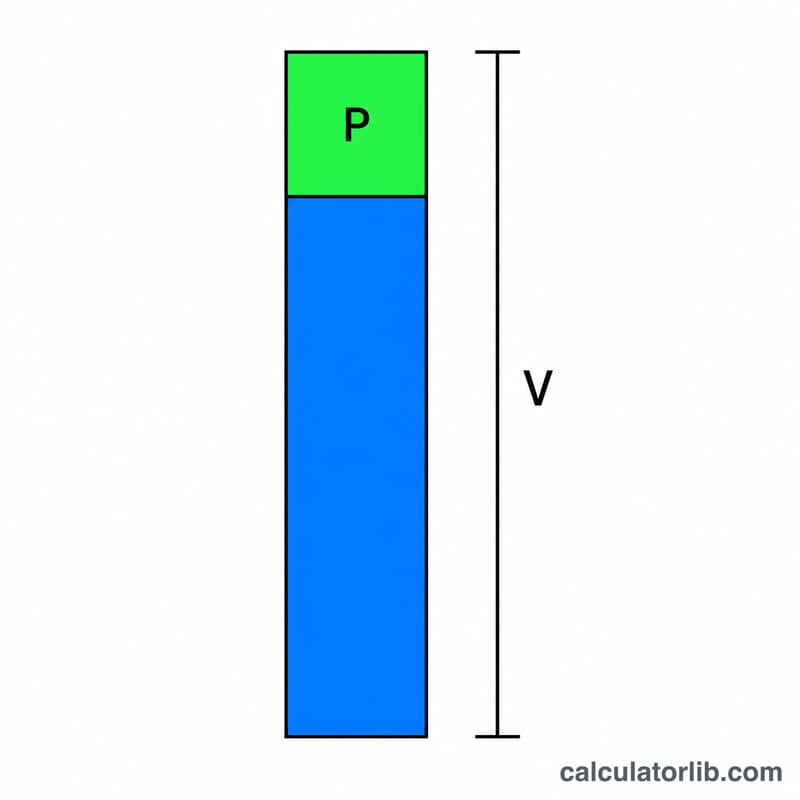
The antifreeze volume is simply the total multiplied by the fraction you want as concentrate: $$\text{A} = \text{V} \times \frac{\text{P}}{100}$$ Whatever volume is left is water: $$\text{W} = \text{V} - \text{A}$$ For example, a 50% mix means half concentrate, half water — a classic 1:1 ratio.
Worked example
Suppose your system holds 10 liters and you want a 50% mix. Antifreeze = \(10 \times \frac{50}{100} = 5\) liters. Water = \(10 - 5 = 5\) liters. That is a 1:1 ratio — perfect for typical climates with protection to roughly −37 °C.
Antifreeze Concentration vs. Freeze Protection
The table below shows approximate freeze-point protection for an ethylene glycol coolant mixed with water. Values are rounded and vary by product, additive package and glycol type, so always check the label of the coolant you buy. Propylene glycol coolants give somewhat less freeze protection at the same concentration.
| Antifreeze concentration | Approx. freeze point (°C) | Approx. freeze point (°F) |
|---|---|---|
| 25% | −12 °C | 10 °F |
| 30% | −15 °C | 5 °F |
| 40% | −24 °C | −12 °F |
| 50% | −37 °C | −34 °F |
| 60% | −52 °C | −62 °F |
| 70% | −64 °C | −84 °F |
About 70% is the practical maximum. Going above it does not give more protection: pure (100%) concentrate freezes at a higher temperature than a 60–70% mix. A higher concentration also carries heat away less effectively than a water-rich mix, which is why 50% is the common default.
Common Mix Scenarios Compared
Each row uses Antifreeze = Total Volume × Percent ÷ 100 and Water = Total Volume − Antifreeze. For example, 15 L at 40% needs 6 L of antifreeze and 15 − 6 = 9 L of water.
| Total volume | Concentration | Antifreeze (L) | Water (L) | Ratio (antifreeze:water) |
|---|---|---|---|---|
| 5 L | 40% | 2 | 3 | 2:3 |
| 5 L | 50% | 2.5 | 2.5 | 1:1 |
| 5 L | 60% | 3 | 2 | 3:2 |
| 8 L | 40% | 3.2 | 4.8 | 2:3 |
| 8 L | 50% | 4 | 4 | 1:1 |
| 8 L | 60% | 4.8 | 3.2 | 3:2 |
| 10 L | 40% | 4 | 6 | 2:3 |
| 10 L | 50% | 5 | 5 | 1:1 |
| 10 L | 60% | 6 | 4 | 3:2 |
| 15 L | 40% | 6 | 9 | 2:3 |
| 15 L | 50% | 7.5 | 7.5 | 1:1 |
| 15 L | 60% | 9 | 6 | 3:2 |
The ratio depends only on the percentage, not on the total volume: 40% is always 2:3, 50% is always 1:1, and 60% is always 3:2.
Practical Tips for Mixing and Filling
- Buy a little extra concentrate. Having a bit more than the calculated amount covers top-ups and small spills, so you do not have to remix later.
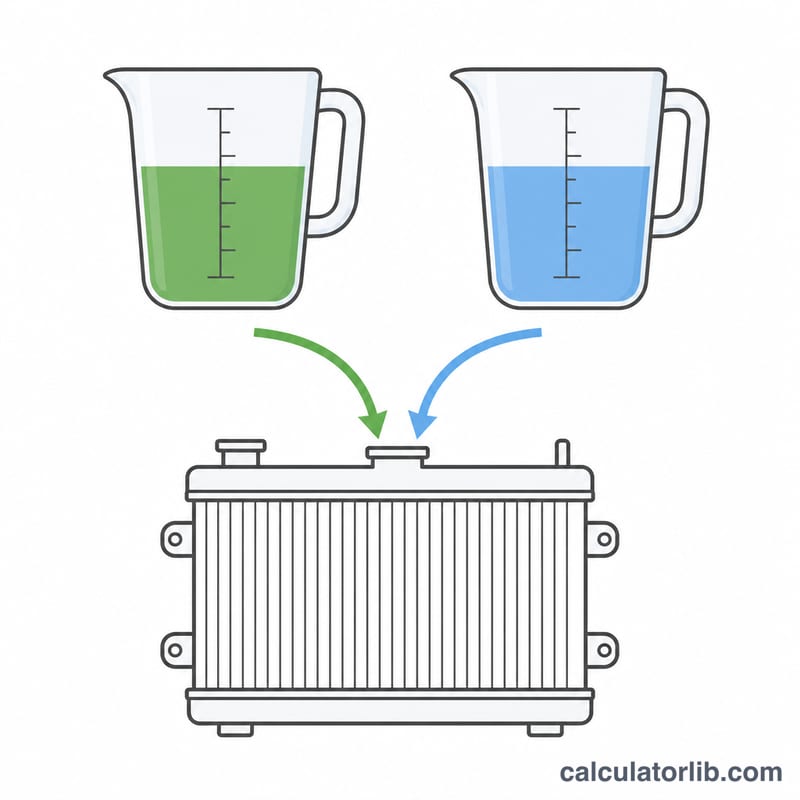
- Mix in a separate clean container. Combine the antifreeze and water first, then fill the system. This gives you a known ratio instead of guessing inside the radiator.
- Use distilled water. Tap water contains minerals that can cause scale and corrosion and can react with the coolant additives.
- Check the owner's manual. It gives the coolant specification and the cooling system capacity. Use the capacity as your total volume.
- Never mix incompatible chemistries. Color alone does not reliably identify coolant type, but mixing different technologies can reduce corrosion protection or form deposits. Use the specification the manufacturer calls for, and flush the system if you change types.
- Allow for residual coolant. Draining usually leaves some old coolant in the engine block, heater core and hoses. This dilutes or changes your new mix, so adjust for it or flush the system.
- Verify the final mix. Test the finished coolant with a refractometer or hydrometer to confirm the actual freeze protection. Do this again after the engine has circulated it.
This is general information only. Follow your vehicle manufacturer's and coolant maker's instructions, and handle and dispose of used coolant properly, as glycol is toxic to people and animals.
FAQ
Should I use distilled water? Yes. Distilled or deionized water avoids mineral deposits and corrosion that tap water can cause.
Can I use pre-mixed coolant? Pre-mixed (ready-to-use) coolant is already diluted, usually to 50%, so you add it directly without extra water. This calculator is for concentrate.
What concentration should I choose? 50% is standard. Going up to ~60–70% increases freeze protection but excessive concentrate actually reduces freeze and heat-transfer performance, so stay within manufacturer limits.