
What is the Mixture Problem Calculator?
This calculator solves classic mixture (or "alligation") problems where two solutions of different concentrations are blended together. Given the volume and concentration of each solution, it computes the concentration of the resulting mixture, the total volume, and the total amount of pure solute. It is useful for chemistry labs, pharmacology dosing, agriculture spray mixing, cooking, and any situation where you combine liquids of differing strengths.
How to use it
Enter the volume of Solution 1 and its concentration as a percentage, then do the same for Solution 2. The units of volume can be anything (mL, L, gallons) as long as both volumes use the same unit. Concentrations are entered as percentages. Click calculate to see the blended concentration.
The formula explained
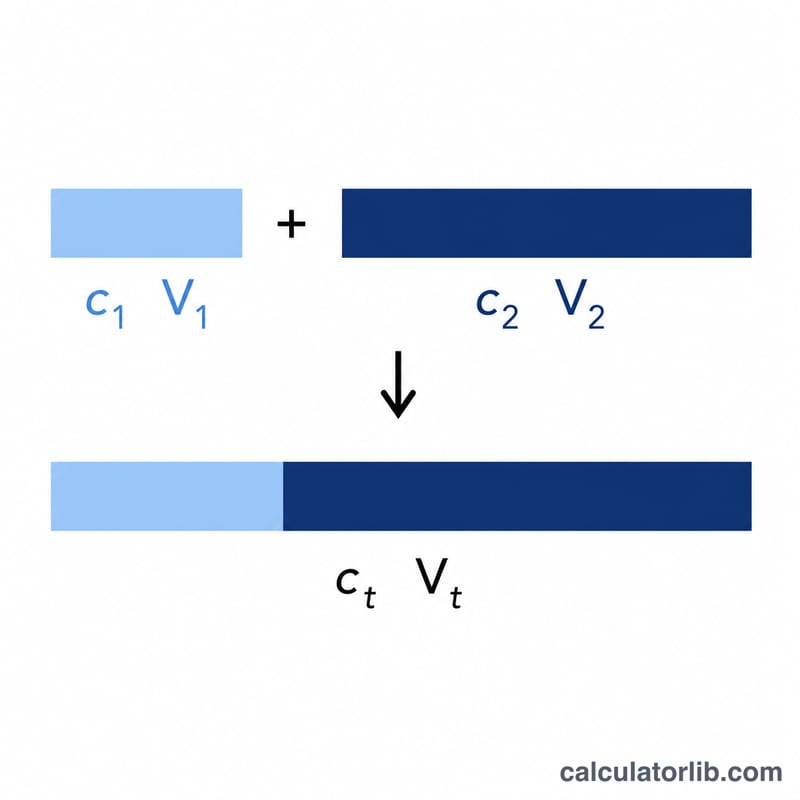
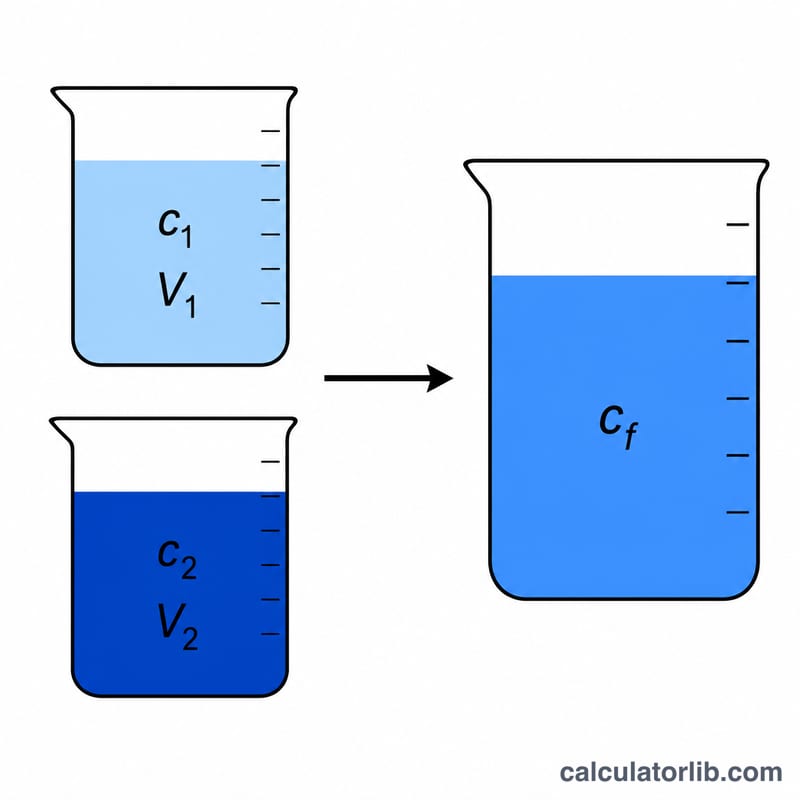
The amount of pure solute is conserved when mixing. The solute from each solution is its concentration times its volume. Adding the two and dividing by the total volume gives the final concentration:
$$c_f = \frac{c_1 \cdot V_1 + c_2 \cdot V_2}{V_1 + V_2}$$
If instead you know a target final concentration and want to find how much of Solution 1 to add, rearrange to \(x = \frac{V_2(c_2 - c_f)}{c_f - c_1}\).
Worked example
Mix 100 mL of a 10% solution with 300 mL of a 50% solution. Pure solute = \((10\times100 + 50\times300)/100 = (1000 + 15000)/100 = 160\) units. Total volume = 400 mL. Final concentration = $$\frac{10 \cdot 100 + 50 \cdot 300}{400} = \frac{16000}{400} = 40\%.$$ So the blend is 40% concentration with 160 units of pure solute.
FAQ
Do the volumes have to be in the same unit? Yes — both volumes must share the same unit so the weighted average is valid.
Can I mix water (0%) with a stock solution? Absolutely. Set one concentration to 0% to model diluting with pure solvent.
What if both volumes are zero? The calculator guards against division by zero and returns a final concentration of 0.