What is the Brix to Final Gravity Calculator?
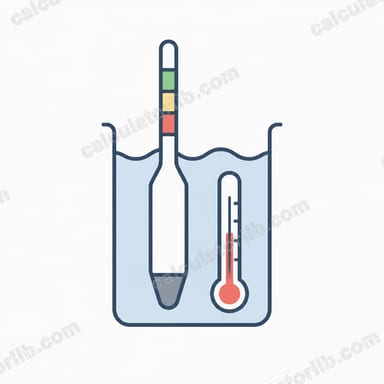
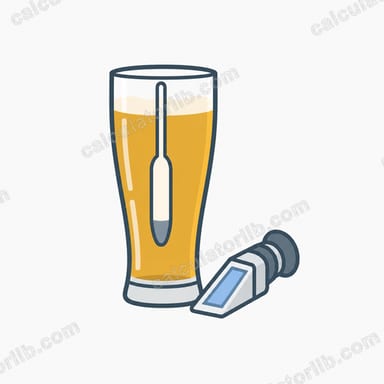
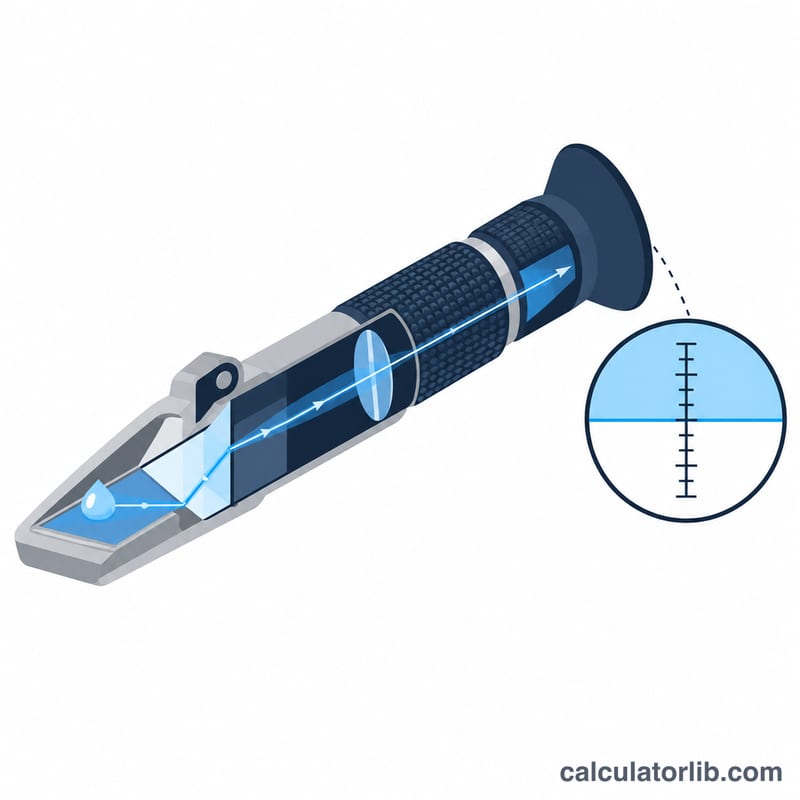
A refractometer measures how much light bends in a liquid, which brewers and winemakers read in degrees Brix. Before fermentation the sample is mostly sugar and water, so Brix converts neatly to specific gravity. Once fermentation starts, alcohol changes the refractive index too, so a raw Brix reading overstates the real gravity. This calculator corrects for that and estimates the true final gravity (FG) from your original and current Brix readings.
How to use it
Enter the original Brix measured on your wort or must before pitching yeast, then the Brix reading of the fermented sample. The tool returns the corrected final gravity, the original gravity, estimated ABV and apparent attenuation. Let the sample cool to room temperature before reading, and use only a few drops.
The formula explained
The final gravity uses the Terrill cubic correction, where \(OB\) is the original Brix and \(FB\) is the final Brix:
$$\text{FG} = 1 - 0.0044993\,OB + 0.011774\,FB + 0.00027581\,OB^2 - 0.0012717\,FB^2 - 0.00000728\,OB^3 + 0.000063\,FB^3$$Original gravity comes from the standard Brix to SG conversion, and ABV is approximated with the common factor 131.25:
$$\text{ABV} = (\text{OG} - \text{FG}) \times 131.25$$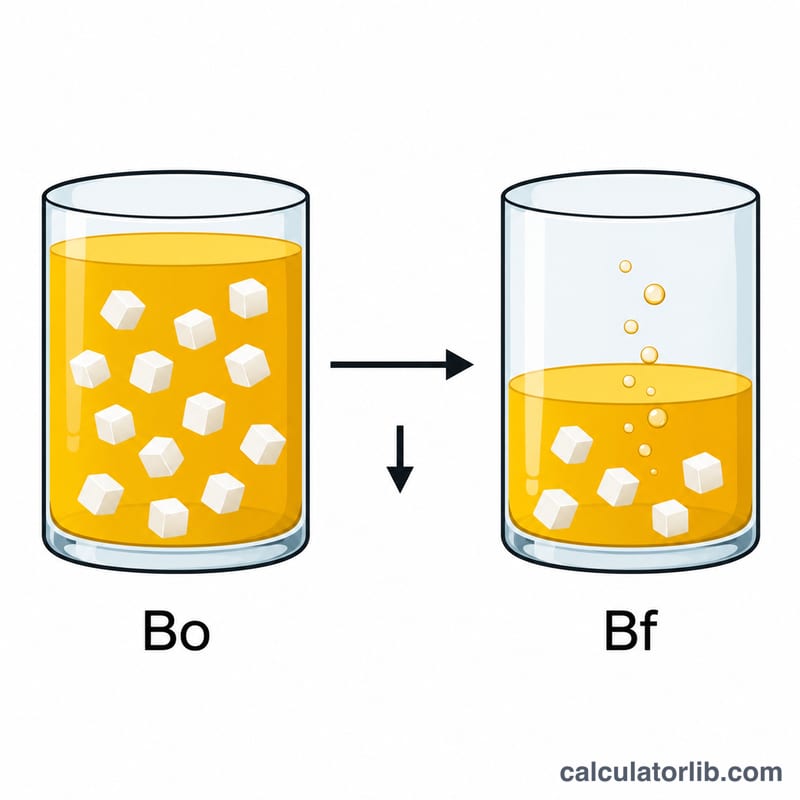
Worked example
Suppose \(OB = 12\) and \(FB = 7\). Substituting into the cubic gives:
$$\text{FG} = 1 - 0.05399 + 0.08242 + 0.03972 - 0.06231 - 0.01258 + 0.02161 \approx 1.0149$$The original gravity for 12 Brix is about 1.0484, so the ABV is roughly \((1.0484 - 1.0149) \times 131.25 \approx 4.4\%\) and apparent attenuation is near 69%.
Interpreting Your Final Gravity, ABV and Attenuation
The calculator takes your original and final refractometer Brix readings and returns an alcohol-corrected final gravity (FG), an original gravity (OG), an estimated ABV and an apparent attenuation. Once fermentation starts, alcohol changes how light bends in the sample. A raw Brix reading taken after fermentation therefore overstates the sugar left, and the correction is needed to get a usable FG.
Final gravity: what the number suggests
- Beer: most finished beers land at about 1.008-1.016. Lower values (about 1.006-1.010) give a drier, crisper beer. Higher values (about 1.012-1.016 and up) leave more residual sweetness and body. Very strong or heavily malted styles can finish higher and still be normal.
- Dry wine: a fully fermented dry wine usually finishes at about 0.990-0.998, because alcohol is less dense than water. A wine that stalls well above this range probably still holds fermentable sugar, or was meant to be off-dry or sweet.
Apparent attenuation
Apparent attenuation is the share of the original gravity points that fermentation removed:
$$\text{Apparent attenuation} = \frac{ \text{OG} - \text{FG} }{ \text{OG} - 1 } \times 100\%$$
For example, with OG 1.050 and FG 1.010: \( (1.050 - 1.010) / (1.050 - 1.000) = 0.040 / 0.050 = 80\% \). Common ale yeasts usually reach about 65-80% apparent attenuation. The exact figure depends on the strain, the fermentability of the wort (mash temperature, adjuncts, sugars) and fermentation conditions. A result well below the yeast's published range suggests a stalled or under-pitched fermentation. A result above it can point to a very fermentable wort, an infection, or a measurement error.
Apparent attenuation is not the same as real attenuation. Apparent attenuation ignores that alcohol lowers the density of the liquid, so the hydrometer or corrected reading looks lower than the true residual extract. Real attenuation accounts for the alcohol and is typically about 20% lower than the apparent figure, for example roughly 65% real against 80% apparent. Yeast manufacturers almost always quote apparent attenuation, so compare your result to that figure.
ABV
A common approximation is \( \text{ABV} \approx (\text{OG} - \text{FG}) \times 131.25 \). With OG 1.050 and FG 1.010 this gives \( 0.040 \times 131.25 = 5.25\% \). Treat the ABV as an estimate, because it inherits any error in both gravity values.
Confirming that fermentation is finished
Don't judge fermentation from one reading, and don't rely on airlock activity. If the corrected FG stays the same across readings taken over several days (for example 2-3 days apart), fermentation has most likely finished. A gravity that is still dropping means the yeast is still working, so wait before packaging. This avoids over-carbonated bottles and unstable wine.
Limits of a Brix-derived FG
A refractometer needs only a few drops of sample, which is convenient, but the alcohol-corrected FG is a mathematical estimate. The polynomial correction is fitted to typical wort and may be less accurate for wines, ciders, meads, very high-gravity batches, or samples containing unusual sugars. Small errors also come from temperature, a poorly calibrated instrument, and haze or suspended yeast in the sample. Use the result for tracking and planning, and confirm the final value with a calibrated hydrometer (after degassing the sample) before you bottle, keg or stabilize. This is general brewing and winemaking information, not a guarantee of any particular result.
FAQ
Why not read final gravity straight from Brix?
Alcohol is less dense than water and also affects refraction, so the raw Brix of a fermented liquid does not match its true gravity. Correction formulas fix this.
How accurate is the result?
Expect roughly plus or minus 0.002 SG for typical beers. A hydrometer reading remains the more reliable check, especially for high-gravity or very dry fermentations.
Does it work for wine?
Yes, within typical ranges. For very sweet musts or high-alcohol ferments, treat the number as an estimate.