What this calculator does
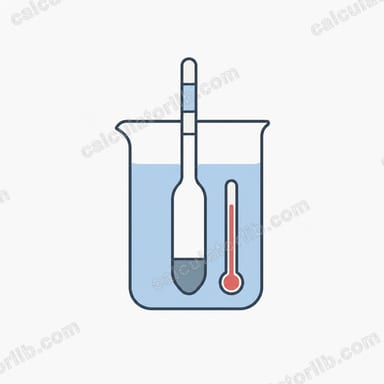
A hydrometer only tells the truth at one temperature: the one printed on its stem, usually 60 °F (15.6 °C) or 68 °F (20 °C). Hot wort is less dense, so a sample pulled straight off the chiller reads low; an ice-cold sample reads high. This tool corrects your reading back to the calibration temperature and then reports the brewing numbers that matter: original gravity, degrees Plato, final gravity, alcohol by volume and apparent attenuation. It is unit-agnostic and applies to any brewery anywhere.
How to use it
Pick your temperature unit, type the hydrometer reading exactly as you saw it at the meniscus, enter the temperature of that sample, and enter the temperature printed on the hydrometer. If fermentation is not finished, enter 0 for the final gravity and only the OG results are shown.
The formula explained
Correction uses the standard four-term expansion polynomial in degrees Fahrenheit:
$$\text{CG} = \text{MG}\times\frac{f(T)}{f(T_c)},\quad f(T)=1.00130346-1.34722124\times10^{-4}T+2.04052596\times10^{-6}T^{2}-2.32820948\times10^{-9}T^{3}$$Here \(\text{MG}\) = the measured gravity, \(T\) = sample temperature and \(T_c\) = hydrometer calibration temperature. Celsius entries are converted with \(T_F = \tfrac{9}{5}T_C + 32\) before the polynomial is applied.
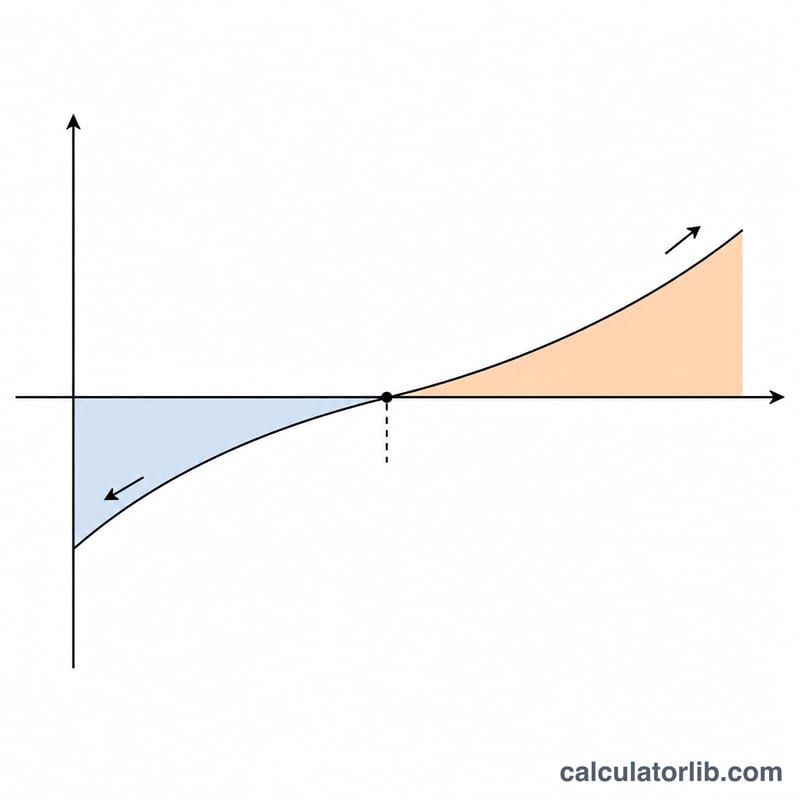
Readings are corrected with the standard four-term hydrometer expansion polynomial. The correction assumes a glass hydrometer in water-like wort; it is accurate to roughly ±0.0005 SG over normal brewing temperatures and becomes unreliable far above boiling-hot samples.
Worked example
You read 1.050 on a 60 °F hydrometer in wort still sitting at 80 °F:
$$\text{CG}=1.050\times\frac{f(80)}{f(60)}=1.050\times\frac{1.0023930}{1.0000631}=1.0524$$Two weeks later the beer reads 1.010 at 70 °F, correcting to 1.0110. Then
$$\text{ABV}=(1.0524-1.0110)\times131.25=5.44\%$$and apparent attenuation is \(\frac{0.0414}{0.0524}\times100 = 79\%\) — a clean, fully fermented ale.
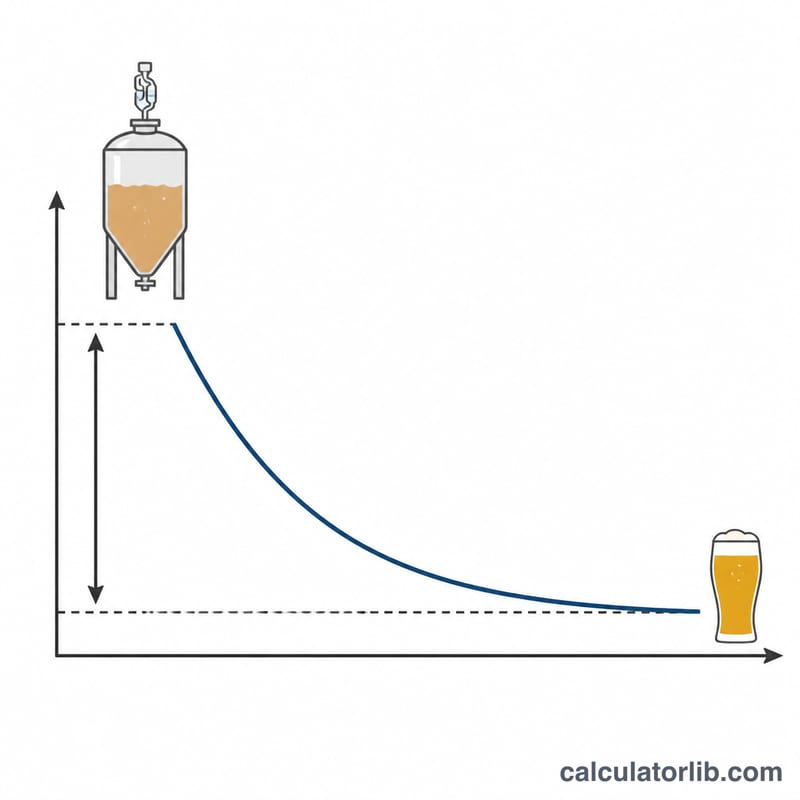
How Temperature Error Changes Your Numbers
A glass hydrometer is only accurate at the temperature it was calibrated at. Wort that is warmer than that temperature is less dense, so the hydrometer sinks deeper and under-reads; wort that is colder over-reads. The correction used here scales the reading by the ratio of a water-density polynomial evaluated at the sample temperature and at the calibration temperature (both in °F):
$$\text{SG}_{corr}=\text{SG}_{read}\times\frac{f(T_{read})}{f(T_{cal})}$$
$$f(t)=1.00130346-1.34722124\times10^{-4}\,t+2.04052596\times10^{-6}\,t^{2}-2.32820948\times10^{-9}\,t^{3}$$
Worked substitution for a 1.050 reading taken at 100 °F on a hydrometer calibrated at 60 °F:
$$f(100)=1.00130346-0.01347221+0.02040526-0.00232821=1.005908$$
$$f(60)=1.00130346-0.00808333+0.00734589-0.00050289=1.000063$$
$$\text{SG}_{corr}=1.050\times\frac{1.005908}{1.000063}=1.050\times1.005845=1.056137\approx 1.0561$$
| Measured gravity | Sample temp | Hydrometer calibration temp | Corrected gravity | Delta (gravity points) |
|---|---|---|---|---|
| 1.050 | 100 °F (37.8 °C) | 60 °F (15.6 °C) | 1.0561 | +6.1 |
| 1.050 | 80 °F (26.7 °C) | 60 °F (15.6 °C) | 1.0524 | +2.4 |
| 1.050 | 60 °F (15.6 °C) | 60 °F (15.6 °C) | 1.0500 | 0.0 |
| 1.050 | 50 °F (10.0 °C) | 68 °F (20.0 °C) | 1.0485 | −1.5 |
| 1.010 (FG) | 75 °F (23.9 °C) | 60 °F (15.6 °C) | 1.0116 | +1.6 |
Calibration temperature is not universal: hydrometers sold in the United States are usually calibrated at 60 °F (15.6 °C), while many European and laboratory-grade instruments are calibrated at 20 °C (68 °F). Read the stem or the instrument's certificate before entering a value — assuming 60 °F on a 20 °C instrument builds a permanent ~1.5-point bias into every reading. The polynomial above is a water-density approximation; it is intended for roughly 0–40 °C (32–105 °F) and gets less exact for very high-gravity wort and for temperatures far outside that band.
What the error does to ABV
Take one brew where the OG was read hot (straight out of the kettle sample, 100 °F) and the FG was read at 75 °F, both on a 60 °F hydrometer, using \(\text{ABV}\approx(\text{OG}-\text{FG})\times131.25\):
| Basis | OG used | FG used | ABV | Apparent attenuation |
|---|---|---|---|---|
| Raw readings (no correction) | 1.050 | 1.010 | 5.25 % | 80.0 % |
| Temperature-corrected | 1.0561 | 1.0116 | 5.84 % | 79.2 % |
The uncorrected numbers understate the beer by about 0.6 percentage points of alcohol — roughly an 11 % relative error — and overstate attenuation slightly, because the OG error is larger than the FG error. Note also that correcting both readings by a similar amount largely cancels out in the subtraction: the big ABV errors come from correcting one reading and not the other, or from a hot OG paired with a cool FG.
Specific Gravity, Degrees Plato and Brix Conversion Table
The °Plato values below are computed from the standard cubic fit used throughout this page:
$$^{\circ}\text{P}\approx-616.868+1111.14\,\text{SG}-630.272\,\text{SG}^{2}+135.997\,\text{SG}^{3}$$
Gravity points are simply the decimal part of the specific gravity multiplied by 1000 — so 1.048 is 48 points, and a wort that drops from 1.048 to 1.012 has lost 36 points.
| Specific gravity | Gravity points | °Plato | ≈ °Brix |
|---|---|---|---|
| 1.000 | 0 | 0.00 | ≈ 0.0 |
| 1.005 | 5 | 1.28 | ≈ 1.3 |
| 1.010 | 10 | 2.56 | ≈ 2.6 |
| 1.015 | 15 | 3.83 | ≈ 3.8 |
| 1.020 | 20 | 5.08 | ≈ 5.1 |
| 1.025 | 25 | 6.32 | ≈ 6.3 |
| 1.030 | 30 | 7.56 | ≈ 7.6 |
| 1.035 | 35 | 8.79 | ≈ 8.8 |
| 1.040 | 40 | 9.99 | ≈ 10.0 |
| 1.045 | 45 | 11.21 | ≈ 11.2 |
| 1.050 | 50 | 12.39 | ≈ 12.4 |
| 1.055 | 55 | 13.57 | ≈ 13.6 |
| 1.060 | 60 | 14.74 | ≈ 14.7 |
| 1.065 | 65 | 15.90 | ≈ 15.9 |
| 1.070 | 70 | 17.06 | ≈ 17.1 |
| 1.075 | 75 | 18.20 | ≈ 18.2 |
| 1.080 | 80 | 19.33 | ≈ 19.3 |
| 1.085 | 85 | 20.45 | ≈ 20.5 |
| 1.090 | 90 | 21.57 | ≈ 21.6 |
| 1.095 | 95 | 22.67 | ≈ 22.7 |
| 1.100 | 100 | 23.77 | ≈ 23.8 |
Degrees Plato and degrees Brix are built on the same idea — grams of sucrose per 100 g of solution — and are defined against slightly different reference data, but for brewing purposes they agree to within about 0.2 °P across this whole range. That is why the Brix column above is shown as an approximation of the Plato value rather than as an independent scale.
Refractometer caveat. A refractometer reads sugar in a sucrose solution, and wort is not sucrose — maltose, dextrins and proteins bend light differently. Most brewers divide the raw refractometer reading by a wort-correction factor (WCF) of about 1.04 (values between roughly 1.02 and 1.06 are reported for different instruments and grain bills) to get true °Plato; the factor is instrument- and recipe-specific, so calibrate yours against a hydrometer on a known wort. More importantly, once fermentation starts the ethanol in solution shifts the refractive index and a raw refractometer reading becomes invalid as a gravity measurement — it must either be run through a dedicated alcohol-correction formula or be replaced by a hydrometer reading for FG. The temperature correction on this page is for hydrometers; refractometers with ATC handle their own temperature compensation.
Brewing Terms and Variables Used Here
- Wort
- The sweet, unfermented liquid produced by mashing malted grain and boiling it with hops. Once yeast is pitched and fermentation begins, brewers usually call it beer rather than wort.
- Specific gravity (SG)
- The density of a liquid divided by the density of water at a stated reference temperature — a dimensionless number such as 1.050. Wort is denser than water because of dissolved sugars, so its SG is above 1.000; finished beer contains ethanol, which is less dense than water, which pulls the final figure back down.
- Original gravity (OG)
- The specific gravity of the wort measured just before yeast is pitched. It sets the potential alcohol of the batch and is the baseline for attenuation.
- Final gravity (FG)
- The specific gravity measured when fermentation has finished. A stable reading over two or three consecutive days is the usual confirmation that fermentation is genuinely complete.
- Gravity points
- The decimal part of the SG times 1000: 1.048 is 48 points. Points make mental arithmetic easy — a drop from 1.055 to 1.012 is 43 points consumed.
- Degrees Plato (°P)
- The concentration of dissolved extract expressed as grams of sucrose per 100 g of solution. Commercial breweries generally work in °P; homebrewers in the US and UK more often work in SG. Roughly, 1 °P ≈ 4 gravity points in the normal beer range.
- Apparent vs. real attenuation
- Apparent attenuation is calculated straight from hydrometer readings: \(\text{AA}=\dfrac{\text{OG}-\text{FG}}{\text{OG}-1}\). It reads high because ethanol (density ≈ 0.789 g/cm³ at 20 °C) is lighter than water, so the alcohol produced depresses the FG beyond what sugar removal alone would cause. Real attenuation removes the alcohol's contribution — typically it lands around 80–82 % of the apparent figure, so an apparent 80 % corresponds to roughly 65 % real. Recipe software and this calculator report the apparent value unless stated otherwise.
- Hydrometer calibration temperature
- The temperature at which the hydrometer's scale is exact, printed on the stem or paper insert. US instruments are commonly 60 °F (15.6 °C); many European and laboratory instruments are 20 °C (68 °F). Every correction on this page is relative to this value.
- Meniscus
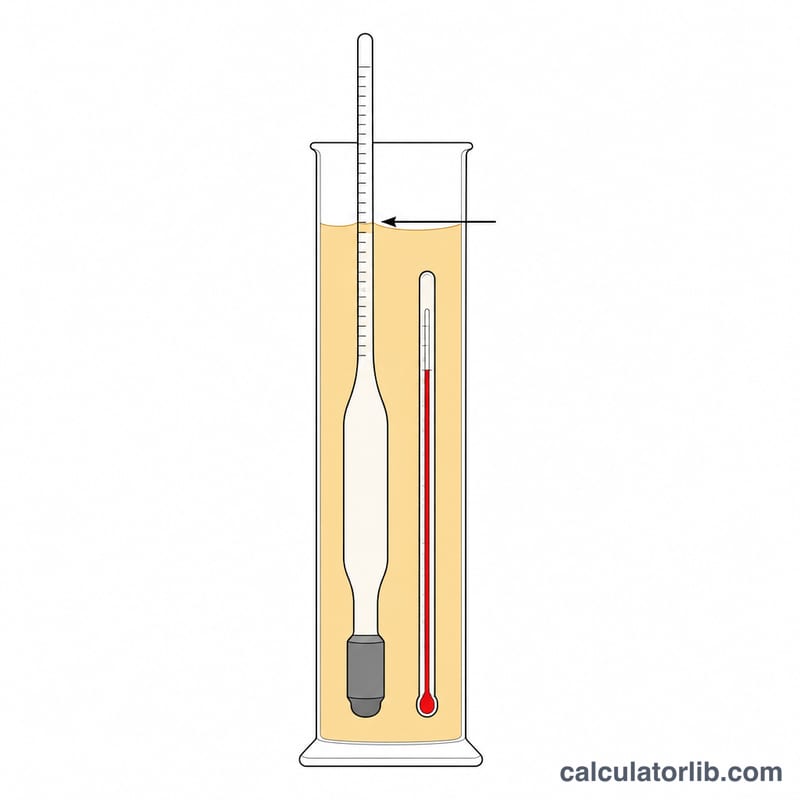
- The curved surface the liquid forms where it meets the hydrometer stem. In wort the curve is concave; the convention is to read the scale at the bottom of the curve, with your eye level with the liquid surface. Reading the top of the meniscus instead typically costs 1–2 gravity points, which is the same order of magnitude as a modest temperature error.
- Measured vs. corrected gravity
- Measured (or raw) gravity is what you read off the stem at whatever temperature the sample happens to be. Corrected gravity is that reading rescaled to the calibration temperature, and it is the number you should record in your brew log, feed into ABV formulas, and compare with a recipe's target.
- ABV and the 131.25 factor
- The standard shortcut is \(\text{ABV}\%\approx(\text{OG}-\text{FG})\times131.25\) — an empirical fit that is good to roughly ±0.2 % ABV for beers up to about 1.070 OG. For stronger worts it drifts low, and many brewers switch to the alternative fit $$\text{ABV}\%=\frac{76.08\,(\text{OG}-\text{FG})}{1.775-\text{OG}}\times\frac{\text{FG}}{0.794}$$ where 0.794 is the approximate specific gravity of ethanol. Both are approximations, not laboratory measurements; only distillation or a densitometer gives a legally reportable ABV, which matters if you are labelling beer under national alcohol-labelling rules (for example US TTB or EU labelling requirements).
- Refractometer
- An optical instrument that infers sugar concentration from how much a few drops of liquid bend light, reported in °Brix. It needs only a tiny sample and is ideal for pre-boil and pre-pitch checks, but it requires a wort-correction factor (~1.04) and its raw reading is invalid once alcohol is present. Use a hydrometer — temperature-corrected — for FG.
FAQ
Does temperature correction matter for final gravity too? Yes. A 10 °F error is worth about 0.001 SG, which is roughly 0.13% ABV and several points of attenuation.
Why does my refractometer disagree? Alcohol distorts refractometer readings after fermentation starts; this calculator is for hydrometers, which are unaffected by alcohol in the same way.
How accurate is the correction? Within about 0.0005 SG across normal brewing temperatures. Very hot samples also risk damaging the hydrometer, so cool to below 100 °F (38 °C) when you can.